Sandwich Panel Production Line Startup And Shutdown Standard Operating Procedures
Sep 17, 2026
The standard startup and shutdown operating procedures of the sandwich panel production line, covering pre-operation inspections, step-by-step startup operations, formal production debugging, pre-shutdown preparations, standardized shutdown steps, and post-shutdown maintenance to ensure safe, stable and efficient equipment operation.
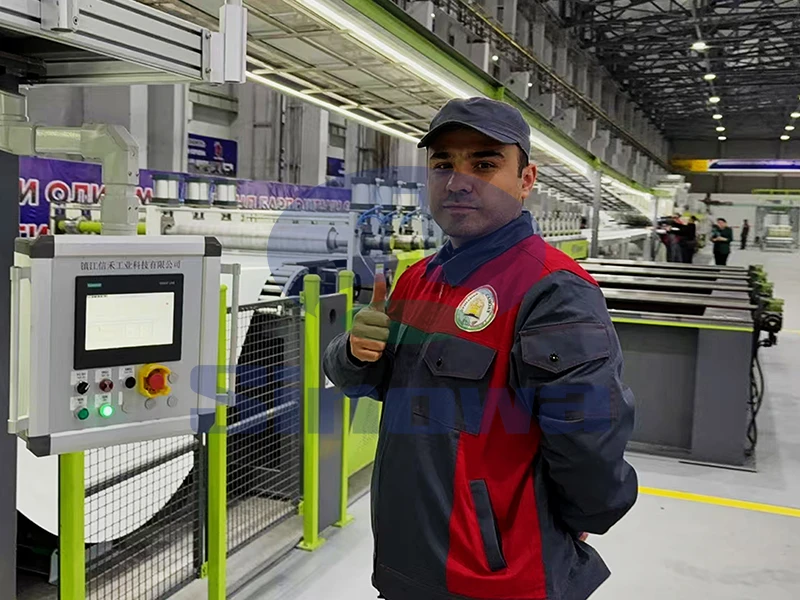
Before initiating the startup process of the sandwich panel production line, comprehensive and systematic pre-operation inspections are essential to eliminate potential equipment faults and safety hazards, which lays a solid foundation for smooth subsequent production. Operators need to conduct a full visual and functional inspection of all mechanical components of the entire production line first, including rolling machines, glue coating devices, cutting systems, and conveying equipment. It is necessary to check whether all connecting bolts, fasteners and transmission parts are loose, worn or displaced, and ensure that the moving parts are flexible and free of jamming and abnormal resistance. Meanwhile, the lubrication status of key rotating and friction components should be verified, with sufficient and qualified lubricating oil and grease added as required to avoid component wear and equipment overheating caused by insufficient lubrication during operation. In addition, operators must inspect the entire electrical control system, check whether the power lines, signal lines and control circuits are intact and free of aging, damage or short-circuit risks, and confirm that all control buttons, switches and indicator lights work normally. The air pressure and hydraulic systems of the production line also need detailed inspection to ensure stable pressure values, no air leakage or oil leakage in pipelines, and normal operation of pressure regulating valves and filter devices. Finally, the production site should be cleaned up to remove sundries, obstacles and irrelevant items around the equipment, ensure a clean and unobstructed operating environment, and confirm that all safety protection devices are in place and effective before preparing for formal startup.
The formal startup of the sandwich panel production line must follow a sequential and standardized operation process, and blind and rapid startup is strictly prohibited to prevent equipment impact damage and operational failures. After completing all pre-operation inspections and confirming that all indicators are normal, operators first turn on the main power supply of the production line, wait for the electrical control system to complete self-inspection and enter the standby state, and check whether all system parameter displays are normal and no fault alarm information exists. Subsequently, the auxiliary equipment such as the ventilation system and cooling system of the production line are started in advance, and a 3 to 5 minute idle operation is performed to observe the operating state of the auxiliary systems and ensure that they can provide stable support for the formal production operation of the main equipment. Next, the main transmission system of the production line is started at a low speed, and the low-speed idle running state is maintained for a certain period. During this process, operators need to carefully listen to the operating sound of each mechanical component, observe the operation stability of the conveying mechanism and transmission parts, and check for abnormal vibration, noise and equipment jitter. After confirming that the low-speed operation is stable, the equipment operating speed is gradually adjusted to the preset production speed in a step-by-step manner, instead of one-time speed adjustment to avoid sudden load changes causing equipment failure. After the speed adjustment is completed, the no-load operation is continued for a period of time, and all system parameters are monitored in real time to ensure that the entire production line is in a stable standby production state before starting formal feeding and production processing.
After the production line is successfully started and enters the formal production stage, real-time operation monitoring and fine debugging work need to be persisted to maintain continuous and stable production quality and equipment operation status. During the formal production process, operators need to regularly observe the operating state of each key equipment module, focusing on the glue coating uniformity of the sandwich panel, the alignment accuracy of board lamination, and the stability of cutting and sizing processes. Once uneven glue coating, board deviation or inconsistent product specifications are found, fine parameter adjustment should be carried out in a timely manner according to the actual production situation to ensure the consistency and qualification rate of finished products. At the same time, the operating parameters of the equipment, including operating speed, system pressure, and temperature of thermal bonding components, need to be monitored in real time to avoid product quality problems and equipment overload operation caused by parameter deviation. Operators should also regularly check the feeding state of raw materials to ensure continuous and uniform feeding, prevent production interruption and equipment empty running caused by raw material shortage, and avoid equipment blockage and damage caused by excessive feeding. In addition, during the production process, the equipment operation state should be recorded regularly, and minor abnormal phenomena found should be dealt with in a timely manner to avoid small faults evolving into large equipment failures, ensuring the long-term stable and efficient operation of the production line.
When the daily production task is completed or the production line needs to be shut down for temporary suspension of work, standardized pre-shutdown preparation work must be completed first to avoid equipment damage and residual material waste. First of all, operators need to stop the raw material feeding work in advance, suspend the input of core materials and surface materials of sandwich panels, and let the remaining raw materials in the production line complete the subsequent processing procedures such as lamination, shaping and cutting normally, so as to ensure that no residual semi-finished materials are left in the equipment transmission and processing components. This operation can effectively prevent residual materials from solidifying, bonding or blocking the equipment interior, which may affect the next startup and operation. After all the on-line materials are processed into finished products and output completely, the operating speed of the production line is gradually reduced from the production speed to the low-speed idle running state, and the sudden shutdown under high-speed operation is strictly forbidden. During the speed reduction process, the operating state of each component is continuously monitored to confirm that there is no abnormal noise or vibration. Meanwhile, the relevant auxiliary production systems are adjusted appropriately according to the shutdown progress, and unnecessary auxiliary operation links are suspended in an orderly manner on the premise of ensuring equipment safety. In addition, operators need to simply clean the surface of key processing equipment to remove floating dust and residual debris on the equipment surface, and check whether there are hidden dangers such as component looseness during high-speed operation, so as to lay a foundation for formal shutdown and subsequent maintenance.
The formal shutdown operation of the sandwich panel production line needs to be carried out in strict accordance with the reverse sequence of the startup process to ensure the safety and standardization of the shutdown process. After finishing all pre-shutdown preparation work and confirming that the production line has no residual materials and runs stably at low speed, operators first turn off the operating switches of the main processing equipment in turn, including the cutting system, glue coating system and lamination forming system, to stop the core processing functions of the production line. After the main processing equipment completely stops running, the main transmission and conveying system switches are turned off to terminate the overall operation of the production line. Subsequently, the auxiliary equipment such as cooling, ventilation and dust removal systems are shut down in sequence, and the shutdown interval of each equipment is reasonably controlled to avoid simultaneous startup and shutdown of multiple devices causing circuit load fluctuation. After all mechanical equipment stops running completely, the main power switch of the production line is turned off, and the power supply of the entire equipment system is cut off. For the hydraulic and pneumatic systems, the pressure relief operation needs to be carried out after the equipment is completely shut down to release the residual pressure in the pipeline and equipment, so as to avoid long-term pressure bearing of the pipeline system leading to pipeline aging and seal damage. After the entire shutdown operation is completed, operators need to check all equipment switches and power circuits again to confirm that the shutdown is thorough and no equipment is in standby power-on state, eliminating potential safety hazards such as electric leakage and equipment self-starting.
Post-shutdown daily maintenance and equipment inspection are key links to extend the service life of the sandwich panel production line and maintain stable equipment performance for a long time, and must be implemented meticulously after each shutdown. First of all, comprehensive cleaning of the entire production line equipment and production site is carried out, focusing on cleaning residual glue, dust, debris and processing waste on the surface and interior of processing components such as glue coating rollers, pressing plates and cutting tools, to prevent residual materials from solidifying and corroding equipment components and affecting the processing accuracy of subsequent production. After cleaning, the key friction and rotating parts of the equipment are inspected and maintained, with worn lubricating oil replaced and missing lubricating parts refilled to ensure the flexibility of equipment operation for the next startup. Operators also need to check the tightness of all connecting fasteners, transmission chains and belts, tighten loose parts in time, and replace severely worn accessories in advance to avoid equipment failure in the next operation. In addition, the electrical control cabinet, lines and safety protection devices are inspected comprehensively to ensure that the lines are intact and the protection devices are sensitive and effective. Finally, the equipment operation and maintenance status of the day are recorded in detail, including abnormal phenomena occurring during operation, processed faults and maintenance contents, to form complete equipment operation files, provide reference for subsequent equipment maintenance and fault troubleshooting, and ensure the long-term safe and stable operation of the sandwich panel production line.
Main Products
-

Continuous PU Sandwich Panel Production Line
This continuous PU sandwich panel production line is an integrated automatic equipment. It covers uncoiling, forming, foaming, curing and cutting processes. With automatic raw material proportioning and precise temperature & pressure control, PIR sandwich panel production line continuously composites panels with double skins. Polyurethane sandwich panel production line stably produces steel and aluminum sandwich panels. Featuring high automation, the line makes fireproof and thermal-insulation panels for building enclosure and cold storage. -

Rock Wool Sandwich Panel Production Line
Continuous rockwool sandwich panel production line is an automatic integrated production equipment, consisting of uncoiling, forming, gluing and compounding, heating curing, fixed-length cutting, automatic stacking and other modules. The mineral wool sandwich panel production line continuously conveys color steel plates and rock wool core materials to automatically complete lamination and curing, which can produce fireproof and thermal insulation sandwich panels. Featuring high automation degree and stable operation, this production line is suitable for mass production of panels used for building walls, roofs and other scenarios. -

Phenolic Insulation Board Production Line
This integrated automatic production line continuously manufactures PU and phenolic insulation boards. The insulation board production line covers raw material proportioning, high-pressure foaming, laminating, curing and fixed-length cutting. Featuring high automation and stable molding, the insulation panel production line supports various surface materials. PU boards offer excellent thermal insulation, while phenolic boards have superior fire resistance. These products are widely used in construction, cold chain, ventilation ducts and other thermal insulation fields.
Other FAQs
- Difference Between Continuous And Discontinuous PU Sandwich Panel Production Lines
- Daily Maintenance Items Of Polyurethane Sandwich Panel Production Line
- Production Efficiency Improvement Measures Of Sandwich Panel Production Line
- Production Line Operation Steps For Continuous PU Sandwich Panel Molding
- Price Composition Of Complete PU Sandwich Panel Production Line