sandwich panel line
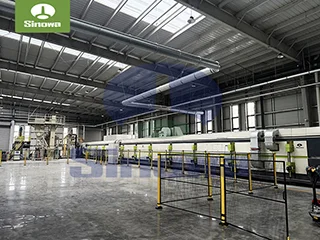
The overall structural design of the color steel sandwich panel production line follows a linear continuous production logic, with all functional modules arranged in accordance with the sequential order of the production process. The complete system covers raw material pretreatment, surface roll forming, core material processing, glue coating and bonding, constant-temperature composite pressing, fixed-length cutting, finished product conveying and stacking, as well as an intelligent central control module. Each functional unit maintains independent operational logic while achieving precise linkage and synchronous coordination through the central control system, ensuring that every production link is closely connected without intermittent gaps or operational delays. This integrated structural layout not only reduces the manual intervention required in the production process but also minimizes product quality fluctuations caused by human operation errors, laying a solid foundation for large-scale batch production.
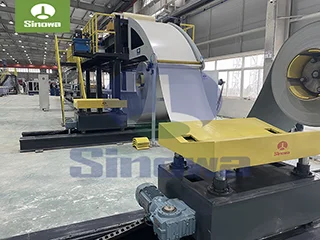
The front-end raw material pretreatment module serves as the starting point of the entire production flow, undertaking the storage, unwinding, leveling and preliminary shaping of color steel coil materials. Color steel coils, as the surface protective layer of sandwich panels, require strict flatness and surface uniformity to ensure the appearance quality and structural stability of finished panels. The unwinding unit is equipped with a tension adjustment structure, which can adapt to steel coils of different winding tightness and specifications, maintaining stable and uniform material output speed during continuous operation to avoid material deviation, wrinkling or stretching deformation. The subsequent precision leveling structure adopts multi-roller leveling technology, which can effectively eliminate the internal mechanical stress generated during steel coil winding and storage, flatten subtle curved deformations on the steel plate surface, and ensure that the steel plate maintains a flat and smooth state before entering the forming process. In addition to surface steel plate processing, this module also supports the automatic feeding and sorting of different core materials, including porous foam materials and fibrous thermal insulation materials commonly used in building insulation. The core material feeding structure is equipped with thickness calibration and uniform laying functions, which can evenly spread core materials of fixed thickness between upper and lower steel plates, ensuring consistent internal structure of each panel product.
The roll forming module is a key link that determines the structural diversity and dimensional accuracy of color steel sandwich panels. After pretreatment, the flat color steel plate is sent to the roller set of the forming system, and through the gradual rolling and extrusion of multiple groups of precision molds, the flat steel plate is processed into various preset cross-sectional structures. Different from one-time stamping forming, the continuous roll forming process adopts segmented gradual deformation, which can avoid local stress concentration and surface damage of the steel plate, effectively protecting the anti-corrosion and decorative coating on the surface of the color steel plate. By replacing different mold sets and adjusting roller spacing and pressure parameters, the sandwich panel production machine can process flat plates, corrugated plates, plug-in structural plates and other diversified plate types, meeting the structural matching requirements of different building scenarios such as wall enclosure, roof waterproofing and interior partition. The entire forming process maintains synchronous speed matching with the front-end feeding system, realizing uninterrupted continuous forming, and the dimensional error of the formed plate section is controlled within a tiny range, ensuring the assembly accuracy of subsequent building construction.
The glue coating and composite bonding system is the core functional unit that determines the overall structural strength and service life of sandwich panels. The stable bonding between the color steel surface layer and the internal core material directly affects the wind resistance, pressure resistance and structural integrity of the panel during long-term use. The automated glue supply and coating system adopts quantitative and uniform gluing logic, which can evenly coat the bonding surfaces of the upper and lower steel plates and the core material. The system can automatically adjust the glue application amount and coating uniformity according to different core material types and plate thickness specifications, avoiding product quality problems such as insufficient bonding force caused by uneven glue application or residual bubbles, and panel bulging and degumming caused by excessive glue accumulation. For fibrous core materials with porous structures, the glue coating process is optimized to ensure that the adhesive can appropriately penetrate the surface pores of the core material, forming a firm occlusion bonding structure; for dense foam core materials, uniform surface coverage coating is adopted to balance bonding firmness and material cost control.
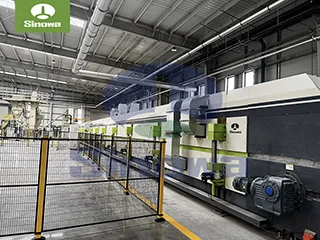
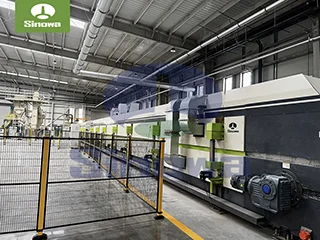
Following the glue coating operation, the constant-temperature composite pressing module completes the integral compounding of the surface steel plate and the core material, which is the decisive link for forming the stable sandwich structure. The composite pressing system combines constant-temperature heating and constant-pressure mechanical pressing, creating a stable curing environment for the adhesive. The heating system maintains a uniform temperature field in the pressing area through infrared heating or circulating heat conduction, which can accelerate the curing reaction of the adhesive and shorten the composite forming cycle while ensuring that the adhesive is fully cured without local overheating and aging. The pressing structure adopts flexible pressure adjustment, which can adapt to panels of different thickness specifications, applying uniform vertical pressure to the composite material layer. This process can effectively eliminate gaps between layers, discharge residual air between the steel plate and the core material, and enable the adhesive to form a continuous and compact bonding layer after curing. After composite pressing, the steel plate and the core material are closely integrated into an integral structure, with significantly improved overall rigidity, avoiding delamination and separation problems that may occur in long-term use.
The post-processing system undertakes the finishing and shaping of continuously formed sandwich panels, mainly including fixed-length cutting, edge trimming, surface finishing and finished product conveying. The high-precision flying saw cutting device realizes dynamic cutting in the continuous moving state of the plate, avoiding the production pause caused by static cutting and ensuring the continuity of the entire production line. The cutting system supports arbitrary adjustment of cutting length according to production requirements, and the cutting section is flat and smooth without burrs or deformation, which does not require secondary manual trimming. The edge trimming unit can fine-tune the edge size of the panel to ensure that the overall dimensional deviation of the finished product is within the standard range and meet the precise assembly requirements of prefabricated buildings. After cutting and trimming, the finished panels are transported to the stacking area through the automatic conveying platform, and the orderly stacking mechanism automatically arranges and stacks the finished products, which is convenient for subsequent packaging, transportation and storage.
The intelligent central control system runs through all links of the sandwich panel production line and is the core brain to ensure the stable and efficient operation of the entire equipment. The system adopts integrated programming control, which can uniformly adjust and monitor the operating speed, processing temperature, pressing pressure, glue application parameters and cutting specifications of each functional module. Operators can set production parameters through the human-machine interaction interface according to different product specifications, and the system will automatically complete the synchronous matching of each link’s operating parameters, realizing one-button start and fully automated production. In the production process, the control system can monitor the operating status of each module in real time, identify abnormal conditions such as material blockage, parameter deviation and equipment overload in a timely manner, and trigger early warning or automatic protection mechanisms to avoid equipment failure and defective product output. While improving production automation, the system also realizes the traceability of production data, providing data support for production management and process optimization.
Compared with traditional discrete production equipment, the integrated color steel sandwich panel line has significant advantages in production efficiency, product quality stability and operational cost control. The fully continuous production mode eliminates the intermediate handling and waiting links between multiple independent processes, greatly shortening the single-piece production cycle and realizing large-scale batch continuous production. The standardized parameter setting and automated operation mode avoid quality differences between products caused by manual operation, making the thickness, flatness, bonding strength and dimensional accuracy of each batch of panels highly consistent. In terms of material utilization, the precise quantitative glue supply system and fixed-length cutting design effectively reduce the waste of adhesive and raw plates, improving the overall material utilization rate. In addition, the centralized structural design reduces the floor space of production equipment, simplifies the production site layout, and facilitates the standardized management of factory production.
The products manufactured by the color steel composite sandwich panel manufacturing line have excellent comprehensive performance, enabling them to adapt to complex and diverse application scenarios in the construction field. The composite structure of metal surface layer and lightweight core material endows the panels with lightweight and high-strength characteristics, which can reduce the self-weight of building enclosure structures, thereby lowering the overall load-bearing pressure of buildings and saving foundation construction costs. The internal porous or fibrous core material has excellent thermal insulation and heat preservation performance, which can effectively block indoor and outdoor heat exchange, reduce building energy consumption, and meet the energy-saving and environmental protection requirements of modern buildings. At the same time, the integrated composite structure has good sound insulation, waterproof and weather resistance, and can maintain stable structural performance and appearance state in long-term outdoor use, adapting to different climatic environments. These performance advantages make color steel sandwich panels widely used in industrial workshops, logistics warehouses, clean workshops, temporary construction facilities, rural prefabricated buildings and public building decoration projects.
With the continuous upgrading of the construction industry towards energy conservation, environmental protection and prefabrication, the technological iteration of color steel sandwich panel machine is also accelerating. Modern production lines are gradually developing towards higher automation, intelligent monitoring, diversified production and energy-saving operation. The optimized mechanical structure further reduces equipment operation energy consumption and noise, and the upgraded control system realizes more precise parameter control and intelligent fault diagnosis. In terms of product adaptation, the new generation of production lines can meet the composite production requirements of multi-functional core materials, enabling finished panels to have better fire resistance, thermal insulation and environmental protection performance. In addition, the modular design of the production line facilitates equipment maintenance, parameter adjustment and functional expansion, enabling the equipment to quickly adapt to the updated market product standards and diversified customer customization needs.
In the entire industrial chain of lightweight building materials, the color steel sandwich panel composite production line plays an irreplaceable basic supporting role. It not only realizes the standardized and large-scale manufacturing of high-performance building enclosure materials but also promotes the standardized development of the prefabricated construction industry. By optimizing the production process and improving product quality consistency, the equipment effectively improves the overall quality level of color steel sandwich panel products in the market, provides reliable material support for the safe, energy-saving and efficient construction of modern buildings, and creates greater economic and social value for the construction industry and building material manufacturing industry. In the future, with the continuous progress of industrial manufacturing technology and the continuous improvement of building energy-saving standards, the composite production line will continue to complete technological innovation and performance upgrading, adapting to the higher-level development needs of the construction industry and lightweight building material manufacturing field.
https://www.cnsinowa.com/sandwich-panel-machines/color-steel-sandwich-panel-composite-production-line.html