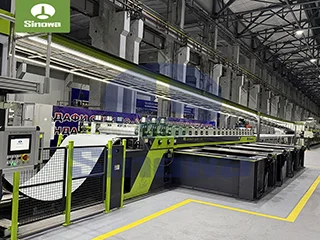
sandwich panel line
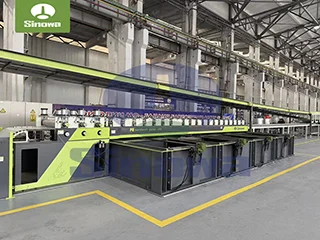
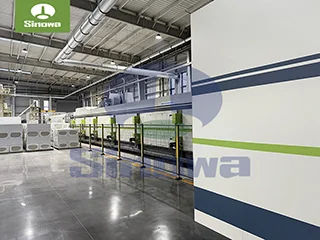
The overall structural design of the PU sandwich panel production line follows a streamlined continuous production logic, with all functional units closely connected and coordinated to eliminate intermittent operation gaps and achieve uninterrupted mass production. The entire production system can be divided into multiple interrelated functional modules, covering raw material unwinding and surface pretreatment, precision roll forming, preheating treatment, polyurethane high-pressure foaming and composite lamination, constant-temperature curing, fixed-length cutting, cooling shaping, and automatic stacking. Each functional module operates with independent precision control while maintaining synchronous linkage with the overall production rhythm, ensuring the stability and consistency of the production process and the uniformity of finished product quality.
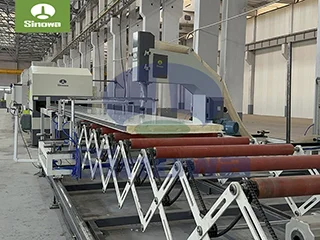
The front-end processing section serves as the foundation of the entire production process, undertaking the pretreatment and shaping of color steel raw materials. The coiled color steel substrates, featuring good surface flatness and structural toughness, are fixed on the unwinding equipment, which adopts a stable hydraulic and pneumatic linkage structure to realize slow and uniform unwinding. This design effectively avoids tensile deformation, surface scratches, and edge warping of the steel plate during the unwinding process, laying a solid foundation for subsequent precise forming and composite processing. After unwinding, the steel plate enters the surface finishing unit, where residual dust, oil stains, and oxide layers on the surface are thoroughly removed through physical cleaning and surface smoothing treatments. These pretreatment steps are critical to enhancing the bonding tightness between the steel plate and the polyurethane foam core layer, preventing delamination and cracking of the composite panel during long-term use.
Subsequently, the processed flat steel plate is sent to the roll forming system, a core unit that determines the dimensional accuracy and structural morphology of the panel. The roll forming system is composed of multiple groups of precision arranged forming rollers with gradient pressing designs. Through progressive mechanical pressing and bending, the flat color steel plate is gradually shaped into the required plate profile with standardized edge structures and surface radian. The whole forming process adopts non-destructive cold pressing technology, which does not change the physical properties and structural strength of the steel plate while ensuring the uniformity of plate thickness and profile dimension. Real-time dimensional monitoring devices are installed inside the forming system to dynamically detect the plate width, edge height, and flatness, and automatically fine-tune the pressure and spacing of the forming rollers through feedback signals, effectively controlling the dimensional tolerance of the formed plate within a tiny range and meeting the high-precision assembly requirements of building enclosure structures.
Before the composite foaming process, the steel plate will pass through an independent preheating unit to complete uniform temperature adjustment. The preheating treatment adopts circulating hot air heating and far-infrared auxiliary heating modes, which can evenly raise the surface temperature of the upper and lower color steel plates to the optimal temperature range required for polyurethane foaming reaction. This step eliminates the temperature difference on the steel plate surface caused by ambient temperature changes, avoids incomplete foaming or uneven foam density caused by temperature mismatch, and greatly improves the bonding efficiency and composite stability between the steel plate and the foam core. The preheating system features intelligent temperature adjustment, which can automatically adjust the heating power according to the production speed and ambient temperature, maintaining a constant and stable heating state throughout the production process.
The polyurethane foaming and composite lamination system is the technical core of the entire color steel sandwich panel line, directly determining the thermal insulation performance, structural strength, and service life of the finished sandwich panel. The system relies on a high-pressure foaming and mixing device to fully mix two-component polyurethane raw materials in a sealed and sterile mixing chamber. The mixed liquid polyurethane raw materials are evenly sprayed between the upper and lower color steel plates through a precise quantitative injection system. The quantitative injection mechanism can accurately control the spraying amount and uniformity of polyurethane materials according to the set core layer density requirements, ensuring consistent thickness and compactness of the foam core layer in each section of the panel.
After the polyurethane material is injected, the steel plate with the liquid foam enters the double-belt laminating mechanism for composite molding. The double-belt system consists of upper and lower circulating tension belts and auxiliary limiting structures on both sides, which can provide uniform and continuous static pressure for the composite plate. Under stable pressure and constant temperature conditions, the liquid polyurethane undergoes rapid chemical foaming, expansion, and curing reactions, gradually filling the gap between the upper and lower steel plates and forming a dense and integrated foam core structure. The whole lamination process maintains a stable pressure environment to avoid local bulging, hollowing, or uneven thickness of the core layer. The integrated composite structure formed by physical bonding and chemical reaction between the foam core and the color steel plate effectively improves the overall structural integrity of the panel, enabling the product to have excellent compressive resistance, bending resistance, and shear resistance.
The constant-temperature curing unit behind the laminating system is key to stabilizing the performance of the polyurethane core layer. The closed curing chamber adopts a multi-section temperature zoning control design, forming a gradual temperature curing environment. The initially foamed and molded composite panel slowly passes through the curing chamber, and the polyurethane core layer completes sufficient molecular cross-linking and solidification reactions under continuous and stable temperature conditions. This gradual curing process eliminates internal stress generated during rapid foaming, prevents core layer shrinkage, deformation, and performance attenuation in the later stage, and significantly improves the weather resistance and structural stability of the sandwich panel. The internal circulating air system of the curing chamber ensures uniform temperature distribution in all areas, avoiding inconsistent curing degrees of the panel surface and interior.
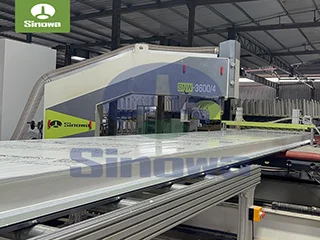
After completing curing and shaping, the continuous composite panel enters the fixed-length cutting process. The automatic cutting system adopts high-precision servo driving and tracking cutting technology, which can conduct real-time tracking and positioning according to the set panel length parameters. The cutting tool features high-speed and stable cutting performance, which can complete the cutting operation instantly without generating burrs, deformation, or surface scratches on the steel plate section. The system supports flexible adjustment of cutting length to meet the diversified size requirements of different engineering projects. Meanwhile, the cutting process is linked with the main production rhythm, realizing synchronous cutting and uninterrupted production, which greatly improves production efficiency and avoids material waste caused by start-stop equipment operation.
The cut finished panels are transported to the cooling and shaping area for natural air cooling and stress relief. After high-temperature curing and cutting, the panel will have a slight temperature difference and internal stress, and the cooling process can balance the overall temperature of the panel and release residual internal stress, ensuring that the finished panel maintains excellent flatness and dimensional stability during long-term storage and use. The cooled panels are automatically sorted and transported to the stacking unit, where the intelligent stacking mechanism neatly stacks the panels according to the set stacking height and arrangement rules. The whole stacking process is stable and orderly, avoiding surface friction and collision damage between panels, and facilitating subsequent transportation and storage management.
The polyurethane sandwich panel line is equipped with a centralized intelligent control system, which integrates all functional units to realize unified scheduling and automatic operation. The control system adopts visual operation interfaces and programmable logic control modules, which can accurately set and adjust production speed, processing temperature, foaming density, cutting size, and other core parameters. During the production process, the system conducts real-time monitoring of the operating status, temperature data, pressure parameters, and production progress of each equipment unit. Once abnormal parameters or equipment failures are detected, the system will automatically trigger early warning prompts and perform self-protection and shutdown operations to ensure production safety and stable product quality. In addition, the system has a data storage and statistical function, which can record daily production output, parameter changes, and equipment operation status, providing reliable data support for production management and process optimization.
Compared with traditional intermittent production equipment, the continuous color steel polyurethane sandwich panel production line has obvious advantages in production efficiency and product quality stability. The integrated continuous production mode greatly reduces manual intervention links, effectively lowers the error rate caused by human operation, and realizes standardized and standardized production of products. The precise parameter control system ensures that the thermal insulation performance, structural strength, and dimensional accuracy of each batch of panels remain highly consistent, avoiding product quality differences caused by manual operation differences. At the same time, the streamlined production process optimizes the material utilization rate, reduces residual waste generated in the production process, and realizes energy-saving and efficient production.
In terms of product performance advantages, the sandwich panels produced by this production line combine the high strength and weather resistance of color steel plates with the excellent thermal insulation and sound insulation properties of polyurethane foam materials. The dense closed-cell structure of the polyurethane core layer gives the product ultra-low thermal conductivity, which can effectively block heat transfer and achieve excellent building energy-saving effects. Meanwhile, the integrated composite structure enables the panel to have good seismic resistance, wind pressure resistance, and impact resistance, adapting to various complex building environments and climatic conditions. The smooth surface of the color steel plate has good anti-corrosion, anti-fouling, and self-cleaning properties, which can maintain a beautiful appearance and stable performance for a long time after installation, reducing the later maintenance cost of buildings.
With the continuous upgrading of the construction industry's energy-saving and environmental protection requirements, the application scope of color steel polyurethane sandwich panels is expanding day by day, which also drives the continuous technological optimization and functional upgrading of the sandwich panel production line. Modern production lines are gradually developing towards higher automation, more precise control, stronger energy-saving performance, and more flexible production modes. The optimized mechanical structure and control program further improve production efficiency and product qualification rate, while the improved foaming process and composite technology make the core layer structure more compact and the composite bonding strength higher. In addition, the PU sandwich panel machine can adapt to the production of panels with different thicknesses, densities, and surface profiles by adjusting parameters, meeting the personalized production needs of different application scenarios such as industrial workshops, cold storage buildings, clean workshops, and mobile integrated buildings.
In practical industrial production applications, the stable operation of the polyurethane sandwich panel manufacturing line depends on the matching of various functional systems and daily standardized maintenance. The transmission system, foaming system, temperature control system, and cutting system all require regular inspection and maintenance to ensure the flexibility and accuracy of equipment operation. Reasonable equipment maintenance can effectively extend the service life of the production line, maintain long-term stable production capacity, and ensure the continuous output of high-quality sandwich panel products. As a key equipment in the field of energy-saving building materials, the color steel polyurethane sandwich panel machinery will continue to play an important role in promoting the upgrading of the construction material industry and the development of green energy-saving buildings, providing reliable equipment support for the efficient and high-quality construction of modern buildings.
https://www.cnsinowa.com/sandwich-panel-machines/color-steel-polyurethane-sandwich-panel-production-line.html