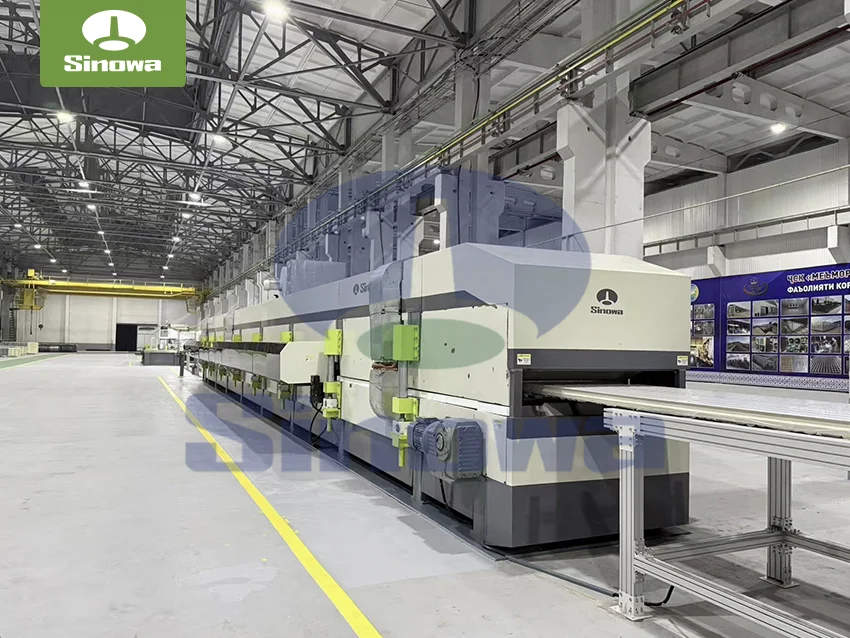
 sandwich panel line
The fundamental working logic of the PU sandwich panel production line is based on the physical compounding and chemical foaming curing principle of polyurethane rigid foam materials. Polyurethane raw materials, composed of two-component chemical materials with specific reaction characteristics, are precisely proportioned and uniformly mixed through professional metering and mixing equipment. The mixed liquid raw materials undergo rapid chemical reactions, foaming expansion, gelation, and solidification processes in the closed space between upper and lower surface layers. During the reaction and forming stage, the foam core material closely bonds with the surface layer materials under continuous pressure and constant temperature conditions, forming an integral composite structure with unified stress and stable thermal insulation performance. Compared with traditional manual or semi-automatic production methods, the continuous production mode adopted by the equipment ensures the consistency of foam density, bonding strength, and panel thickness of each finished product, laying a solid foundation for the standardized application of thermal insulation sandwich panels in various engineering scenarios.
The complete operation flow of the thermal insulation polyurethane sandwich panel line covers multiple interconnected and coordinated working sections, each undertaking independent functional tasks while maintaining synchronous operation rhythm to ensure the continuity and stability of the entire production process. The first stage of production is the surface material pretreatment and forming process, which is the basic link to determine the appearance and structural performance of the sandwich panel. In this stage, coiled surface materials are transported to the production line through automatic uncoiling equipment. The uncoiling system supports uninterrupted feeding operation, realizing automatic docking and connection of new material coils when the raw material coils are exhausted, avoiding production line shutdown and material waste caused by coil replacement, and greatly improving the overall production continuity. After uncoiling, the coiled materials pass through a series of leveling and cleaning mechanisms, which can eliminate tiny wrinkles, unevenness, and surface attachments generated during coil storage and transportation, ensuring that the surface materials maintain a flat, clean, and uniform state, which is a key prerequisite for achieving high-strength bonding between surface materials and polyurethane foam core materials.
Subsequently, the flat surface materials enter the roll forming mechanism for profile processing. Through multi-group precision roller sets arranged in an orderly manner, the surface materials are gradually bent, pressed, and shaped according to preset structural parameters, forming the edge closing, overlapping, and fixing structures required for the installation and assembly of sandwich panels. The roll forming process adopts progressive processing logic, which avoids structural damage and stress concentration of the surface materials caused by one-time strong pressing. The roller spacing, pressing angle, and transmission speed of the forming mechanism can be adaptively adjusted according to different surface material thicknesses and profile requirements, meeting the production and processing needs of diversified panel specifications. After forming, the surface materials are accurately conveyed to the composite station through the synchronous transmission system, and the upper and lower surface layers form a closed molding space with a fixed thickness, preparing for the subsequent polyurethane foam pouring and compounding process.
The core functional stage of the PU sandwich panel line is the polyurethane raw material metering, mixing, and pouring foaming process, which directly determines the thermal insulation performance, structural compactness, and service life of the finished sandwich panels. The production line is equipped with a high-precision raw material metering and feeding system, which quantitatively conveys the two-component polyurethane raw materials to the high-speed mixing head according to the optimal reaction proportion. The metering system maintains stable and accurate material supply volume in the continuous operation state, effectively avoiding product quality defects such as uneven foam density, incomplete reaction, or excessive residual materials caused by inaccurate proportioning. The high-speed mixing mechanism realizes instantaneous and uniform mixing of different raw materials, ensuring that the chemical reaction of polyurethane materials is fully and evenly carried out in the subsequent foaming stage.
The uniformly mixed polyurethane liquid is evenly poured onto the surface of the lower layer material through the movable pouring mechanism. The pouring position and pouring volume can be dynamically adjusted according to the panel width and thickness parameters, realizing full coverage and uniform distribution of the raw materials in the molding space. With the synchronous transmission of the upper and lower surface materials, the liquid raw materials enter the constant-temperature laminating and curing system together. In the closed laminating space, the polyurethane raw materials start a violent foaming reaction, and the volume expands steadily and uniformly to fill the entire gap between the upper and lower surface layers. Under the continuous constant pressure and constant temperature environment provided by the double-track laminating conveyor, the foam completes gelation, curing, and bonding forming. The whole process realizes the integration of foaming, pressure maintaining, and composite bonding, making the foam core material and the surface layer materials form an inseparable integral structure, with extremely high bonding strength and overall structural stability.
The laminating and curing section is equipped with segmented temperature control and pressure regulation systems, which can accurately control the reaction speed and curing degree of polyurethane foam. The front section of the curing area adopts appropriate heating measures to catalyze the chemical reaction of raw materials, accelerate foaming expansion and gel molding, while the rear section adopts slow cooling and pressure maintaining settings to stabilize the internal structure of the foam, eliminate internal stress generated during the reaction and expansion process, and prevent post-expansion, deformation, or cracking of the panels after molding. The double-track circulating pressing structure can maintain consistent pressure on the panel surface during the entire curing process, ensuring that the thickness of each position of the sandwich panel is uniform, and the flatness of the panel surface meets the industrial production standards. The length of the curing section can be matched and adjusted according to different production speeds and panel specifications, ensuring that the polyurethane foam is fully cured and molded without affecting the continuous production rhythm.
After completing the curing and compounding process, the continuous integral panel enters the trimming and fixed-length cutting stage. In this link, the polyurethane sandwich panel production line is equipped with automatic edge trimming mechanisms on both sides, which can accurately trim the excess foam and edge burrs on both sides of the panel, making the panel edges neat and uniform, eliminating the dimensional deviation caused by foaming expansion, and ensuring the assembly accuracy of subsequent engineering installation. The trimmed continuous panel is then transported to the flying cutting station, which adopts a synchronous tracking cutting mode. The cutting equipment moves synchronously with the running panel during operation, realizing non-stop cutting in the continuous production state, which effectively avoids the production efficiency loss caused by frequent start-stop of the production line.
The fixed-length cutting system supports arbitrary setting of cutting dimensions within the conventional specification range, and the high-precision sensing and positioning components can ensure that the dimensional error of each finished panel is controlled within a tiny range, meeting the precise size requirements of different application scenarios. The cutting tool adopts high-hardness and wear-resistant structural design, which can maintain stable cutting accuracy and smooth cutting section during long-term continuous operation, without phenomena such as burrs, collapses, and uneven sections. After cutting, the finished single panels are transported to the sorting and stacking station through the rear-end conveying equipment.
The final stage of the production process is automatic sorting, stacking and finished product output. The stacked panels are neatly arranged and sorted by the automatic stacking equipment according to the preset stacking standards. The stacking mechanism has stable bearing capacity and flexible action logic, which can avoid extrusion damage and surface scratch of the panels during the stacking process. The entire stacking process is fully automated without manual intervention, which not only improves the neatness and uniformity of finished product storage, but also greatly reduces the labor cost and improves the overall production efficiency of the insulation board production line. For the panels that need subsequent packaging treatment, the production line can be connected with the automatic packaging system to realize integrated production from raw material processing to finished product packaging and storage, forming a closed-loop and automated production system.
The overall structural design of the thermal insulation polyurethane sandwich panel machine has excellent systematicness and flexibility, and each functional module is highly matched and coordinated. The transmission system of the whole line adopts synchronous frequency conversion control technology, which can realize stepless adjustment of production speed according to production demand, and maintain the synchronous operation of all links such as feeding, forming, pouring, curing, and cutting. This synchronous control mode effectively avoids quality problems such as foam delamination, uneven thickness, and incomplete curing caused by inconsistent operation speeds of each station. At the same time, the modular structural design facilitates daily maintenance, component replacement, and functional upgrading of the equipment. Each functional section is relatively independent in structure and interconnected in operation, which can quickly respond to the production demands of different panel specifications and process parameters.
In terms of production performance advantages, this continuous PU sandwich production line has far higher production efficiency than traditional batch production equipment. The uninterrupted production mode realizes continuous output of panels, and the overall production rhythm is stable and efficient. The automated operation throughout the whole process greatly reduces the dependence on manual operation, reduces the error rate and quality fluctuation caused by human factors, and significantly improves the yield rate of finished products. The polyurethane foam prepared by the continuous pouring and curing process has uniform internal pore structure, high compactness, and stable density, which endows the finished sandwich panels with superior and durable thermal insulation performance. The integral composite structure formed by one-time foaming and bonding has good wind resistance, pressure resistance, and bending resistance, and the overall structural strength is far better than that of panels produced by secondary bonding process.
In terms of energy consumption and production cost control, the continuous PU sandwich panel line adopts optimized temperature control and power distribution design. The segmented constant-temperature curing system can accurately control the heating and cooling range, effectively reducing invalid energy consumption and improving energy utilization efficiency. The precise raw material metering system avoids raw material waste caused by excessive feeding or repeated processing, realizing the maximum utilization rate of polyurethane chemical raw materials. The long-term continuous and stable operation of the equipment reduces the failure rate and downtime loss, and the standardized production process reduces the defective rate and rework cost, bringing significant cost optimization benefits for large-scale and mass production of thermal insulation sandwich panels.
The products manufactured by the thermal insulation sandwich panel machine have wide application value and strong environmental adaptability. Relying on the excellent low thermal conductivity of polyurethane foam core material, the panels have outstanding heat insulation and heat preservation effects, which can effectively isolate the internal and external heat transfer of buildings and equipment, reduce the energy consumption of temperature regulation equipment, and achieve the purpose of building energy conservation and consumption reduction. At the same time, the composite structure of surface layer and foam core material gives the panels good waterproof, moisture-proof, sound insulation, and fire-retardant auxiliary performance. The stable chemical properties of polyurethane foam enable the panels to resist aging, corrosion, and mildew in complex outdoor and industrial environments, with long service life and low later maintenance cost.
In industrial application scenarios, this PU sandwich panel machine can adapt to the production of sandwich panels for different fields. In industrial plant construction, the produced panels are used for factory enclosure, roof, and wall thermal insulation structures, meeting the lightweight, high-strength, and energy-saving construction needs of modern industrial buildings. In cold chain logistics and refrigeration engineering, the high-precision thermal insulation panels produced by the equipment can build low-temperature storage environments with stable temperature control, effectively reducing the cold loss of refrigeration equipment and improving the operation efficiency of cold chain systems. In temporary buildings, purification workshops, and municipal enclosure projects, the standardized and high-precision finished panels have convenient installation, good overall sealing performance, and strong environmental adaptability, which can meet the rapid construction and long-term use requirements of various temporary and special buildings.
With the continuous upgrading of building energy-saving standards and the rapid development of new building materials industry, the market demand for high-performance thermal insulation polyurethane sandwich panels is increasing day by day, which also puts forward higher requirements for the performance, automation degree, and production flexibility of supporting production equipment. Modern thermal insulation panel production line is gradually developing towards higher automation, more precise control, stronger flexibility, and lower energy consumption. The intelligent control system can realize real-time monitoring, data recording, and parameter optimization of the whole production process, automatically adjust process parameters such as raw material proportioning, production speed, and curing temperature according to different production tasks, further improve production stability and product consistency, and reduce manual intervention and operation errors.
In terms of process optimization, the upgraded production line optimizes the foam reaction and curing process, improves the uniformity and compactness of the foam internal structure, and further enhances the thermal insulation performance and structural stability of the finished panels. The optimized edge sealing and composite process effectively solves the problems of edge water seepage, delamination, and poor sealing of traditional sandwich panels, improving the overall sealing performance and weather resistance of the panels. At the same time, the equipment can realize the flexible switching of multiple specifications of panels, meeting the personalized and diversified production needs of the market, and improving the comprehensive utilization rate and market adaptability of the production line.
From the perspective of industrial development, the thermal insulated sandwich panel production line, as a key equipment for the production of energy-saving building materials, plays an important role in promoting the upgrading of the construction industry's energy-saving level. The efficient and low-consumption production mode of the equipment conforms to the development trend of green manufacturing and low-carbon industry. The high-performance thermal insulation panels produced by the equipment can effectively reduce the overall energy consumption of buildings, help realize the energy-saving and emission-reduction goals of the construction field, and have good social and economic benefits. With the continuous progress of material technology and mechanical manufacturing technology, the performance of polyurethane sandwich panel production equipment will be further improved, and the produced panels will have better thermal insulation, fire resistance, environmental protection, and structural performance, which will be more widely used in new energy buildings, high-end industrial manufacturing, cold chain transportation, and other emerging fields.
In the actual production and operation process, the stable operation of the thermal insulation polyurethane sandwich panel production machine is closely related to standardized operation and daily maintenance. Scientific and standardized operation procedures can ensure that each functional module of the equipment operates in an optimal state, avoid equipment failure and product quality problems caused by irregular operation. Regular maintenance and maintenance of transmission components, metering systems, temperature control systems, and cutting mechanisms can effectively extend the service life of the equipment, maintain long-term stable production efficiency, and ensure the continuous output of high-quality thermal insulation sandwich panels. The systematic and automated characteristics of the equipment also reduce the technical threshold of daily operation and maintenance, which is convenient for enterprises to realize standardized production management and large-scale capacity expansion.
In conclusion, the thermal insulation polyurethane sandwich panel manufacturing line is a highly integrated, efficient, and stable modern industrial production equipment. It realizes the standardized, automated, and large-scale production of high-performance thermal insulation composite panels through the organic integration of mechanical transmission, chemical reaction control, and precision processing technology. The whole production process is compact and efficient, the product quality is stable and reliable, and the produced sandwich panels have outstanding thermal insulation performance, structural stability, and environmental adaptability, covering the application needs of multiple fields such as industrial construction, cold chain refrigeration, and municipal engineering. With the continuous development of the green building industry and the improvement of energy-saving requirements, this type of production line will continue to play an important role in the field of building materials manufacturing, and continuously drive the technological progress and industrial upgrading of the thermal insulation sandwich panel industry through continuous technological optimization and performance upgrading.
https://www.cnsinowa.com/sandwich-panel-machines/thermal-insulation-polyurethane-sandwich-panel-production-line.html