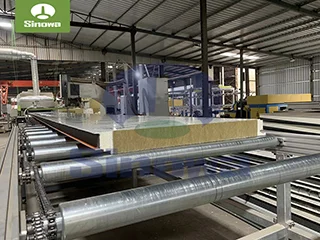
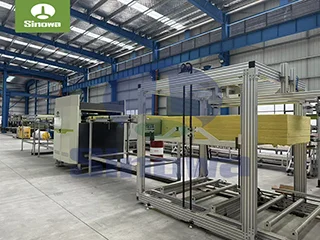
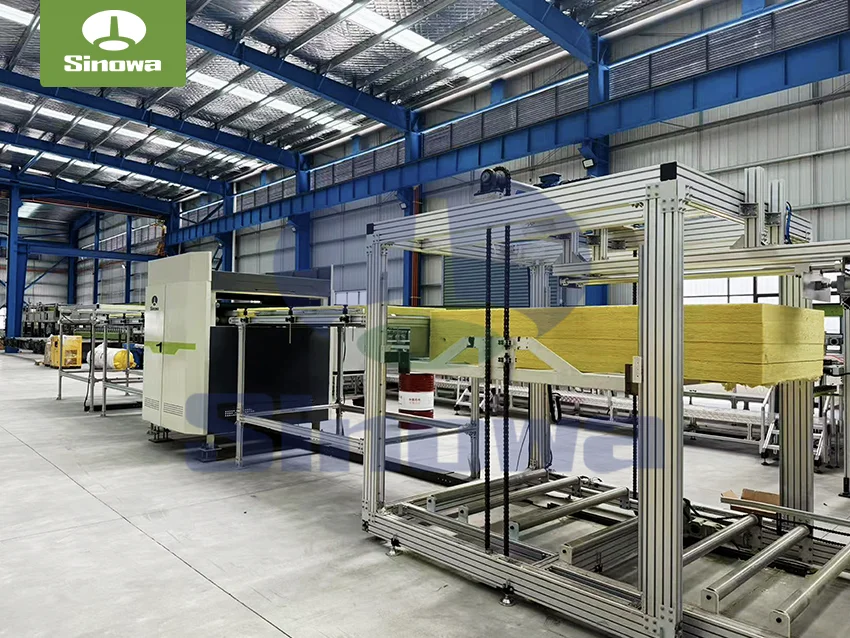
 sandwich panel line
The structure of the sound insulation rock wool board production line is a complex systematic project, which is composed of multiple functional units closely connected, and each unit undertakes a specific production task to form a continuous and automatic production process. The whole production line starts with the batching and feeding system, which is the foundation of ensuring the stability of product performance. This system usually includes storage hoppers, vibrating screens, weighing conveyors and control modules. Raw materials such as basalt, dolomite and other natural rocks are first screened to remove impurities and ensure the purity of the raw materials. Then, through the electronic metering device, the raw materials are accurately proportioned according to a certain ratio. The proportion of each component directly affects the fiber quality and sound insulation performance of the final product. The metered raw materials are transported to the melting furnace through the conveyor belt, and the feeding speed is controlled by the automatic control system to maintain the stability of the melting process.
The melting furnace is the core equipment of the production line, which is mainly used to melt the mixed raw materials into a molten state. The furnace body is built with high-temperature resistant refractory materials to withstand the high temperature of more than 1400 ℃ required for melting. In order to ensure production safety and energy saving, the furnace is usually equipped with a cooling water circulation system to cool the furnace wall and prevent overheating damage. At the same time, a hot air preheating system is configured, which uses the waste heat of the furnace to preheat the incoming raw materials, thereby reducing energy consumption and improving melting efficiency. The molten rock material is discharged from the furnace outlet in a stable flow state and then sent to the centrifugal fiber forming device, which is the key link to realize the fiberization of the material.
The centrifugal fiber forming device is mostly a four-roller centrifuge, which achieves fiberization through high-speed rotation. The molten rock flow is thrown onto the high-speed rotating roller, and under the action of centrifugal force, it is stretched into fine inorganic fibers with a diameter of 4-7 microns. The roller position of the four-roller centrifuge can be adjusted, which can effectively control the fineness and uniformity of the fibers. The quality of the fibers directly determines the sound insulation performance of the rock wool board, because the fine and uniform fiber structure can form more porous spaces, which is conducive to absorbing sound waves. After fiberization, a certain amount of additives are evenly sprayed on the fibers, including binders, dust suppressants and water repellents. The binder can make the fibers bond together to form a stable structure, the dust suppressant reduces the generation of dust during production, and the water repellent improves the water resistance of the product without affecting the sound insulation effect.
After the fibers are mixed with additives, they are sent to the cotton collecting device by the negative pressure air flow. The cotton collecting device usually adopts a vertical cotton collecting structure, and the fibers are adsorbed on the mesh belt under the action of negative pressure to form a primary cotton felt. The mesh belt continuously conveys the primary cotton felt to the pendulum cotton spreading machine, which evenly spreads the cotton felt through the swing motion to ensure the uniformity of the thickness of the cotton layer. The uniformity of the cotton layer is crucial to the sound insulation performance of the product, because the uneven thickness will lead to the difference in sound absorption capacity of different parts of the board. After pendulum cotton spreading, the cotton felt is sent to the pleating press machine for compaction, which adjusts the density of the cotton felt to meet the requirements of different types of products.
The cured forming unit is the next important process. The compacted cotton felt is sent to the curing furnace, where it is heated and cured at a specific temperature and time. The curing temperature and time are strictly controlled, because excessive temperature or too long time will lead to the aging of the binder, affecting the structural stability of the product; while insufficient temperature or too short time will result in poor bonding of the fibers, reducing the strength of the board. During the curing process, the fibers and binders fully react to form a semi-rigid board with stable structure. After curing, the board is sent to the cooling system for cooling to room temperature, which prevents the board from deforming due to thermal expansion and contraction. Then, the cooled board is cut into standard sizes by the cutting machine, and the waste edges generated during cutting are collected by the waste edge recovery system, crushed and reused, realizing the recycling of materials and reducing production waste.
The final link of the production line is packaging and storage. The cut finished products are inspected for appearance, thickness, density and other indicators, and the qualified products are packaged to prevent moisture and damage during transportation and storage. The whole production line adopts automatic control technology, and the PLC control system realizes the real-time monitoring and adjustment of each process parameter, such as melting temperature, centrifugal speed, curing time, etc., ensuring the stability and consistency of product quality. The degree of automation of the production line not only improves production efficiency, but also reduces human errors, making the performance of each batch of sound insulation rock wool boards more stable.
The sound insulation rock wool board produced by the production line has a variety of excellent performance characteristics, among which the sound insulation and absorption performance is the core. This performance is mainly derived from the unique fibrous porous structure of the product. The internal fibers of the rock wool board are interwoven randomly to form a large number of tiny pores, and these pores are connected to each other to form a sound wave propagation channel. When sound waves enter the board, they will collide and friction with the fibers, and the energy of the sound waves will be converted into heat energy and dissipated, thereby achieving the effect of sound absorption and noise reduction. The sound insulation performance of the rock wool board is related to its density, thickness, fiber fineness and other factors. Generally speaking, under the same thickness condition, the higher the density, the better the sound insulation effect, but when the density exceeds a certain range, the improvement of sound insulation performance will tend to be flat, and the thermal insulation performance may be affected. In addition, the rock wool board has good sound insulation effect on both high-frequency and low-frequency sound waves, especially for low-frequency noise which is difficult to handle, it has obvious absorption capacity, which is better than many organic sound insulation materials.
In addition to excellent sound insulation performance, the sound insulation rock wool board also has outstanding fire resistance. As an inorganic material, it does not burn, and its combustion performance reaches the non-combustible level. In the event of a fire, it will not release toxic and harmful gases, and can effectively block the spread of flames, forming a fire barrier. This performance makes it widely used in buildings with high fire safety requirements, because it can not only reduce noise, but also improve the fire resistance of the building. At the same time, the rock wool board has good thermal stability, and its performance will not change significantly in the temperature range of -200 ℃ to 600 ℃, which can adapt to various harsh working environments.
The mechanical performance of the sound insulation rock wool board is also an important indicator to ensure its application effect. It has a certain compressive strength and flexural strength, which can resist the external pressure during construction and use, and is not easy to deform or break. The mechanical performance is mainly determined by the density of the board and the type of binder. The appropriate density and high-quality binder can ensure that the board maintains structural stability under the action of external force. In addition, the rock wool board has good water resistance and moisture resistance. After adding water repellent during production, its water absorption rate is low, and it will not soften or lose performance when exposed to moisture, which can adapt to the use environment with high humidity.
Environmental protection performance is another advantage of sound insulation rock wool board. It is made of natural rock as raw material, which is a renewable resource and has no pollution to the environment during production and use. The product does not contain harmful substances such as formaldehyde, and will not release toxic gases, which is harmless to human health. At the end of its service life, the rock wool board can be recycled or degraded naturally without causing environmental pollution, in line with the concept of green and sustainable development.
According to different classification standards, sound insulation rock wool boards can be divided into multiple types, each with unique performance characteristics and application scenarios. According to the density, it can be divided into low-density, medium-density and high-density rock wool boards. Low-density rock wool boards have a density range of 80-100 kg/m³, with a loose structure and excellent sound absorption performance. They are mainly used in indoor non-load-bearing parts such as interior walls, ceilings and partitions, which are suitable for residential buildings, offices and other places that need to reduce indoor noise. Because of their light weight, they will not increase too much load on the building structure.
Medium-density rock wool boards have a density of 120-150 kg/m³, which balance sound insulation performance and mechanical strength. They are the most widely used type, suitable for external walls, roofs, fire barriers and other parts. They can not only play a role in sound insulation and noise reduction, but also have certain compressive and weather resistance, adapting to the external environment of the building. High-density rock wool boards have a density of 160-200 kg/m³, with high mechanical strength and excellent sound insulation effect. They are mainly used in industrial equipment, machine rooms, highways and other places with high noise and high load requirements. For example, in industrial machine rooms, high-density rock wool boards can effectively absorb the noise generated by equipment operation and resist the vibration of mechanical equipment.
According to the production process, sound insulation rock wool boards can be divided into pendulum-type and sedimentation-type. Pendulum-type rock wool boards adopt a three-dimensional weaving process, and the fibers are interwoven in a non-directional way, with uniform structure and stable performance. The sound insulation effect is better than that of sedimentation-type products, and they are suitable for places with high sound insulation requirements such as recording studios and theaters. Sedimentation-type rock wool boards are formed by fiber sedimentation, with a two-dimensional planar fiber distribution and relatively loose structure. Their sound insulation performance is general, but the production cost is low, and they are suitable for auxiliary sound insulation scenarios with low requirements, such as temporary buildings and storage rooms.
In addition, according to the use environment, sound insulation rock wool boards can be divided into indoor and outdoor types. Outdoor rock wool boards are treated with special weather resistance, with strong resistance to wind, sun and rain, and are suitable for external walls, sound barriers and other outdoor parts. Indoor rock wool boards pay more attention to sound absorption performance and environmental protection, and are suitable for interior decoration and noise reduction projects.
The application range of sound insulation rock wool boards is very wide, covering construction, industry, transportation, cultural and entertainment and other fields, and plays an important role in improving the living and working environment. In the construction field, it is one of the most commonly used sound insulation materials. In residential buildings, it is often used in interior walls, partitions, ceilings and floor interlayers to reduce the noise transmission between adjacent rooms, such as the noise of walking, talking and household appliances. In high-rise buildings and commercial complexes, it is used in external walls and fire barriers, which not only achieves sound insulation and noise reduction, but also improves the fire safety of the building. For example, in the partition walls of hotels and apartments, the composite structure of "gypsum board + light steel keel + rock wool board" is adopted, which can effectively isolate the noise between rooms and ensure the privacy of guests.
In the cultural and entertainment field, sound insulation rock wool boards are widely used in places with high acoustic requirements such as recording studios, theaters, concert halls and home theaters. Professional recording studios need to control the ambient noise below 20 dB to ensure the quality of recordings. The high-density pendulum-type rock wool boards are used in the wall and ceiling structure, which can absorb high, medium and low frequency sound waves comprehensively, with a sound insulation capacity of 40-50 dB, effectively reducing external noise interference. In home theaters, rock wool boards are installed in the background wall and side wall interlayers, which can not only block the leakage of sound effects, avoid disturbing neighbors, but also absorb excess sound reflections, reduce echoes and standing waves, and enhance the immersion of watching movies.
In the industrial field, sound insulation rock wool boards are mainly used in noise reduction projects of industrial equipment and machine rooms. The noise generated by the operation of industrial boilers, fans, compressors and other equipment is usually 60-85 dB, which is harmful to the health of operators for a long time. By installing high-density rock wool boards on the walls and ceilings of the machine room, the noise can be reduced to 30-35 dB, creating a comfortable working environment. At the same time, the fire resistance of rock wool boards can also prevent the spread of fire in the machine room and protect the safety of equipment and personnel.
In the transportation field, sound insulation rock wool boards are used in the production of sound barriers on highways, railways and urban viaducts. The noise generated by the operation of motor vehicles and trains will seriously affect the life of residents along the line. The sound barrier made of rock wool boards can effectively absorb and block the noise, reducing the noise pollution to the surrounding environment. In addition, it is also used in the sound insulation and noise reduction of automobile interiors and ship cabins, improving the comfort of driving and taking.
In addition to the above fields, sound insulation rock wool boards are also used in hospitals, schools, libraries and other places. Hospitals need a quiet environment to ensure the rest and treatment of patients. Rock wool boards are used in the walls and ceilings of wards, operating rooms and other places to reduce the noise of medical equipment and personnel activities. Schools and libraries use rock wool boards to create a quiet learning and reading environment, helping to improve learning efficiency. In data centers, rock wool boards are used for sound insulation and fire protection, balancing the needs of noise reduction and equipment safety.
With the continuous improvement of people's requirements for living environment quality and the strengthening of environmental protection policies, the demand for sound insulation rock wool boards is increasing, and the production line technology is also constantly upgrading and improving. In the future, the sound insulation rock wool board production line will develop in the direction of higher automation, more precise parameter control and more energy saving and environmental protection. By optimizing the production process and improving the performance of products, the application range of sound insulation rock wool boards will be further expanded, making greater contributions to noise control and environmental improvement in various fields. At the same time, with the deepening of research and development, new types of sound insulation rock wool boards with better performance and more diversified functions will continue to emerge, meeting the increasingly complex application needs of different fields.
https://www.cnsinowa.com/sandwich-panel-machines/rock-wool-board-production-line-for-sound-insulation.html