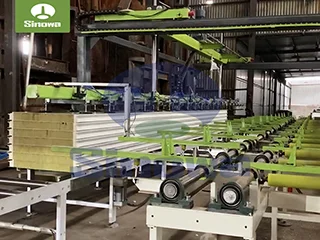
sandwich panel machine
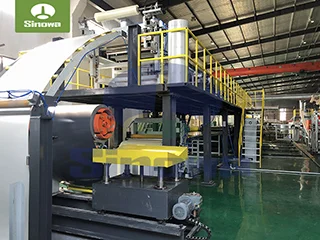
The structure of industrial rock wool sandwich panel production equipment is composed of multiple functional modules that work in coordination to complete the entire production process from raw material feeding to finished product packaging. The core structural components include uncoiling systems, roll forming units, rock wool feeding and processing systems, adhesive application systems, laminating and pressing units, cutting systems, cooling systems, stacking systems, and control systems. Each module is designed to fulfill specific functions, ensuring the smooth operation of the production line and the stability of product quality. The uncoiling system is responsible for stably feeding metal coils, usually color-coated steel sheets or galvanized steel sheets, into the production line. It is equipped with hydraulic mandrels and tension control devices to prevent coil loosening or deformation during the uncoiling process, ensuring the flatness of the surface layers. The mandrel type uncoiler can be operated automatically, allowing for quick coil replacement without stopping the production line, which greatly improves production efficiency.
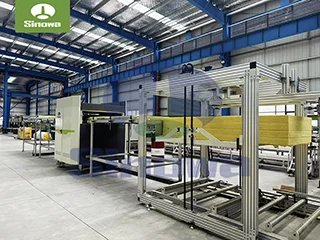
The roll forming unit is another critical structural component, which shapes the metal sheets into the required profiles through a series of roller presses. The rollers are precisely designed according to the cross-sectional shape of the sandwich panels, such as wall panels or roof panels. The cassette-type and railway wheel-type design of the roll forming unit facilitates the replacement of rollers, enabling the production of different types of panels with a single production line. After forming, the metal sheets are conveyed to the laminating area, where they are combined with the processed rock wool core material. The rock wool feeding and processing system is designed to handle the core material, including lifting, cutting, turning, and edge trimming. The rock wool slabs are first cut into strips of specified thickness according to the product requirements, then turned 90 degrees to make the fibers perpendicular to the metal surface layers, which enhances the structural strength and thermal insulation performance of the final panels. The edge trimming device ensures that the rock wool strips have neat edges, avoiding gaps between the core material and the metal sheets.
The adhesive application system is responsible for applying high-strength, fire-resistant adhesives to the inner surfaces of the metal sheets or the rock wool core material. This system usually adopts a bidirectional spraying design, ensuring uniform adhesive coverage and strong bonding between the core material and the surface layers. The adhesive dosage can be adjusted according to the production speed and panel thickness, generally ranging from 180 grams to 250 grams per square meter, to ensure sufficient adhesion without excessive waste. The laminating and pressing unit combines the upper metal sheet, rock wool core, and lower metal sheet into an integrated structure through rolling and pressing. This unit is equipped with double belts and heating devices, which not only ensure the tight bonding of the three layers but also accelerate the curing of the adhesive. The pressure and temperature of the laminating unit are precisely controlled to avoid damage to the rock wool fibers and ensure the flatness and rigidity of the panels.
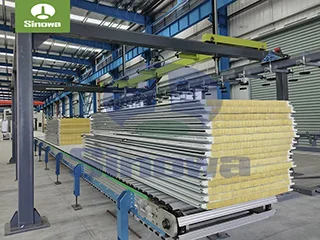
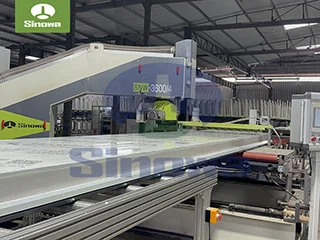
The cutting system is used to cut the continuous composite panel into specified lengths according to customer requirements. It usually adopts a three-axis vertical cutting or servo automatic reciprocating cutting design, which ensures accurate cutting size and smooth cutting edges. The cutting process can be completed without stopping the production line, maintaining continuous operation and high efficiency. The cooling system follows the cutting unit to cool down the finished panels, as the panels may have a certain temperature after the laminating and heating process. Proper cooling ensures the dimensional stability of the panels and prevents deformation. The stacking system automatically arranges the cooled panels into neat stacks, which are then conveyed to the packaging system for wrapping with plastic film or other protective materials. The entire structural design of the production equipment emphasizes automation and integration, minimizing manual intervention and improving production consistency.
The performance of industrial rock wool sandwich panel production equipment directly determines the quality of the finished panels and the efficiency of the production process. High automation performance is one of the core advantages of modern production equipment. The whole production line is controlled by a computer-integrated control system, which integrates digital servo technology, frequency conversion vector technology, and hydraulic control technology. Operators only need to input production parameters such as panel thickness, length, and speed into the man-machine interface, and the system can automatically complete the entire production process from raw material feeding to finished product stacking. This high degree of automation not only reduces the number of operators required—generally only 5 to 8 people are needed for a full production line—but also minimizes human errors, ensuring consistent product quality.
Production efficiency is another important performance indicator of this equipment. The production speed varies according to the thickness of the panels and the type of core material, generally ranging from 3 meters to 16 meters per minute. For panels with a thickness of 50 millimeters, the production speed can reach 5 meters per minute, and the annual production capacity can reach 800,000 to 1,000,000 square meters based on 250 working days per year and 10 working hours per day. The continuous production design, non-stop coil replacement, and non-stop cutting functions all contribute to the high efficiency of the equipment. Energy-saving performance is also highly valued in modern production equipment. Compared with traditional production methods, the latest equipment can reduce energy consumption by 40% through optimized heating systems, frequency conversion speed regulation, and waste reduction. Additionally, the equipment is designed with dust collection and treatment devices, ensuring no dust pollution during the production process and meeting environmental protection requirements.
Precision and stability are key performance characteristics that ensure product quality. The roll forming unit and cutting system adopt high-precision mechanical components and servo control technology, ensuring that the dimensional tolerance of the panels is within ±2 millimeters. The adhesive application system ensures uniform glue spraying, avoiding insufficient bonding or glue overflow. The rock wool processing system maintains the integrity of the rock wool fibers during cutting and turning, ensuring that the core material has excellent thermal insulation and sound absorption performance. The equipment also has good stability and durability, with core components made of high-quality materials that can withstand long-term continuous operation. The low operating noise design of the equipment creates a comfortable working environment for operators, which is also an important part of its performance.
Industrial rock wool sandwich panel production equipment can be classified into different types according to production mode, production capacity, and product scope. The most common classification is based on the production mode, which includes continuous production lines and discontinuous production lines. Continuous production lines are the mainstream type in modern industrial production, characterized by uninterrupted operation from raw material feeding to finished product output. These production lines integrate all functional modules into a single system, enabling high-speed and large-scale production. They are suitable for large-scale manufacturers with high demand for production capacity and product consistency. Continuous production lines can also be equipped with optional components to produce multiple types of panels, such as rock wool sandwich panels, polyurethane sandwich panels, or composite panels with mixed core materials.
Discontinuous production lines, also known as batch production lines, are suitable for small and medium-sized manufacturers with relatively low production demand. These production lines complete the production process in batches, with each batch of panels going through feeding, forming, pressing, cutting, and other processes sequentially. Although the production efficiency is lower than that of continuous production lines, discontinuous production lines have the advantages of simple structure, low investment cost, and flexible operation. They can easily adjust production parameters to produce small batches of customized panels, meeting the diverse needs of different customers. Another classification method is based on the product scope, which includes equipment specialized in producing wall panels, roof panels, or both. Wall panel production equipment focuses on the flatness and structural rigidity of the panels, while roof panel production equipment emphasizes the waterproof performance and load-bearing capacity of the panels, with corresponding adjustments in the roll forming and laminating modules.
In addition, according to the processing capacity of the rock wool core material, the equipment can be divided into those suitable for low-density rock wool (64-80 kg/m³) and high-density rock wool (80-120 kg/m³). High-density rock wool processing equipment is equipped with more powerful cutting and pressing devices to handle the harder core material, ensuring the integrity of the fibers and the bonding strength of the panels. Some advanced production lines also have the function of producing curved or special-shaped panels, which are used in buildings with complex structures such as stadiums and exhibition halls. These special production lines are equipped with customized roll forming and laminating units that can adapt to different curved radii and shapes.
The application scope of industrial rock wool sandwich panel production equipment is closely linked to the application of rock wool sandwich panels, covering a wide range of industrial and civil construction fields. In the industrial construction sector, this equipment is widely used in the production of panels for factory buildings, warehouses, workshops, and prefabricated industrial structures. Rock wool sandwich panels produced by this equipment have excellent fire resistance, which is crucial for industrial buildings that store flammable materials or involve high-temperature operations. They can effectively prevent the spread of fire and reduce property losses and casualties. Additionally, the thermal insulation and sound absorption performance of the panels helps to maintain a stable working environment in the factory buildings, reduce energy consumption for heating and cooling, and minimize noise pollution from production equipment.
In the field of civil construction, the equipment is used to produce panels for residential buildings, office buildings, public facilities such as schools and hospitals, and prefabricated houses. With the development of prefabricated construction, rock wool sandwich panels have become an important component of prefabricated walls and roofs due to their lightweight, quick installation, and excellent performance. The panels produced by the equipment can be easily assembled on-site, shortening the construction period and reducing labor costs. In public buildings with high fire safety requirements, such as hospitals and schools, rock wool sandwich panels provide reliable fire protection, ensuring the safety of personnel. The sound absorption performance of the panels also makes them suitable for use in auditoriums, stadiums, and other large public spaces, improving the acoustic environment.
The equipment also has important applications in special construction fields, such as cold storage, clean rooms, and fire isolation belts. Cold storage requires panels with excellent thermal insulation performance to maintain low temperatures, and rock wool sandwich panels produced by this equipment can meet this demand with their low thermal conductivity. Clean rooms, such as those in the pharmaceutical and electronic industries, require panels with smooth surfaces and no dust accumulation, and the equipment can produce panels with high flatness and tight bonding to meet the cleanliness requirements. Fire isolation belts are important components of building fire protection systems, and the high-density rock wool panels produced by the equipment can effectively block the spread of fire between building layers, improving the overall fire safety of the building.
Beyond the construction industry, the equipment also serves the needs of other fields such as transportation and agriculture. In the transportation field, rock wool sandwich panels are used in the production of vehicle compartments, such as refrigerated trucks and special-purpose vehicles, providing thermal insulation and fire protection. In the agricultural field, the panels are used to build greenhouses, livestock houses, and storage facilities, helping to maintain a stable internal environment and protect crops and livestock from extreme temperatures. The versatility of the production equipment allows it to adapt to different core material densities and surface layer materials, enabling the production of panels for various special applications.
The development trend of industrial rock wool sandwich panel production equipment is closely related to the advancement of materials science, mechanical engineering, and automation technology. Future equipment will focus on higher automation, intelligence, and energy efficiency. The integration of artificial intelligence and Internet of Things technology will enable real-time monitoring of the production process, predictive maintenance of equipment components, and automatic adjustment of production parameters to optimize product quality and production efficiency. The development of new adhesive materials and rock wool processing technologies will also promote the upgrading of production equipment, enabling the production of panels with better performance, such as higher fire resistance, lower thermal conductivity, and stronger structural strength.
In addition, environmental protection will continue to be a key focus in the design and production of this equipment. Manufacturers will further reduce energy consumption and waste emissions through optimized structural design and the adoption of green technologies. The development of modular equipment will also become a trend, allowing manufacturers to flexibly combine functional modules according to their production needs, reducing investment costs and improving the adaptability of the equipment. With the increasing global demand for energy-saving and fire-safe building materials, industrial rock wool sandwich panel production equipment will play an increasingly important role in the construction industry, driving the sustainable development of the industry.
In conclusion, industrial rock wool sandwich panel production equipment is a complex and sophisticated integrated system that combines multiple technologies and functional modules. Its rational structure ensures the smooth operation of the production process, excellent performance guarantees high efficiency and product quality, diverse types adapt to different production needs, and wide applications cover various fields of construction and beyond. As the demand for high-performance composite building materials continues to grow, this equipment will undergo continuous innovation and upgrading, contributing to the development of a more energy-efficient, safe, and sustainable construction industry. The continuous improvement of production equipment technology will not only enhance the quality and performance of rock wool sandwich panels but also expand their application scope, bringing new opportunities for the development of the building materials industry.
https://www.cnsinowa.com/sandwich-panel-machines/rock-wool-sandwich-panel-production-equipment-for-industrial-use.html