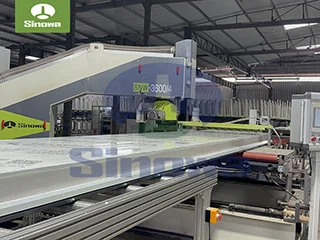
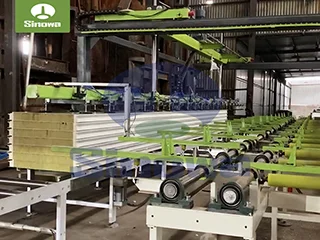
sandwich panel line
The production of wall rock wool sandwich panels begins with the careful selection and preparation of raw materials, which are the foundation of product quality. The core raw materials include basalt, the primary material for rock wool core, and metal coils for the surface panels. Basalt, a volcanic silicate rock rich in silicon dioxide, aluminum oxide, and calcium oxide, is chosen for its high melting point and excellent fire-resistant properties. Before entering the production process, basalt is crushed into uniform particles to ensure consistent melting efficiency. The metal coils, typically made of steel, undergo preliminary processing to remove impurities and rust, which is crucial for enhancing the adhesion of subsequent coatings and ensuring the durability of the finished panels. This stage of raw material preparation also involves strict quality inspection to screen out materials that do not meet the required standards, as any flaw in the raw materials can directly affect the performance of the final products.
The first key stage in the manufacturing line is the production of rock wool core, a process that involves the transformation of solid basalt into fibrous insulation material through high-temperature melting and centrifugation. The crushed basalt particles are fed into a cupola furnace heated to temperatures exceeding 1500℃, where they are melted into a homogeneous molten magma. This high-temperature melting process not only breaks down the crystalline structure of the rock but also removes any residual impurities, ensuring the purity of the final rock wool fibers. The molten magma is then discharged from the bottom of the furnace and flows into a high-speed rotating four-roll centrifuge. Under the action of strong centrifugal force, the magma is stretched and shredded into extremely fine fibers, similar to how cotton candy is made by a rotating machine. During this process, a certain amount of binder, mainly phenolic resin, and dust-proof oil are uniformly sprayed onto the fibers to enhance their cohesion and prevent dust generation.
After the fiber formation, the next step is the curing and shaping of the rock wool core. The fibers coated with binder fall onto a collection belt in a settling chamber, forming a loose and fluffy cotton mat. This mat is then conveyed into a curing oven, where it is heated to 200-300℃. At this temperature, the binder undergoes a cross-linking reaction and cures, bonding the disordered fibers into a solid integral structure with a certain strength. To further improve the uniformity and structural stability of the rock wool core, a high-speed pendulum device is used to distribute the fibers in a three-dimensional manner, which enhances the compressive strength and thermal insulation performance of the core. Finally, the cured rock wool mat is precisely cut into panels of specified thickness and width by a cutting machine, ready for the subsequent lamination process with metal surface panels.
Parallel to the production of the rock wool core, the metal surface panels undergo a series of processing steps to achieve the required performance and appearance. The cleaned metal coils are first uncoiled and leveled by a decoiling and leveling machine to eliminate any wrinkles or deformations caused during storage and transportation. The leveled metal sheets are then fed into a roll forming machine, where they are pressed into preset profiles, such as corrugated or flat panels, according to the design requirements of the wall panels. Common profile types include 960mm and 1150mm width models, which are widely used in different construction scenarios. After forming, the metal panels undergo a coating process to enhance their corrosion resistance and weatherability. This involves applying a layer of zinc coating through hot-dip galvanizing, which forms a dense protective layer on the metal surface. The zinc coating acts as a sacrificial anode, protecting the steel from corrosion even if the coating is slightly scratched. Subsequent to galvanizing, the panels are coated with primer, topcoat, and backcoat using precision roller coating equipment. The topcoat, usually made of weather-resistant polymers such as polyester or fluorocarbon, not only provides a variety of color options but also improves the panels' resistance to ultraviolet radiation and harsh weather conditions. The coated metal panels are then dried in a high-temperature oven to cure the paint film, ensuring a firm and durable finish.
The lamination process, which combines the rock wool core with the metal surface panels, is the core link in the manufacturing line, determining the overall performance and quality of the wall rock wool sandwich panels. Before lamination, both the rock wool core and the metal panels are subjected to final inspection to ensure they meet the dimensional accuracy and quality requirements. The metal panels are then conveyed to the lamination station, with one panel serving as the upper surface and the other as the lower surface. The pre-cut rock wool core is fed into the gap between the two metal panels by a feeding system. To ensure a strong bond between the core and the panels, a layer of polyurethane adhesive is pre-coated on the inner surface of the metal panels. This adhesive, when activated by heat and pressure, penetrates the pores of the rock wool core and forms a firm bond with the metal panels, acting like numerous strong hands holding the three layers together.
The three-layer assembly (upper metal panel, rock wool core, lower metal panel) is then fed into a double-track hot-press lamination machine. This machine applies precise temperature and pressure to the assembly, ensuring that the adhesive is fully cured and the three layers are tightly bonded into an integral structure. The control of temperature and pressure during this process is crucial: excessively high temperature or pressure may damage the rock wool core, while insufficient temperature or pressure will result in poor adhesion, affecting the structural stability of the finished panels. After lamination, the continuous composite board is conveyed to a high-speed flying saw, which cuts it into panels of fixed length according to the order requirements. The cutting process is highly precise, ensuring that the length error of the panels is within a small range, which facilitates the subsequent installation work.
After the cutting process, the finished panels enter the post-processing and packaging stage. The cut panels are first conveyed to an automatic stacking machine, which arranges them neatly into stacks of specified quantities. During this process, edge trimming may be performed to ensure the neatness of the panel edges and the accuracy of the dimensions. The stacked panels are then wrapped with waterproof and dust-proof packaging materials to protect them from damage during transportation and storage. This packaging also helps to prevent moisture absorption of the rock wool core, which could affect its thermal insulation performance. Some advanced manufacturing lines also integrate automatic quality inspection systems at this stage, using sensors and cameras to detect surface defects, dimensional deviations, and bonding quality of the finished panels, ensuring that only qualified products leave the factory.
The rock wool sandwich panel manufacturing line for walls is characterized by a high degree of automation and continuity, which significantly improves production efficiency and product consistency. Modern production lines are usually controlled by a PLC programmable logic controller, which integrates the operation of various equipment such as the furnace, centrifuge, lamination machine, and cutting machine. Operators can monitor the entire production process through a touch screen interface, adjust parameters in real time, and handle abnormal situations promptly. This automated control system not only reduces the need for manual intervention but also minimizes human errors, ensuring that each batch of products has consistent quality. The production speed of the line can reach 4-16 meters per minute on average, with an annual output of approximately 800,000 square meters, which can meet the large-scale supply needs of construction projects.
Another notable feature of the manufacturing line is its flexibility and adaptability to different product specifications. The line can be adjusted to produce wall panels of various thicknesses (ranging from 50mm to 200mm) and widths (common 950mm and 1150mm), as well as different surface profiles and colors, to meet the diverse requirements of different construction projects. For example, in industrial workshop projects that require high fire resistance, the line can produce panels with a thicker rock wool core; in high-rise building projects that focus on lightweight and energy saving, it can adjust the thickness of the metal panels and the density of the rock wool core to achieve the optimal balance between performance and weight. This flexibility allows the manufacturing line to adapt to the changing market demands and expand the application scope of the products.
The performance advantages of the wall rock wool sandwich panels produced by this manufacturing line are closely related to the advanced processes of the line. These panels exhibit excellent fire resistance, as the rock wool core is an incombustible material that can withstand high temperatures up to 600℃ and does not release toxic gases when exposed to fire. This makes them ideal for use in high-risk areas such as schools, hospitals, and data centers, effectively slowing down the spread of fire and providing valuable time for personnel evacuation. In terms of thermal insulation, the porous structure of the rock wool core gives it a low thermal conductivity (≤0.04W/(m·K)), which is far superior to traditional building materials such as red bricks and concrete. A 100mm thick rock wool sandwich panel can achieve the same thermal insulation effect as a 370mm thick brick wall, significantly reducing building energy consumption. In northern regions, the use of these panels in building exteriors can increase indoor temperatures by 5℃ in winter and reduce air conditioning energy consumption by 28% in summer, achieving significant energy savings.
The wall rock wool sandwich panels also possess the advantages of high strength and light weight. The combination of the metal surface panels and the rock wool core, bonded by high-strength adhesive, gives the panels excellent structural performance. A 100mm thick panel can withstand the impact of a 50kg sandbag dropped from a height of 1.5m without cracking. At the same time, the unit weight of the panels is only 1/5 that of traditional masonry walls, which reduces the load on the building structure and lowers the construction cost. For example, the use of rock wool sandwich panels in high-rise buildings can save 5%-8% of steel usage. In terms of construction efficiency, the modular design of the panels allows for quick on-site installation, with the installation speed being 60% faster than traditional bricklaying. A 1000 square meter wall can be completed in just 5 days, greatly shortening the construction period.
In addition to performance advantages, the manufacturing line also emphasizes environmental protection and sustainability. The production process of rock wool core adopts a circulating water cooling system, with a wastewater reuse rate of 95%, minimizing water resource consumption. The metal surface panels can be 100% recycled and reused at the end of their service life, and the rock wool core can be processed into subgrade materials, achieving zero pollution throughout the life cycle. This aligns with the global trend of green and low-carbon construction, making wall rock wool sandwich panels an environmentally friendly building material choice. The manufacturing line also controls dust and noise emissions during production, creating a clean and safe working environment for operators.
The application scope of wall rock wool sandwich panels produced by this manufacturing line is extremely wide, covering various types of construction projects. In industrial buildings, such as factories and workshops, they are used as exterior wall materials due to their excellent fire resistance and corrosion resistance. In high-rise residential and commercial buildings, they serve as exterior wall insulation and partition materials, improving the energy efficiency and living comfort of the buildings. In special projects such as cold storage and data centers, the panels' excellent thermal insulation and fire resistance properties ensure the stable operation of the facilities. They are also suitable for renovation projects of old buildings, as they can be directly installed on existing substrates without complex leveling work, reducing the difficulty and cost of renovation.
Looking to the future, with the continuous advancement of building energy efficiency standards and the accelerated development of prefabricated buildings, the demand for wall rock wool sandwich panels will continue to grow, which will drive the further upgrading and innovation of the manufacturing line. The future development direction of the manufacturing line will focus on higher automation, intelligence, and environmental protection. For example, the integration of Internet of Things (IoT) technology will enable real-time monitoring and remote management of production equipment, improving production efficiency and reducing maintenance costs. The development of new environmentally friendly binders and coating materials will further enhance the environmental performance of the products. In addition, the optimization of the production process will reduce energy consumption and material waste, making the entire production chain more sustainable.
In conclusion, the rock wool sandwich panel manufacturing line for walls is a complex and sophisticated production system that integrates multiple processes such as raw material preparation, rock wool core production, metal panel processing, lamination, and packaging. Its high degree of automation, precise process control, and flexible production capacity ensure the production of high-quality wall panels with excellent fire resistance, thermal insulation, and structural performance. These panels not only meet the diverse needs of modern construction projects but also contribute to the realization of green and energy-saving buildings. As technology continues to evolve, the manufacturing line will continue to improve, bringing more advanced and efficient solutions to the construction industry and promoting the sustainable development of the industry.
https://www.cnsinowa.com/sandwich-panel-machines/rock-wool-sandwich-panel-manufacturing-line-for-wall.html