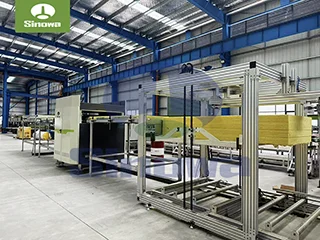
sandwich panel machine
The structure of a rock wool sandwich panel making machine with an automatic decoiling system is a complex integration of multiple functional modules, each contributing to the smooth progress of the production process. The automatic decoiling system is typically composed of an expansion and contraction drum, motor drive unit, induction bracket, and tension control device. The metal coil is vertically placed on the expansion and contraction drum, which is tightened by the motor to fix the coil securely. When the production line starts, the motor drives the drum to rotate, uncoiling the metal sheet gradually. The induction bracket is installed at the front end of the decoiler to control the start and stop of the uncoiling process automatically—when the uncoiled metal strip hangs down and touches the induction bracket, the decoiler stops; when the strip is pulled forward by the subsequent process and leaves the bracket, the decoiler resumes working. This automatic control ensures a stable supply of metal sheets to the next process without excessive accumulation or shortage. The tension control device adjusts the tension of the uncoiled metal sheet to prevent deformation, ensuring that the surface layer of the final panel is flat and smooth.
Following the automatic decoiling system is the roll forming module, which shapes the uncoiled metal sheets into the required profiles. This module usually includes upper and lower roll forming units with adjustable rolling shafts, allowing for the production of panels with different widths and profile designs within a specified range. The roll forming process applies gradual pressure to the metal sheets through a series of rolling shafts, transforming the flat sheets into corrugated or other structured surface layers that enhance the mechanical strength of the panels. After roll forming, the metal sheets enter the preheating system, which uses hot air circulation to heat the surface of the metal sheets to an optimal temperature for bonding with the rock wool core. Proper preheating ensures strong adhesion between the metal surface layers and the rock wool core, improving the overall structural stability of the sandwich panels.
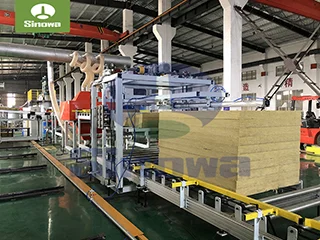
The rock wool processing module is another critical part of the machine structure, responsible for preparing and feeding the rock wool core layer. This module includes a rock wool lifting device, slitting device, turning device, glue spraying system, and dust collecting device. First, large rock wool slabs are lifted to the slitting device, which cuts them into strips of specified thickness according to the requirements of the final panel. The thickness of the rock wool strips can be adjusted to produce panels with different insulation performance. The turning device then adjusts the fiber direction of the rock wool strips to be vertical, which significantly increases the compressive strength and structural stability of the sandwich panel. The glue spraying system applies an appropriate amount of adhesive to both sides of the rock wool strips—usually polyurethane-based glue—to ensure firm bonding with the metal surface layers. The dust collecting device effectively removes dust generated during the rock wool slitting process, maintaining a clean production environment and protecting the health of operators.
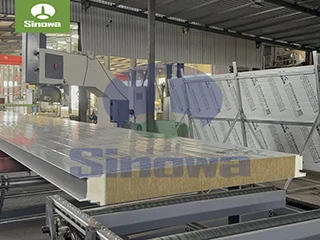
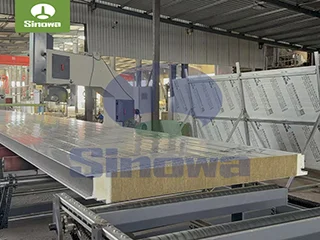
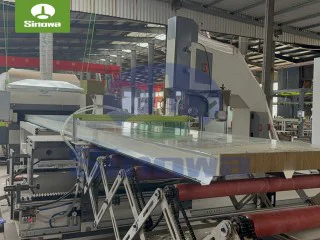
The composite lamination module is where the metal surface layers and rock wool core are combined. This module is equipped with a double belt conveyor system that applies uniform pressure to the composite structure as it moves forward. The double belts ensure that the metal layers and rock wool core are tightly bonded without gaps, which is essential for maintaining the thermal insulation and sound insulation performance of the panels. After lamination, the composite panel enters the cooling system, which uses air cooling or water cooling to solidify the adhesive and stabilize the structure of the panel. The cooling process ensures that the panel maintains its shape and dimensional accuracy, preventing deformation caused by residual heat. Finally, the cutting module uses a servo-controlled reciprocating cutting device to cut the continuous composite panel into pieces of specified length. The cutting process is carried out without stopping the production line, ensuring continuous operation and high production efficiency. The cutting accuracy is controlled by advanced PLC systems, ensuring that the length of each panel meets the required specifications with minimal tolerance.
The performance of rock wool sandwich panel making machines with automatic decoiling systems is characterized by high automation, efficiency, stability, and flexibility. High automation is achieved through the integration of PLC control systems, digital servo technology, and frequency conversion vector technology. The entire production line can be controlled by a single industrial computer, with man-machine interaction interfaces that allow operators to input production parameters such as panel thickness, width, length, and production speed. Once the parameters are set, the machine operates automatically, requiring only 5 to 8 operators to monitor the production process, load raw materials, and handle finished products. This level of automation significantly reduces labor costs and human errors, improving the consistency of product quality.
Production efficiency is another key performance indicator of these machines. The production speed is adjustable according to the product requirements, typically ranging from 3 to 8 meters per minute. For panels with a certain thickness, the production speed can reach even higher levels, enabling an annual production capacity of hundreds of thousands of square meters based on standard working days. The continuous production design, combined with the non-stop cutting technology, eliminates downtime between batches, maximizing production throughput. Energy efficiency is also an important performance feature—advanced frequency conversion technology and optimized mechanical design reduce energy consumption by a significant margin compared to traditional machines, lowering the overall production cost for enterprises.
Stability and precision are crucial for ensuring product quality. The automatic decoiling system with tension control maintains consistent feeding of metal sheets, preventing deformation and ensuring the flatness of the surface layers. The roll forming module uses high-precision rolling shafts and adjustable frames to produce profiles with accurate dimensions and uniform shape. The servo-controlled cutting system ensures that the length of each panel is precise, with tolerance within a small range. The glue spraying system applies adhesive in a uniform and controlled manner, ensuring strong bonding between the layers without excessive glue usage. These features collectively result in sandwich panels with consistent dimensions, flat surfaces, and reliable structural performance.
Flexibility is another important performance aspect, allowing the machine to produce a variety of rock wool sandwich panels to meet different application needs. The machine can accommodate metal coils of different materials, including color steel sheets, stainless steel sheets, and aluminum sheets, with thickness ranging from 0.35 to 0.8 millimeters and maximum width up to 1250 millimeters. The rock wool core thickness can be adjusted from 30 to 250 millimeters, enabling the production of panels with different thermal insulation levels. Additionally, some machines can be upgraded or equipped with optional components to produce composite panels with other core materials such as polyurethane (PU) or expanded polystyrene (EPS), expanding their application range.
Rock wool sandwich panel making machines with automatic decoiling systems can be classified into different types based on production mode, structural design, and functional characteristics. The most common classification is based on production mode, dividing the machines into continuous production lines and modular production lines. Continuous production lines are designed for large-scale, high-volume production, featuring a single integrated line that completes all processes from decoiling, roll forming, rock wool processing, lamination, cooling, cutting, to stacking and packing. These lines offer high production efficiency and consistent product quality, making them suitable for large manufacturing enterprises that supply panels in bulk for large-scale construction projects.
Modular production lines, on the other hand, consist of independent modules that can be combined or used separately according to production needs. Each module is designed for a specific process, such as decoiling, roll forming, rock wool slitting, or lamination. This design allows for greater flexibility, as enterprises can add or remove modules based on their production volume and product types. Modular lines are easier to install, maintain, and upgrade, making them suitable for small and medium-sized enterprises or those that produce a variety of panel types with varying specifications. They also require less initial investment compared to continuous lines, making them a cost-effective option for businesses with limited production capacity.
Another classification is based on the type of metal surface layer processing, dividing the machines into corrugated panel machines and flat panel machines. Corrugated panel machines produce panels with corrugated surface layers, which offer higher structural strength and are commonly used for roof panels or exterior wall panels that need to withstand wind and snow loads. Flat panel machines produce panels with flat surface layers, which are suitable for interior walls, clean rooms, cold storage, and other applications where a smooth surface is required. Some advanced machines are capable of producing both corrugated and flat panels by adjusting the roll forming modules, further enhancing their flexibility.
Additionally, machines can be classified based on the level of automation, ranging from semi-automatic to fully automatic. Semi-automatic machines require more manual intervention, such as manually loading metal coils, adjusting parameters, or handling finished products, while fully automatic machines integrate all processes with minimal human input. Fully automatic machines are equipped with advanced control systems, automatic stacking devices, and packing systems, enabling unattended operation for extended periods. They are ideal for large-scale production where efficiency and consistency are top priorities.
The applications of rock wool sandwich panels produced by these machines are extensive, covering construction, industrial, agricultural, and commercial sectors, thanks to their excellent performance characteristics. In the construction industry, rock wool sandwich panels are widely used for exterior walls, interior partitions, roof insulation, and fire isolation belts. Their thermal insulation property helps reduce building energy consumption by minimizing heat transfer between the interior and exterior, contributing to energy-efficient buildings. The fire resistance of rock wool—being non-combustible and capable of withstanding high temperatures—makes these panels an ideal choice for fire isolation zones in buildings, such as between floors, stairwells, and elevator shafts, helping to prevent the spread of fire and smoke.
Industrial buildings such as factories, warehouses, and workshops also extensively use rock wool sandwich panels. These buildings often require large-span structures with good insulation and sound insulation performance. Rock wool sandwich panels provide effective sound insulation, reducing noise pollution from machinery and equipment, creating a more comfortable working environment. Their structural strength enables them to be used for wall and roof cladding of industrial buildings, withstanding harsh industrial environments such as high humidity, temperature fluctuations, and chemical exposure. Additionally, the panels are easy to install, reducing construction time and costs for industrial projects.
Cold storage and refrigeration facilities are another important application area. Rock wool sandwich panels have excellent thermal insulation performance, maintaining stable internal temperatures in cold storage facilities while reducing energy consumption for refrigeration. The panels are also waterproof and moisture-proof, preventing condensation and ensuring the integrity of the insulation layer. They are used for the walls, roofs, and doors of cold storage facilities, as well as for refrigerated trucks and containers, ensuring the safe transportation and storage of perishable goods such as food, pharmaceuticals, and chemicals.
Agricultural buildings such as greenhouses, livestock barns, and poultry houses also benefit from the use of rock wool sandwich panels. The thermal insulation property helps maintain a stable internal temperature in greenhouses, extending the growing season for crops and improving yield. For livestock barns, the panels provide insulation to keep animals warm in cold weather and cool in hot weather, while their sound insulation property reduces noise stress on animals. The panels are also easy to clean and disinfect, making them suitable for agricultural environments where hygiene is important.
Commercial buildings such as shopping malls, office buildings, hospitals, and schools also use rock wool sandwich panels for interior partitions, ceiling panels, and exterior cladding. In hospitals, the fire resistance and sound insulation performance of the panels are crucial for ensuring patient safety and creating a quiet environment for recovery. In schools, the panels provide a safe and comfortable learning environment, with fire protection features that meet strict building codes. The aesthetic appearance of rock wool sandwich panels, available in a variety of colors and finishes, also makes them suitable for decorative purposes in commercial buildings.
Furthermore, rock wool sandwich panels are used in special applications such as clean rooms, data centers, and modular buildings. Clean rooms in pharmaceutical, electronic, and semiconductor factories require panels with smooth surfaces, no dust emission, and good airtightness—rock wool sandwich panels meet these requirements, ensuring a clean production environment. Data centers use the panels for thermal insulation and fire protection, protecting sensitive electronic equipment from temperature fluctuations and fire hazards. Modular buildings, which are prefabricated off-site and assembled on-site, rely on rock wool sandwich panels for their lightweight, high strength, and quick installation, enabling the rapid construction of temporary or permanent buildings such as construction site offices, disaster relief shelters, and temporary housing.
In conclusion, rock wool sandwich panel making machines with automatic decoiling systems are advanced production equipment that combines precision mechanics, automatic control, and material processing technology. Their rational structure design ensures stable and efficient production, while their excellent performance characteristics enable the production of high-quality rock wool sandwich panels with diverse specifications. The different types of machines cater to the varying needs of enterprises of different sizes and production requirements, from small modular lines to large continuous production lines. The extensive applications of the resulting panels across multiple sectors highlight the importance of these machines in modern construction and industrial production. As the demand for energy-efficient, fire-resistant, and environmentally friendly building materials continues to grow, rock wool sandwich panel making machines with automatic decoiling systems will play an increasingly important role, driving innovation and development in the composite panel industry.
https://www.cnsinowa.com/sandwich-panel-machines/rock-wool-sandwich-panel-making-machine-with-automatic-decoiling-system.html