sandwich panel line
The overall structural design of the roof-use rock wool sandwich panel production line follows the concept of modular integration and intelligent linkage, with each functional module closely connected and precisely coordinated to form a closed-loop production system. The whole line covers raw material storage and conveying, surface metal plate pretreatment and forming, rock wool core material processing and arrangement, automatic adhesive coating, high-precision composite pressing, constant temperature curing, fixed-length cutting, surface protection and finished product conveying and stacking. Every functional link is equipped with independent power regulation and precision control systems, which can realize synchronous operation and parameter linkage adjustment, effectively avoiding product quality differences caused by asynchronous operation of individual equipment. In addition, the production line is equipped with professional dust removal and environmental protection processing devices in the core material processing area, which can effectively collect scattered rock wool fibers and floating dust generated during production, maintain the cleanliness of the production environment, prevent fiber residue from affecting the bonding effect of subsequent processes, and also optimize the on-site operation conditions for production personnel.
Raw material pretreatment and feeding is the initial key stage that determines the basic quality of roof panels, mainly including the processing and feeding of surface metal decorative plates and internal rock wool insulation core materials. For the surface metal substrate, the rock wool sandwich panel line is equipped with an automatic uncoiling and leveling unit, which can stably release coiled metal raw materials and eliminate the internal mechanical stress of the metal plate through multi-group roller precision leveling treatment. This process effectively avoids the warping, bending and surface unevenness of the finished roof panel in subsequent use, ensuring the flatness and structural stability of the panel surface. After leveling, the metal plate will go through surface cleaning and preliminary finishing processes to remove oil stains, dust and oxide layers on the surface, creating a clean and flat bonding interface for subsequent adhesive coating, and greatly improving the bonding firmness between the metal surface layer and the rock wool core layer. Different from wall panels, the metal surface layer of roof panels needs special profiling treatment to form anti-slip and pressure-resistant structural lines, and the rolling forming unit of the production line can complete continuous one-time profiling according to the structural design requirements of roof panels, improving the overall rigidity and load-bearing capacity of the panel to adapt to outdoor wind pressure, snow pressure and other external loads.
The pretreatment process of rock wool core materials is the core link to ensure the thermal insulation, fireproof and sound insulation performance of roof panels. High-quality rock wool raw materials with excellent fiber uniformity and high bulk density are selected as the core insulation layer of roof panels, which has natural advantages in fire resistance, heat insulation and noise reduction. The rockwool sandwich panel production line is equipped with special core material cutting and arranging equipment, which can cut the whole rock wool raw material into uniform strip structures according to the preset thickness and width specifications. Different from ordinary sandwich panel production lines, the roof panel production line adopts cross-butted core material arrangement technology, which can effectively eliminate the gap and hollow phenomenon between rock wool strips, realize the seamless fitting of the overall core layer, and avoid the heat conduction and sound transmission loopholes caused by core material gaps. In the core material arrangement process, the equipment can automatically adjust the arrangement density and tightness of rock wool fibers according to the performance requirements of different roof panels, ensuring that the core layer maintains uniform density and stable structural performance, so that each batch of finished panels has consistent thermal insulation and fireproof effects.
Adhesive coating and composite bonding are the decisive processes for the overall structural firmness and service life of roof rock wool sandwich panels. The rock wool sandwich panel machine is equipped with a high-precision automatic glue spraying system, which adopts quantitative and uniform coating technology to spray high-performance environmental protection polymer adhesive on the inner surface of the upper and lower metal plates and the upper and lower surfaces of the rock wool core layer. The system can accurately control the glue coating amount and coating uniformity according to the plate thickness and production speed, avoiding quality problems such as insufficient bonding strength caused by too little glue and glue overflow and panel surface pollution caused by too much glue. The selected adhesive has the characteristics of fast curing speed, strong adhesion, aging resistance and weather resistance, which can form a stable and tough bonding layer after curing, firmly integrate the metal surface layer and rock wool core layer into an integral structure. Before composite pressing, the production line is also equipped with a preheating and pre-bonding unit, which can appropriately adjust the temperature of the bonding interface to accelerate the initial curing speed of the adhesive, enhance the preliminary bonding effect, and lay a foundation for subsequent high-pressure composite shaping.
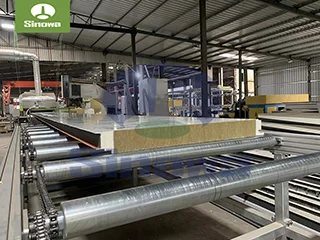
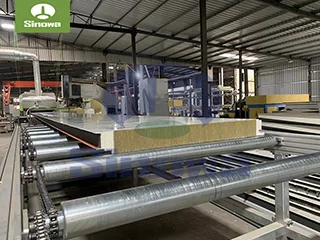
The composite pressing and constant temperature curing process is an important link to finalize the structural performance of roof panels. After the completion of glue coating and pre-bonding, the metal plate and rock wool core material enter the composite pressing unit synchronously for continuous high-pressure lamination. The pressing unit adopts multi-group hydraulic pressure regulation structure, which can provide stable and uniform pressing force, and the pressure value can be adjusted intelligently according to the thickness and specification of different roof panels to ensure that the internal structure of the panel is compact and free of gaps. Unlike indoor wall panels, roof panels need to withstand long-term outdoor environmental erosion, so the composite pressing process of the rock wool board production line focuses on improving the overall compactness and anti-separation performance of the panel. After pressing, the semi-finished panels will be sent to the constant temperature curing channel for continuous thermal insulation curing treatment. The closed constant temperature environment can make the adhesive fully cure and cross-link, maximize the bonding strength, and effectively improve the overall structural stability, anti-peeling performance and anti-aging ability of the panels. The curing time and temperature can be automatically matched by the system according to the production speed and panel specifications, ensuring that each panel achieves the best curing effect.
Fixed-length cutting and surface protection treatment are the finishing processes of finished panel production. After curing and shaping, the continuous integrated plate structure will be transported to the flying saw cutting unit for precise fixed-length cutting. The high-precision cutting system can realize automatic positioning and cutting according to the preset panel length, with extremely high cutting accuracy, ensuring that the end face of the panel is flat and smooth without burrs, and the size error is controlled within a tiny range, which facilitates the seamless docking and installation of on-site roof construction. After cutting, the roof sandwich panel production line is equipped with an automatic film covering device, which can attach a protective film on the outer surface of the roof panel to prevent scratches, abrasions and dust pollution during subsequent transportation, stacking and construction. This protective treatment effectively maintains the flatness and aesthetics of the panel surface, reduces the secondary repair work during construction, and improves the overall construction efficiency of the project.
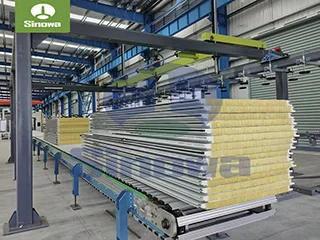
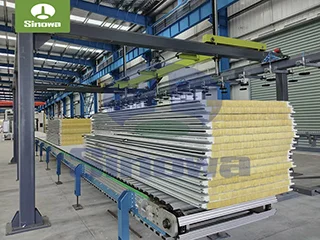
The automatic conveying and stacking system of the roof sandwich panel line realizes the intelligent finishing of finished products and effectively improves the overall production efficiency. The cut finished roof panels are automatically conveyed to the stacking platform through the roller conveying system, and the mechanical stacking device carries out orderly layered stacking according to the set stacking specifications. The whole process does not require manual intervention, which not only reduces the labor cost of production, but also avoids the panel damage and position deviation caused by manual handling. At the same time, the system is equipped with an automatic counting and sorting function, which can classify and stack panels of different specifications, facilitating subsequent warehouse management and outbound transportation. The matching linkage operation of all links of the entire production line realizes uninterrupted continuous production, greatly improves the unit time output, and is suitable for large-scale and batch production demands of roof panels in engineering projects.
In terms of production performance and product advantages, the roof rock wool sandwich panel produced by this professional production line has outstanding comprehensive performance compared with traditional building roof materials. Relying on the high-quality rock wool core material and seamless composite process, the panel has excellent fireproof performance, which can effectively block the spread of flame and meet the fire protection requirements of various industrial and civil buildings. Its unique fiber porous structure gives the panel good thermal insulation and heat preservation performance, which can effectively isolate the external high temperature and low temperature, reduce the temperature difference change inside the building, and achieve the effect of energy saving and consumption reduction. In terms of mechanical performance, the integrally pressed composite structure makes the panel have high bending resistance and compression resistance, which can adapt to harsh outdoor weather conditions such as strong wind, heavy snow and rain erosion, and will not be deformed or damaged after long-term use.
In addition, the rockwool panel production line has strong production flexibility and can meet the diversified production demands of roof panels. By adjusting the operating parameters of each module, the equipment can produce roof panels of different thicknesses, lengths, widths and structural profiles, covering the specification requirements of most building roof projects. The produced panels have the characteristics of light weight and high strength, which can reduce the self-weight of the building roof structure, reduce the load-bearing pressure of the building main body, and further reduce the overall construction cost of the project. At the same time, the standardized and integrated production mode makes the quality of finished panels more stable, avoids the performance inconsistency of handmade panels, and improves the overall quality level of building roof enclosure structures.
In terms of equipment operation and maintenance, the modular design of the rockwool sandwich panel machine brings great convenience to daily use and later maintenance. Each functional module is relatively independent, which can realize targeted inspection, maintenance and replacement of parts without affecting the normal operation of other equipment units. The intelligent control system adopts intuitive operation interface and automatic fault detection function, which can monitor the operating state, production parameters and equipment operation data of the whole line in real time. Once abnormal operation or parameter deviation occurs, the system will automatically trigger prompt and protection measures, effectively reducing the failure rate of equipment and improving the stability and continuity of production. The key moving parts of the equipment are equipped with wear-resistant and anti-corrosion protection structures, which extend the service life of the equipment and reduce the long-term operation cost of the production line.
With the continuous improvement of modern building energy-saving standards and building safety requirements, the market demand for high-performance fireproof and thermal insulation roof panels is increasing day by day, and the professional rock wool sandwich panel manufacturing line for roof has become an indispensable key equipment in the field of building enclosure material production. Its automated, high-precision and high-efficiency production characteristics not only improve the production level of roof insulation panels, but also provide reliable material guarantee for the safety, energy saving and durability of modern building roof structures. In the future, with the continuous upgrading of building industrialization and green building concepts, this type of sandwich panel production equipment will further develop towards higher intelligence, more energy-saving operation and more diversified production, continuously optimizing the production process and product performance, and providing more high-quality and efficient solutions for the construction of modern green buildings.
https://www.cnsinowa.com/sandwich-panel-machines/rock-wool-sandwich-panel-production-line-for-roof.html