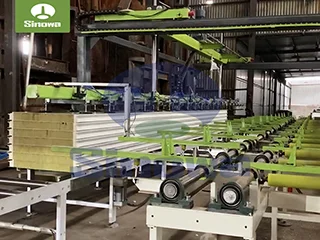
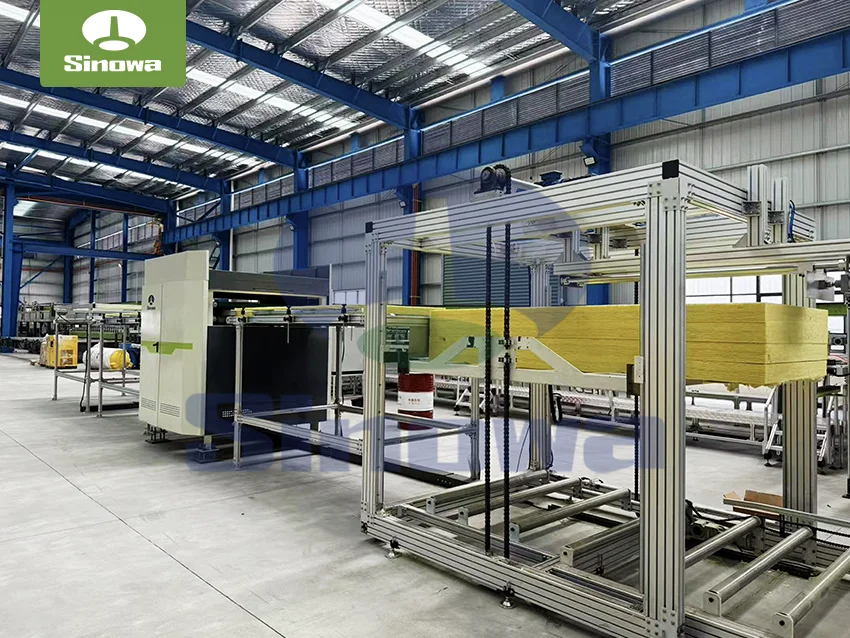
 sandwich panel line
The core advantage of the environmental-friendly rock wool board production line lies in its scientific and low-consumption raw material matching and pretreatment system. The main raw materials for rock wool production are natural inorganic ores such as basalt, dolomite and quartz sand, which are abundant in reserves, non-toxic and harmless, and will not produce harmful substances during mining and subsequent processing, laying a natural green foundation for the final products. The production line is equipped with intelligent crushing, screening and proportioning modules, which can crush bulk raw ores into uniform granular materials with precise particle size control. Through automated weighing and mixing equipment, various raw materials and auxiliary materials are blended in optimal proportions, avoiding raw material waste caused by uneven mixing in traditional manual batching processes. This refined pretreatment mode not only ensures the stability and consistency of subsequent fiber forming quality, but also maximizes the utilization rate of natural ores, reducing the waste of mineral resources from the source. All raw material conveying links adopt fully closed pipeline and belt conveying structures, which completely avoid dust overflow and air pollution caused by open material handling in traditional production modes, maintaining a clean and low-pollution production environment.
High-temperature melting is the key core link of rock wool board production, and the environmental-friendly rock wool sandwich panel production line has achieved comprehensive energy-saving and emission reduction upgrades in this process. The system adopts a closed high-temperature melting furnace with optimized structural design and heat preservation performance, which can heat mixed raw materials to a stable high-temperature state ranging from 1350 to 1500 degrees Celsius to completely melt solid ores into uniform magma. Compared with traditional open melting furnaces, the closed furnace body greatly reduces heat loss, effectively improving thermal energy utilization efficiency and cutting down overall energy consumption per unit of product. Meanwhile, the production line is equipped with a professional flue gas waste heat recovery system, which can collect and reuse the high-temperature waste heat generated during the melting process. The recovered waste heat is applied to raw material preheating, workshop heating and other production links, forming an internal energy circulation system and further reducing the reliance on external energy input. In terms of flue gas treatment, the supporting purification system can effectively filter and purify tiny particulate matter and residual impurities in exhaust gas, ensuring that all exhaust emissions meet environmental discharge standards, eliminating air pollution problems inherent in traditional rock wool production.
The fibrosis process determines the structural performance and quality of rock wool fibers, and the environmental-friendly rock wool sandwich panel line adopts high-speed centrifugal fibrosis technology with high efficiency and low energy consumption. The high-temperature magma flowing out of the melting furnace is evenly delivered to high-speed centrifugal fiber spinning equipment, which uses high-speed rotating mechanical force to stretch and throw the magma into fine and uniform inorganic fibers. The whole fibrosis process is completed in a fully enclosed space, which not only avoids the splashing of high-temperature magma and potential safety hazards, but also prevents the diffusion of fine fiber dust. By adjusting the operating parameters of centrifugal equipment, the production line can stably control the fiber diameter and length distribution, enabling the formed rock wool fibers to have uniform texture, high toughness and good fluffy structure. This precise fiber forming effect not only improves the thermal insulation and sound absorption performance of the final rock wool board, but also reduces unqualified fiber products generated in the production process, indirectly reducing material waste and energy loss caused by rework.
After the fibrosis process, the rock wool sandwich panel machine carries out quantitative cotton laying, bonding and shaping treatment through an automated continuous operation system. The scattered rock wool fibers are evenly spread into continuous fiber cotton layers through a precise pendulum cotton laying mechanism, which ensures uniform thickness and consistent density of the cotton layer in the horizontal and vertical directions. In the bonding link, the production line selects eco-friendly water-based adhesives and hydrophobic agents for spraying treatment, abandoning traditional chemical additives that may contain harmful components. The selected auxiliary materials have stable chemical properties, no volatile harmful substances, and will not cause secondary pollution to the environment during production and use. The adhesive is sprayed quantitatively and evenly according to product specifications, which can firmly bond loose fibers into an integral structure while controlling the usage amount of auxiliary materials to avoid excessive additive residue and waste. The treated fiber cotton layer is then sent to the pressing and folding module for directional compaction and shaping, adjusting the compactness of the cotton layer according to different product requirements to meet the performance needs of various application scenarios.
The curing and forming system is an important link to finalize the structural stability of rock wool boards, and the environmental-friendly rockwool sandwich panel production line realizes precise temperature and time control in this stage. The pressed fiber wool layer is transported to a constant-temperature curing furnace through an automatic conveying system, where the internal temperature is stably controlled between 180 and 220 degrees Celsius. Through circulating hot air heating technology, the heat in the furnace is evenly distributed, enabling the adhesive to undergo full cross-linking and curing reactions within a fixed time. This intelligent curing mode ensures that the internal fiber structure of the rock wool board is tightly combined and stable in shape, effectively improving the overall mechanical strength and structural durability of the product. The curing furnace is equipped with a heat circulation and heat preservation device, which minimizes heat loss during operation and maintains low energy consumption in the curing process. After curing, the semi-finished rock wool board is cooled through a natural air cooling and circulating cooling system, avoiding rapid cooling deformation while making full use of circulating air flow to improve cooling efficiency, without consuming additional cooling energy.
The finishing and processing stage of the rockwool panel production line fully embodies the concept of circular environmental protection and refined production. The cooled rock wool board blanks are sent to the automatic cutting system, which carries out longitudinal and transverse fixed-size cutting according to preset product specifications to produce rock wool boards of standard sizes. The cutting process is efficient and precise, with smooth and neat product edges, effectively reducing the generation of defective products. More importantly, the production line is equipped with a complete waste recycling and reprocessing system. The leftover materials, edge materials and tiny fiber wastes generated in the cutting and shaping process are automatically collected, crushed and screened, and then re-transported to the raw material batching link for secondary utilization. This closed-loop waste recycling mode realizes zero waste discharge in the production process, greatly improving the comprehensive utilization rate of raw materials and reducing the resource waste and environmental pressure caused by production waste. After cutting and screening, qualified finished products are automatically stacked and packaged by intelligent equipment, with the whole process free of manual contact, reducing human error and improving production efficiency while maintaining a clean finished product environment.
In terms of overall operation and energy management, the environmental-friendly rockwool board production line adopts a full-process automated intelligent control system. The entire production process from raw material feeding, melting, fibrosis, cotton laying, curing to cutting and packaging is controlled by a centralized intelligent system, which can monitor production parameters such as temperature, speed, material flow and energy consumption in real time. The system can automatically adjust operating parameters according to production load and product specifications, always maintaining the optimal operating state of each module, avoiding energy waste caused by unreasonable parameter setting in manual operation. In addition, the production line is designed with low-noise operation structures for all mechanical equipment, and is equipped with shock absorption and noise reduction devices, which effectively reduce production noise pollution and improve the working environment of the production workshop. The modular integrated design of the whole production line not only simplifies the equipment structure, facilitates daily maintenance and overhaul, but also reduces the space occupation of the production line, improving the utilization rate of factory land resources.
The popularization and application of environmental-friendly rock wool sandwich panel production machine has far-reaching significance for promoting the green upgrading of the building materials industry and the development of low-carbon construction. Traditional rock wool production processes have problems such as high energy consumption, large dust emission and low resource utilization rate, which restrict the sustainable development of the industry. The new environmental-friendly production line fundamentally solves these industry pain points through technological innovation and process optimization. It not only reduces the comprehensive energy consumption and pollutant emission of the production process, but also improves the yield and quality stability of rock wool products. The rock wool boards produced by this line are pure inorganic green building materials, which do not release toxic and harmful gases during long-term use, have good fire resistance, thermal insulation and sound insulation effects, and can effectively reduce the energy consumption of building operation, helping to realize the energy-saving and low-carbon goals of buildings.
With the continuous improvement of global environmental protection policies and the continuous upgrading of green building standards, the market demand for high-quality and low-carbon environmental-friendly building insulation materials is increasing day by day. The environmental-friendly rock wool board production line, as a representative of green and intelligent manufacturing equipment in the building materials industry, will continue to play an important role in industrial upgrading. Its closed-loop production mode, efficient energy-saving performance and zero-discharge environmental protection effect conform to the development trend of circular economy and green industrialization. In the future, with the continuous iteration of production technology, such production lines will further realize intelligent energy-saving optimization, more precise resource allocation and more efficient waste recycling, providing more reliable and environmentally friendly production guarantees for the manufacturing of high-performance rock wool insulation materials, and contributing more strength to the construction of low-carbon buildings and the sustainable development of the environmental protection building materials industry.
https://www.cnsinowa.com/sandwich-panel-machines/environmental-friendly-rock-wool-board-production-line.html