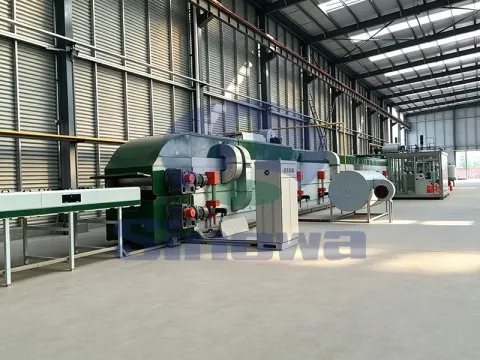
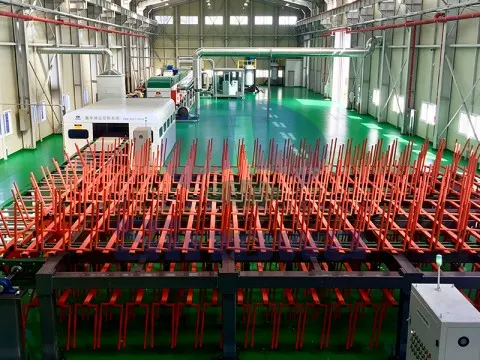
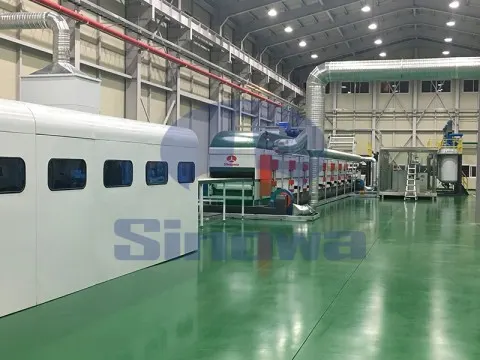
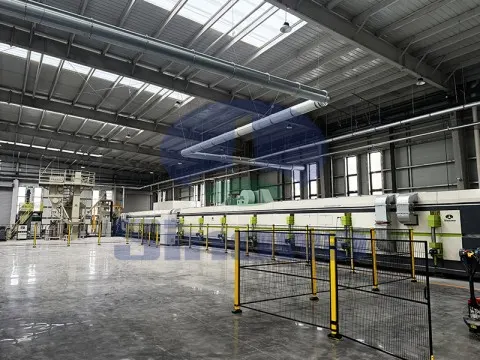
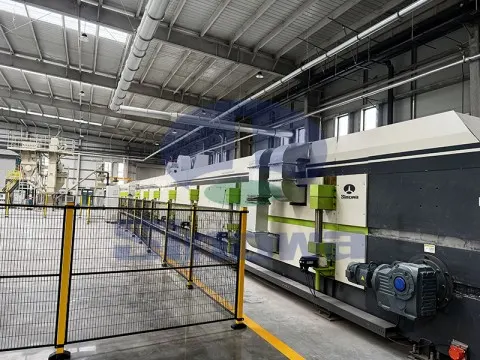
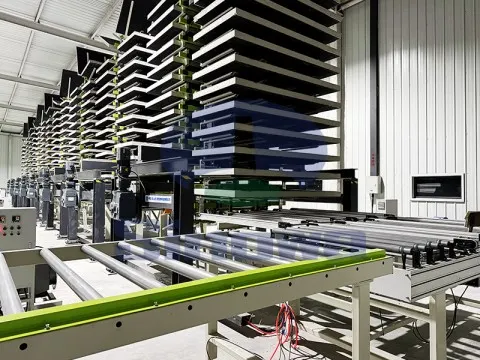
sandwich panel line
To fully grasp the significance of the rockwool sandwich panel production line, it is critical to first understand the inherent properties of the core materials that form the finished product. The primary insulating core is crafted from natural volcanic rock and mineral aggregates, which are processed into fine, resilient fibers through high-temperature melting and centrifugal fiberization. This mineral wool core is inherently non-combustible, withstanding extreme temperatures without melting, dripping, or releasing toxic fumes, a trait that sets it apart from organic insulation alternatives. It also boasts superior thermal insulation capabilities, minimizing heat transfer between indoor and outdoor environments to reduce energy consumption for heating and cooling year-round, and exceptional sound absorption properties, mitigating airborne and impact noise to enhance indoor comfort. Complementing this core are the outer metal facing layers, typically corrosion-resistant metal sheets selected for their structural rigidity, weather resistance, and ease of fabrication. These layers act as a protective barrier, shielding the mineral wool core from moisture, physical damage, and environmental degradation, while also adding structural strength to the panel, allowing it to bear loads and serve as both insulation and building envelope material. The synergy between these two material types is what makes rockwool sandwich panels so versatile, and the production line is meticulously designed to preserve and enhance this synergy at every stage of manufacturing.
The rockwool sandwich panel production line operates as a continuous, streamlined workflow, eliminating manual bottlenecks and ensuring consistent quality across every panel produced. The process commences with the raw material preparation and feeding stage, a foundational step that sets the tone for the entire production run. For the metal facing layers, large coils of corrosion-resistant metal are loaded onto automated decoiling stations, which unwind the metal sheets smoothly and feed them into precision leveling and roll forming machines. These machines straighten any imperfections in the metal coils, remove surface residues, and shape the edges of the sheets to create uniform, interlocking profiles that enable seamless panel installation on-site. Concurrently, the mineral wool core material is prepared in a dedicated processing module: pre-formed mineral wool boards, cut to precise thickness and density specifications, are conveyed through a conditioning station to ensure optimal moisture content and dimensional stability, preventing warping or shrinkage in the final product. This parallel processing of core and facing materials maximizes production efficiency, ensuring that both components are ready for bonding at exactly the right time, without delays or material waste.
Following raw material preparation, the production line advances to the adhesive application and laminating stage, the most critical phase in creating a durable, high-performance sandwich panel. A specialized, automated adhesive dispensing system applies a uniform, controlled layer of high-strength bonding adhesive to the inner surfaces of the metal facing sheets. The adhesive is formulated to create a permanent, flexible bond between the metal and mineral wool core, resisting delamination even under thermal expansion, contraction, and mechanical stress over decades of use. The dispensing system is calibrated with micrometer-level precision, ensuring that adhesive coverage is consistent across the entire surface of the metal sheets—no excess adhesive that could seep into the mineral wool and compromise its insulating properties, and no insufficient coverage that would weaken the bond. Once the adhesive is applied, the conditioned mineral wool core is precisely positioned between the upper and lower metal facing sheets, with automated alignment mechanisms guaranteeing perfect centering and edge uniformity. The layered assembly then enters a continuous laminating press, where controlled heat and pressure are applied to activate the adhesive, cure the bond, and compress the panel to the specified thickness. This laminating process is tightly regulated, with real-time monitoring of temperature, pressure, and dwell time to ensure full adhesion and structural integrity, while also maintaining the porous structure of the mineral wool core to preserve its thermal and acoustic performance.
After the lamination and bonding process is complete, the semi-finished sandwich panels move through the curing and shaping module, a stage designed to lock in the panel’s structural stability and dimensional accuracy. The panels travel through a temperature-controlled curing oven, where the bonded assembly is heated gently to accelerate the full curing of the adhesive, ensuring that the bond reaches maximum strength and durability. Unlike rapid, high-heat curing that can damage the mineral wool core or warp the metal facings, the controlled curing process in this production line balances speed and material preservation, optimizing curing time without compromising panel quality. Exiting the curing oven, the panels pass through a series of precision shaping and trimming stations, which refine the panel edges, cut notches or openings as required for custom applications, and ensure that every panel adheres to strict dimensional tolerances. This automated trimming eliminates human error, ensuring that each panel fits perfectly with adjacent panels during installation, reducing on-site waste and labor costs. The production line’s flexibility allows for the manufacturing of panels in a wide range of thicknesses, widths, and lengths, catering to diverse project requirements from wall insulation and roof cladding to partition walls and industrial equipment enclosures.
The final stages of the production line focus on quality assurance, cutting, and automated handling, wrapping up the manufacturing process with rigorous checks and efficient logistics. Continuous in-line quality inspection systems monitor every panel for defects, including surface imperfections, uneven bonding, dimensional deviations, and core density inconsistencies. These systems use advanced sensing technology to detect even minor flaws that could impact performance, diverting non-conforming panels for rework or recycling to maintain zero-defect production standards. Once inspected and approved, the panels are fed into a high-precision cross-cutting system, which cuts the continuous panel strip into custom lengths based on pre-programmed specifications. The cutting system operates seamlessly with the production line’s speed, ensuring clean, burr-free cuts without disrupting the continuous workflow. Finished panels are then automatically stacked, sorted, and prepared for packaging and storage, with automated handling equipment minimizing physical handling and reducing the risk of damage during transit. This end-to-end automation not only boosts production output but also enhances workplace safety by reducing manual labor in heavy lifting and high-precision tasks.
Beyond its core manufacturing functions, the rockwool sandwich panel production line is engineered with operational efficiency and sustainability at its core, addressing key challenges in modern industrial production. The line is equipped with an intelligent central control system, typically powered by advanced programmable logic controller technology, which integrates all production modules into a single, cohesive operation. Operators can monitor and adjust every process parameter in real time—from decoiling speed and adhesive flow to curing temperature and cutting length—via a user-friendly interface, enabling quick adjustments for different panel specifications and minimizing downtime during product changeovers. This digital control also facilitates data tracking and production analytics, allowing manufacturers to optimize workflow, reduce energy consumption, and identify opportunities for continuous improvement. Additionally, the production line incorporates eco-friendly design features, such as dust collection systems to capture mineral wool fibers and metal particles during processing, waste recycling mechanisms to repurpose scrap metal and mineral wool, and energy-efficient heating and motor systems to lower overall carbon emissions. These sustainable practices align with global environmental regulations and corporate sustainability goals, making the production line not only a high-performance manufacturing tool but also a responsible choice for green industrial operations.
The versatility of the rockwool sandwich panels produced by this line extends far beyond basic thermal insulation, making it a cornerstone material across countless sectors. In commercial construction, these panels are widely used for exterior wall cladding, roof insulation, and partition walls in office buildings, shopping malls, and hospitals, providing reliable fire protection, energy efficiency, and noise reduction. In industrial settings, they serve as insulation for warehouses, manufacturing facilities, and cold storage units, maintaining stable internal temperatures, resisting fire hazards, and withstanding harsh industrial conditions. For infrastructure projects, including transportation hubs, power plants, and industrial pipelines, the panels offer durable insulation that can endure extreme weather, mechanical stress, and long-term wear. Even in residential construction, the panels are gaining traction for their ability to enhance home energy efficiency, improve indoor acoustic comfort, and boost fire safety, addressing key concerns for homeowners and builders alike. Unlike specialized insulation products that serve only a single purpose, rockwool sandwich panels adapt to diverse applications, and the production line’s modular design allows for quick reconfiguration to produce panels tailored to each unique use case, from thin, lightweight interior panels to thick, heavy-duty industrial insulation panels.
As the global construction industry continues to prioritize energy efficiency, fire safety, and sustainable building materials, the rockwool sandwich panel production line is poised to play an even more pivotal role in the insulation sector. Ongoing advancements in manufacturing technology are further enhancing the line’s capabilities, with innovations such as AI-driven process optimization, self-adjusting production modules, and enhanced material processing techniques pushing the boundaries of panel quality, production speed, and customization. Manufacturers are also focusing on refining material formulations to create mineral wool cores with even higher thermal efficiency and lower environmental impact, paired with metal facings that offer superior corrosion resistance and weatherability. Additionally, the growing emphasis on circular economy principles is driving further improvements in the production line’s waste reduction and recycling capabilities, ensuring that the manufacturing process is as sustainable as the end product.
In conclusion, the rockwool sandwich panel production line is far more than a manufacturing system—it is a critical enabler of high-performance, sustainable insulation solutions that meet the evolving needs of the modern built environment. By seamlessly integrating material science, automated engineering, and process optimization, this production line transforms raw natural resources into insulation panels that deliver unmatched thermal, acoustic, fire, and structural performance. Its ability to produce consistent, high-quality panels at scale, while prioritizing efficiency, safety, and sustainability, makes it an indispensable asset for manufacturers worldwide. As demand for energy-efficient, fire-safe, and durable building materials continues to rise, the rockwool sandwich panel production line will remain at the forefront of the insulation industry, driving innovation and supporting the global transition to greener, more resilient construction practices. Every panel produced by this line represents a commitment to quality, performance, and sustainability, making a tangible impact on energy conservation, building safety, and indoor comfort across the globe.
Sinowa is a professional manufacturer of sandwich panel machine in china, we provide diversified and high-performance sandwich panel production lines, including fully automatic continuous PU sandwich panel line and customized special lines to meet mass production and personalized order demands. These sandwich panel lines support processing multiple foam core materials, such as PU, PIR, mineral wool, rock wool and glass wool, covering different insulation and fireproof standards.
Featuring stable operation, high efficiency, energy saving and easy maintenance, our PU sandwich panel line deliver sandwich panels with excellent thermal insulation, fire resistance, sound insulation and lightweight durability. The finished panels are widely applied in industrial workshops, warehouse roofing and wall cladding, cold storage insulation, serving global construction and industrial insulation markets.
https://www.cnsinowa.com/sandwich-panel-machines/rockwool-sandwich-panel-production-line-for-insulation-system.html