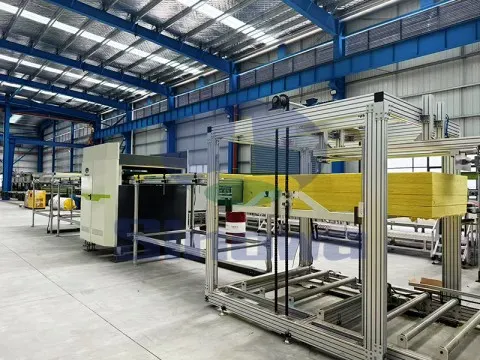
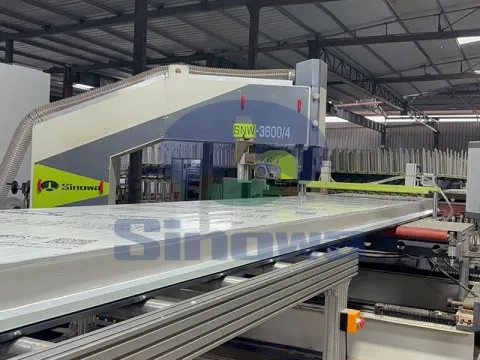
sandwich panel line
Modular building is defined by its emphasis on standardized design, factory prefabrication, rapid on-site assembly, and recyclable components, which sets strict benchmarks for the materials used in its construction. Rock wool sandwich panels, composed of rigid metal face sheets and a dense rock wool core, are inherently compatible with these requirements, offering a unique blend of structural stability, thermal insulation, fire resistance, and sound absorption—properties that are indispensable for residential, commercial, and industrial modular buildings alike. The production line dedicated to these panels is engineered to cater specifically to the dimensional precision, performance consistency, and batch production needs of modular construction, eliminating the inconsistencies and quality fluctuations associated with manual or semi-automated manufacturing. Every stage of the production line is calibrated to ensure that each panel adheres to uniform specifications, whether in terms of thickness, width, flatness, or core density, laying a solid foundation for the seamless splicing and stable assembly of modular building units.
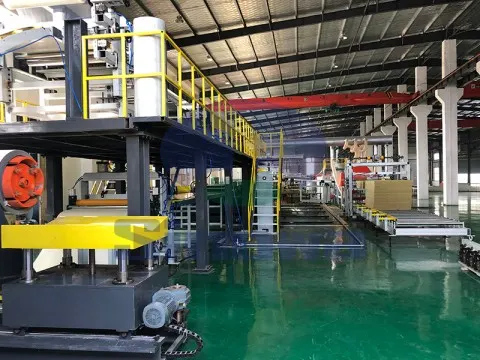
The operational flow of the rock wool sandwich panel production line for modular building is a meticulously orchestrated sequence of processes, each designed to optimize efficiency and uphold material integrity, with no room for errors that could compromise the performance of modular structures. The process commences with the unwinding and pretreatment of metal coil raw materials, which serve as the outer and inner face sheets of the sandwich panels. These metal coils are fed into the line through automated unwinding units, which smoothly release the material while maintaining consistent tension to prevent warping or damage. Following unwinding, the metal sheets undergo a precision roll-forming process, where specialized forming rollers shape the flat coils into profiled sheets with standardized edges and contours—profiles that are precisely matched to the splicing and connection needs of modular building modules. This roll-forming stage is governed by advanced control systems that adjust roller pressure and speed in real time, ensuring that every formed sheet maintains identical dimensions and structural rigidity, a non-negotiable requirement for modular construction’s modular coordination.
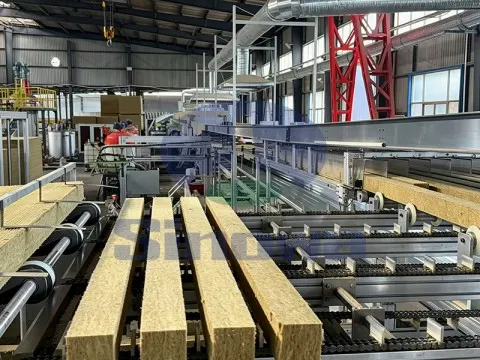
Once the metal face sheets are formed, the production line moves to the core material handling and composite bonding stage, which is the cornerstone of the rock wool sandwich panel’s performance. Rock wool, a non-combustible inorganic material made from natural volcanic rock and industrial slag, is processed into uniform core boards with consistent density and thickness before being integrated into the line. Automated handling systems carefully position these rock wool core boards onto the lower metal face sheet, ensuring full coverage, even distribution, and no gaps or misalignment—defects that would undermine the panel’s thermal and fire-resistant properties in modular buildings. Simultaneously, a precision adhesive coating system applies a uniform layer of high-performance bonding adhesive to the contact surfaces of both the lower face sheet and the rock wool core, as well as the upper face sheet. The adhesive application is tightly controlled to avoid excess glue that could seep into the core or insufficient glue that weakens bonding, striking a balance that ensures long-term adhesion between the metal sheets and the rock wool core even under the variable environmental conditions modular buildings may face.
The composite pressing and curing stage that follows is vital for consolidating the sandwich structure and locking in the panel’s mechanical and functional properties. The layered assembly—lower metal face sheet, rock wool core, upper metal face sheet—passes through a continuous double-belt pressing system, which applies controlled temperature and pressure across the entire surface of the panel. This uniform pressing eliminates air pockets between the layers, compacts the rock wool core to the designed density, and activates the bonding adhesive to achieve a permanent, robust bond between the three layers. The temperature and pressure parameters are dynamically adjusted based on the panel thickness, core density, and production speed, ensuring thorough curing without damaging the rock wool’s fibrous structure or the metal face sheets’ surface finish. After pressing and initial curing, the panels proceed through a controlled cooling and shaping section, where they stabilize at ambient temperature, retaining their flatness and dimensional accuracy. This stability is critical for modular building, as even minor warping or distortion can hinder the assembly of modular units and compromise the overall structural integrity of the finished building.
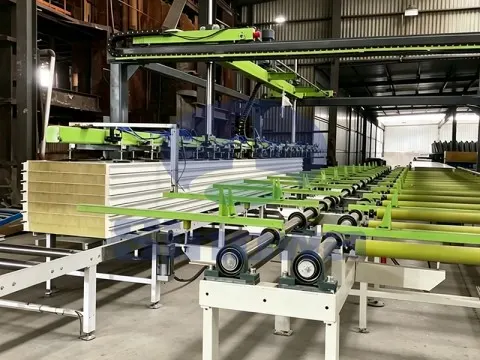
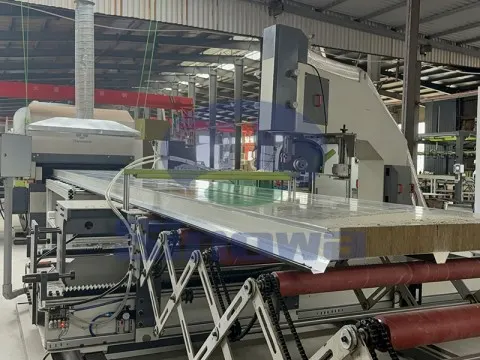
Subsequent processes in the production line focus on precision finishing and automated handling, further aligning the panels with modular building requirements. A high-precision cutting system, equipped with advanced tracking and positioning technology, trims the continuous panels into fixed lengths or custom sizes specified by modular building designs, ensuring clean, burr-free edges that facilitate seamless connection between adjacent panels and modules. The cutting operation is synchronized with the line’s production speed to maintain continuous operation and avoid production bottlenecks, supporting the high-efficiency batch production that modular construction demands. After cutting, the finished panels undergo automated quality inspection, where visual and mechanical checks are performed to screen for defects such as surface scratches, core gaps, bonding failures, or dimensional deviations. Qualified panels are then automatically stacked and palletized, ready for storage or direct delivery to modular assembly factories, while defective panels are diverted for reprocessing or recycling, minimizing material waste and upholding production quality standards.
Beyond the core production processes, the rock wool sandwich panel production line for modular building is equipped with intelligent control and operational optimization systems that elevate its efficiency and adaptability. A centralized programmable logic control (PLC) system serves as the brain of the line, integrating data from every processing stage, monitoring operational parameters in real time, and adjusting equipment performance to maintain stable production. Operators can set production specifications, adjust process parameters, and view production progress through a user-friendly human-machine interface, simplifying operation and reducing the risk of human error. The control system also supports flexible production switching, allowing the line to quickly adapt to different panel specifications, thicknesses, and profiles to meet the diverse design needs of modular buildings—from wall panels and roof panels to partition panels for various modular structures. This flexibility is essential in the modular building industry, where project requirements vary widely, and customized panel solutions are often needed to fulfill architectural and functional designs.
The synergy between the rock wool sandwich panel production line and modular building extends far beyond manufacturing efficiency, deeply impacting the overall performance and sustainability of modular structures. Rock wool sandwich panels produced by this dedicated line offer exceptional thermal insulation, reducing heat transfer between the interior and exterior of modular buildings and lowering energy consumption for heating and cooling throughout the building’s lifecycle. This energy efficiency aligns with the global push for green and low-carbon construction, making modular buildings equipped with these panels more environmentally friendly and cost-effective to operate. Additionally, the non-combustible nature of the rock wool core grants the panels superior fire resistance, a critical safety feature for modular buildings, especially those used for residential or public purposes. The dense fibrous structure of rock wool also delivers excellent sound absorption, minimizing noise transmission between modules and creating a quieter, more comfortable indoor environment—an increasingly important consideration for modern modular building users.
Structurally, the panels manufactured by the line exhibit high compressive and flexural strength, capable of bearing the loads imposed on modular building walls, roofs, and floors. This structural reliability ensures that modular units are sturdy and durable, resistant to deformation, wind, and minor seismic activity, and able to maintain long-term structural stability even in diverse geographic and climatic conditions. The smooth, durable metal face sheets are resistant to corrosion, moisture, and wear, reducing the need for frequent maintenance and extending the service life of modular buildings. Moreover, the standardized, factory-produced panels minimize on-site material waste and construction time, as they can be quickly assembled into modular units without extensive on-site processing. This not only accelerates project delivery but also reduces the environmental footprint of construction, further enhancing the sustainability credentials of modular building projects.
In the broader context of the modern construction industry’s evolution, the rock wool sandwich panel production line tailored for modular building represents a pivotal advancement in industrialized construction. As governments and construction stakeholders worldwide prioritize efficient, sustainable, and high-quality building solutions, modular building continues to gain traction as a viable alternative to traditional construction, driving the demand for reliable, high-performance prefabricated materials. This dedicated production line addresses this demand head-on, scaling up the production of rock wool sandwich panels while maintaining uncompromising quality and consistency, thereby supporting the large-scale popularization of modular building. It bridges the gap between material manufacturing and modular construction, fostering a more integrated, efficient, and standardized industrial chain that benefits manufacturers, construction firms, and end-users alike.
The ongoing optimization and technological upgrading of these production lines further reinforce their value in the modular building sector. Continuous innovations in roll-forming precision, adhesive technology, intelligent control, and automated handling are enhancing production efficiency, reducing energy consumption, and expanding the range of panel specifications that can be produced. These advancements enable the production line to keep pace with the evolving needs of modular building, from lightweight residential modules to heavy-duty industrial modular structures, and from standard commercial modules to specialized modular facilities. As the modular building industry continues to mature and expand, the rock wool sandwich panel production line will remain an indispensable piece of infrastructure, driving the development of high-performance, sustainable modular buildings and shaping the future of the global construction industry.
In summary, the rock wool sandwich panel production line for modular building is a testament to the integration of advanced manufacturing technology and modern construction needs. It combines efficient, automated production processes with strict quality control, delivering standardized, high-performance rock wool sandwich panels that are perfectly suited to the unique requirements of modular construction. By enhancing production efficiency, ensuring material consistency, and boosting the performance and sustainability of modular buildings, this production line plays a vital role in promoting the industrialization, greening, and intelligentization of the construction industry. As modular building continues to redefine how we construct and inhabit spaces, the dedicated production line for rock wool sandwich panels will continue to evolve and innovate, providing reliable material support for the growth of the modular building sector and contributing to the development of a more efficient, sustainable, and resilient built environment for generations to come.
Sinowa is a professional manufacturer of sandwich panel machine in china, we provide diversified and high-performance sandwich panel production lines, including fully automatic continuous PU sandwich panel line and customized special lines to meet mass production and personalized order demands. These sandwich panel lines support processing multiple foam core materials, such as PU, PIR, mineral wool, rock wool and glass wool, covering different insulation and fireproof standards.
Featuring stable operation, high efficiency, energy saving and easy maintenance, our PU sandwich panel line deliver sandwich panels with excellent thermal insulation, fire resistance, sound insulation and lightweight durability. The finished panels are widely applied in industrial workshops, warehouse roofing and wall cladding, cold storage insulation, serving global construction and industrial insulation markets.
https://www.cnsinowa.com/sandwich-panel-machines/rock-wool-sandwich-panel-production-line-for-modular-building.html