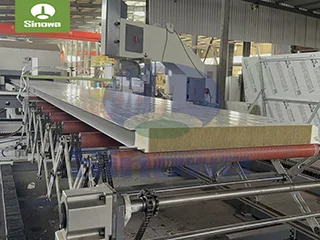
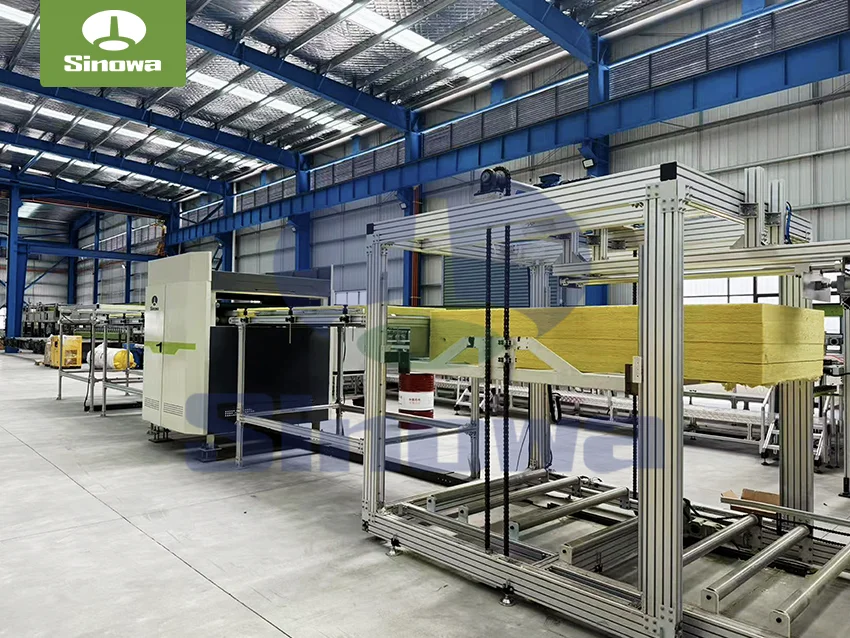
 sandwich panel line
The entire production process starts with scientific raw material pretreatment, which is the primary link to ensure stable product quality and consistent production progress. Natural hard rocks with stable chemical composition and excellent high-temperature resistance serve as the basic raw materials, which need to undergo systematic crushing, screening, drying and impurity removal before entering the melting link. The automated feeding and metering system precisely controls the proportion of different raw materials, maintaining a stable material ratio throughout the production process and effectively avoiding performance fluctuations caused by raw material proportion deviation. The optimized silo structure and conveying equipment ensure smooth and uniform material transportation, eliminating material accumulation and blockage problems that may affect continuous production. Through fine pretreatment, the particle size and moisture content of raw materials are kept within a reasonable and fixed range, which creates uniform material conditions for subsequent high-temperature melting and fiber forming, and fundamentally reduces the probability of defective products in continuous production.
High-temperature melting is the core thermal processing link of the rock wool sandwich panel production line, determining the fineness and uniformity of rock wool fibers. The pretreated raw materials are continuously and quantitatively sent into a closed high-temperature melting furnace, where the internal temperature is stably maintained within a high-temperature range suitable for rock material melting. In the closed furnace body, solid rock materials are completely heated and melted into homogeneous liquid slurry, eliminating solid particle residues and component differences in raw materials. The closed furnace body design effectively reduces heat loss, improves thermal energy utilization efficiency, and avoids external environmental interference on the melting process. Meanwhile, the supporting heat regulation system dynamically adjusts the furnace temperature according to the continuous feeding speed and material melting state, ensuring that the liquid slurry maintains stable fluidity and uniformity at all times. This stable high-temperature melting environment is a key prerequisite for forming fine, uniform and high-strength rock wool fibers, and also guarantees the continuity and stability of subsequent fiber processing procedures.
After high-temperature melting, the liquid rock slurry is immediately sent to the high-speed centrifugal fiber forming system, which is the key procedure to transform raw materials into fibrous structural materials. The high-speed rotating centrifugal equipment throws out the liquid slurry through mechanical centrifugal force, and the slurry is stretched and refined into ultra-fine inorganic fibers under the action of high-speed airflow. In the continuous production state, the rotating speed and airflow parameters of the fiber forming equipment are kept in a constant and optimized state, enabling the fiber diameter and length to maintain a uniform distribution range. During the fiber forming process, a quantitative and uniform atomized binder is sprayed onto the newly formed fibers, which can effectively bond the loose fibers together in the subsequent forming process without affecting the inherent inorganic performance of rock wool. The whole fiber forming process operates continuously and stably, with no intermittent shutdown or parameter adjustment in the production cycle, ensuring that the fiber state of each production section remains consistent and laying a good structural foundation for the uniform thickness and stable density of finished rock wool boards.
The continuous cotton collection and pendulum cotton laying system undertakes the task of orderly stacking and preliminary shaping of fibrous materials, realizing the transition from dispersed fibers to continuous fiber wool layers. The cotton collector uniformly collects the fibers mixed with binder, and continuously conveys them to the pendulum cotton machine through the closed conveying channel. The pendulum cotton machine adopts a reciprocating uniform laying mode to stack fibers layer by layer on the continuous operating conveyor belt, forming a thick and uniform continuous wool blank layer. This layered and staggered laying method effectively optimizes the internal fiber structure of the wool blank, enhances the overall structural uniformity and mechanical stability of the material, and avoids local density differences caused by uneven fiber accumulation. In the continuous production process, the laying speed, reciprocating frequency and laying width of the equipment are precisely matched with the upstream fiber forming speed and downstream pressing speed, realizing seamless docking of processes and ensuring that the wool blank maintains consistent thickness and density in the long-term continuous operation state.
Preliminary pressing and leveling is an indispensable intermediate link in continuous production, which further standardizes the structure of the wool blank and prepares for subsequent curing and shaping. The loose fiber wool blank formed by cotton laying enters the pre-pressing equipment with the conveyor belt, and is subjected to uniform and gentle mechanical pressing to eliminate loose gaps inside the wool blank and make the overall structure compact and flat. The pre-pressing pressure and pressing thickness are dynamically and intelligently adjusted according to the real-time state of the wool blank, adapting to the slight changes in fiber feeding and ensuring that the pressed wool blank has uniform thickness and stable compactness. At the same time, the leveling device trims the edges of the wool blank to remove uneven redundant parts, making the overall specification of the wool blank neat and consistent. This process not only improves the appearance flatness of the finished product, but also enhances the structural uniformity of the rock wool board, preventing warping, deformation and local thickness deviation in the subsequent curing process.
Constant-temperature curing and shaping is the key process to finalize the physical structure and performance of rock wool boards. The pre-pressed wool blank is continuously sent into the closed curing furnace, where a stable constant-temperature hot air environment is formed inside the furnace. Through uniform hot air circulation heating, the binder inside the wool blank undergoes complete curing and cross-linking reaction, so that the loose fibers are firmly bonded into an integral rigid plate structure. The internal temperature, wind speed and heating time of the curing furnace are precisely controlled in real time, matching with the continuous conveying speed of the wool blank to ensure that each part of the wool blank can obtain sufficient and uniform curing effect. In the continuous production mode, the curing state is always kept stable, avoiding insufficient curing or excessive curing problems caused by intermittent production and temperature fluctuation. After curing, the rock wool board forms a stable internal fiber structure, with fixed thickness, density and mechanical strength, and has excellent overall flatness and structural stability.
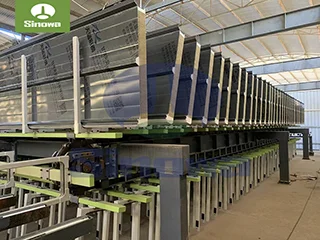
Cooling and constant-temperature shaping follow the curing process, solving the thermal deformation problem of high-temperature cured rock wool boards and further stabilizing product performance. The high-temperature plates discharged from the curing furnace are continuously conveyed to the cooling system, where uniform low-speed airflow is used for gradual and balanced cooling. The gradual cooling mode avoids plate deformation, cracking and internal stress concentration caused by rapid temperature difference, and ensures that the internal structure of the rock wool board tends to be stable after temperature reduction. In the continuous cooling process, the cooling speed and airflow volume are adjusted synchronously according to the plate thickness and conveying speed, realizing synchronous cooling and shaping of the whole plate. After full cooling, the internal performance and structural state of the rock wool board tend to be completely stable, with no subsequent deformation or performance attenuation in the follow-up application process.
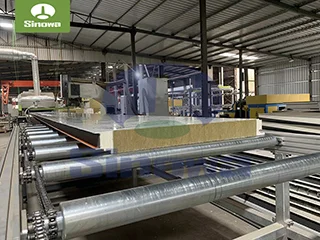
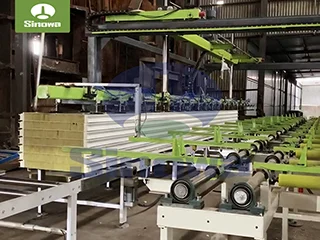
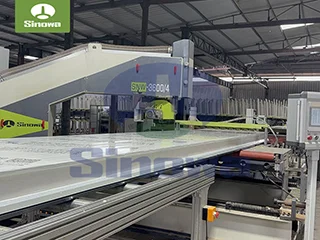
Precision cutting and finishing are the final procedures of the continuous rockwool sandwich panel production line, realizing the specification customization and neat shaping of finished products. The cooled and shaped continuous rock wool board enters the automatic cutting system, which carries out fixed-length cutting and edge trimming according to preset dimensional parameters. The cutting equipment operates synchronously with the front-end continuous conveying speed, realizing dynamic following cutting without stopping production, which ensures the continuity of the whole production line. The high-precision cutting tool ensures smooth and neat cutting sections, no burrs and no fiber falling off, effectively guaranteeing the dimensional accuracy of finished products. After cutting, the finished rock wool boards with standard specifications are formed, and the edge waste generated in the cutting process is automatically collected and recycled, which reduces material loss and improves the comprehensive utilization rate of raw materials. The whole finishing process is completed in a continuous sandwich panel assembly line, with high operation efficiency and stable product specification consistency.
The core advantages of the continuous rock wool board production line are fully reflected in production stability, product consistency and resource utilization efficiency. Different from traditional discontinuous production, which is prone to parameter fluctuation and manual operation errors, the fully integrated continuous production mode realizes automatic docking and synchronous operation of all links from raw material feeding to finished product output. All production parameters are dynamically monitored and adjusted in real time by the system, which effectively eliminates product performance differences caused by human factors and process interruption. In long-term continuous operation, the sandwich panel production line can maintain stable operating rhythm, uniform product thickness, density, thermal insulation performance and mechanical strength, realizing batch standardized production of high-quality rock wool boards. In terms of resource utilization, the closed production structure reduces heat loss and dust emission in the production process, and the recycled waste material system realizes secondary utilization of residual materials, reducing raw material waste and energy consumption per unit product.
In terms of production management and operational stability, the continuous rock wool sandwich panel line has excellent anti-interference ability and fault self-adjustment function. The whole production system is equipped with a real-time monitoring mechanism for material flow, temperature, speed and pressure parameters. When slight parameter deviation occurs in a single link, the system can automatically make fine adjustments to restore the production state to the optimized range without affecting the overall production progress and product quality. The modular equipment layout makes the operation logic of each link clear, and the synchronous matching operation between adjacent processes avoids production stagnation caused by single equipment operation delay. Meanwhile, the continuous production mode simplifies the production management process, reduces frequent start-stop and debugging operations of equipment, effectively extends the service life of production equipment, and reduces the frequency of equipment maintenance and failure shutdown, ensuring the long-term stable and efficient operation of the production line.
From the perspective of product performance optimization, the continuous production process endows rock wool boards more excellent and stable comprehensive performance. The uninterrupted fiber forming and uniform laying process makes the internal fiber arrangement of the product more orderly and the structure more compact, significantly improving the thermal insulation, sound absorption and fire resistance of the rock wool board. The uniform curing and gradual cooling process avoid internal structural defects such as uneven bonding and residual stress, so that the finished product has better structural stability and compression resistance, and is not easy to deform or damage during transportation, installation and long-term use. The consistent production parameters ensure that the performance indicators of each batch of products are highly unified, which improves the overall quality level of rock wool board products and meets the strict application requirements of modern construction, industrial equipment and pipeline thermal insulation fields for insulation materials.
With the continuous upgrading of the building energy conservation and industrial thermal insulation industry, the continuous sandwich panel production line for rock wool board is also constantly optimized and improved in process and equipment. The modernized production line adopts more intelligent parameter control technology, which can realize fine adjustment of production parameters according to different raw material characteristics and product application requirements, and produce rock wool boards with different density, thickness and performance indicators to meet diversified market demands. At the same time, the optimized energy-saving structure further reduces energy consumption in the production process, improves the environmental protection level of production, and adapts to the development trend of green and low-carbon industrial production. The highly automated continuous production mode also reduces the demand for on-site operators, reduces labor operation costs and human error risks, and improves the overall intelligent and standardized level of rock wool board manufacturing.
In practical industrial application, the stable operation of the continuous rockwool board production line provides a reliable guarantee for the large-scale and standardized application of rock wool insulation materials. Rock wool boards produced by continuous processes have stable and reliable comprehensive performance, excellent fire resistance, thermal insulation, sound insulation and weather resistance, and can adapt to various complex application environments. They are widely used in building exterior wall insulation, roof thermal insulation, industrial workshop equipment thermal insulation, pipeline anti-freezing insulation and other fields. The efficient and stable production capacity of the continuous production line can well meet the growing market demand for high-performance inorganic insulation materials, and provide strong technical and production support for the development of the energy-saving insulation material industry.
In conclusion, the continuous production line for rock wool board, with its integrated, automated and streamlined production mode, has completely changed the traditional discrete production mode of rock wool products. Through the precise coordination of raw material pretreatment, high-temperature melting, fiber forming, cotton laying pressing, curing shaping and precision finishing processes, it realizes uninterrupted, high-efficiency and high-quality production of rock wool boards. Its advantages in product consistency, production efficiency, resource utilization and operational stability make it the mainstream production equipment in the modern rock wool material manufacturing industry. With the continuous progress of industrial manufacturing technology, the continuous sandwich panel line for rock wool board will continue to develop towards higher intelligence, lower energy consumption and stronger customization, constantly promoting the upgrading and innovation of the inorganic insulation material industry, and providing more high-quality and reliable material support for green building and industrial energy conservation.
https://www.cnsinowa.com/sandwich-panel-machines/continuous-production-line-for-rock-wool-board.html