sandwich panel line
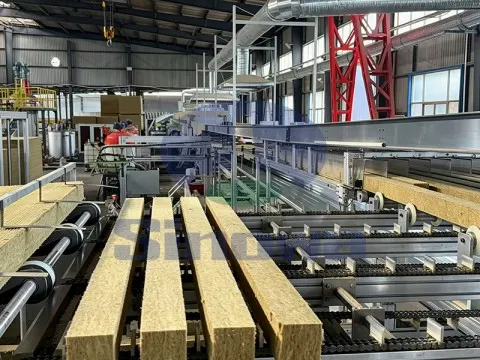
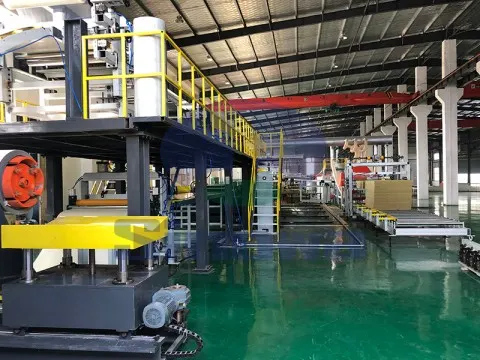
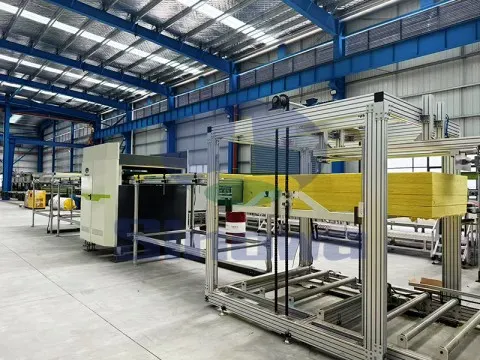
The overall structural composition of the advanced mineral wool sandwich panel line follows a streamlined production logic, with each functional module closely connected to form an enclosed and efficient manufacturing loop. The front-end part of the production line is dominated by raw material feeding and pretreatment units, which are responsible for the orderly transportation and preliminary processing of metal surface sheets and mineral wool substrates. The metal sheet feeding mechanism adopts servo-driven unwinding structures to ensure the flat and steady unfolding of coiled metal materials, avoiding surface wrinkles, scratches, or tensile deformation that may occur during high-speed material conveying. Equipped with dynamic correction devices, this mechanism can automatically adjust the material feeding deviation in real time, controlling the alignment error of metal sheets within an extremely narrow range to lay a foundation for the precise composite forming of subsequent panels. For mineral wool raw materials, the pretreatment unit includes fiber loosening and impurity removal components, which break up compacted mineral wool blocks and eliminate residual impurities and agglomerated particles generated in the mineral wool smelting and molding process. This processing step optimizes the internal fiber distribution of mineral wool, enhancing the uniformity of material density and improving the bonding tightness between mineral wool and metal surface layers.
Following the pretreatment stage is the gluing and composite molding area, which serves as the core functional section determining the bonding quality and structural stability of sandwich panels. The automatic gluing system adopts a circulating spray coating mode to evenly distribute high-viscosity adhesive on the inner surface of metal sheets. The gluing volume and coating density are regulated by intelligent flow control components, which make adaptive adjustments according to the thickness and surface roughness of different metal sheets. This uniform gluing method prevents local glue accumulation or missing coating, effectively avoiding delamination and cracking of panels during long-term use. After the gluing process, the mineral wool substrate is accurately laid between two layers of metal sheets through an automatic cotton distribution device. Guided by encoded positioning technology, the cotton distribution mechanism completes horizontal paving and vertical compaction of mineral wool, ensuring consistent thickness of the intermediate thermal insulation layer and eliminating hollow gaps inside the panel. The composite pressing equipment uses multi-group roller sets with constant pressure control, and the internal hydraulic pressure system maintains stable pressing force throughout the molding process. Under continuous mechanical pressure, the adhesive undergoes preliminary bonding and curing, realizing the permanent combination of metal sheets and mineral wool substrates and forming an integrated sandwich structure.
The curing and shaping process after composite pressing is critical to solidify the comprehensive performance of mineral wool sandwich panels. The advanced production line is equipped with an enclosed constant-temperature curing channel, which adopts a combination of hot air circulation and infrared radiation heating to create a stable temperature field inside the channel. The temperature gradient in the curing area is scientifically distributed to ensure that the adhesive inside the panel undergoes complete cross-linking reaction without causing thermal damage to the mineral wool fiber structure or metal surface coating. Low-temperature slow curing technology is applied in this link to avoid excessive temperature that may lead to adhesive embrittlement and surface coating discoloration. During the slow curing process, the internal stress generated by material lamination is gradually released, improving the flatness and overall rigidity of the panel. Meanwhile, the ventilation system inside the curing channel timely discharges trace volatile substances generated during adhesive curing, maintaining a clean production environment and reducing the impact of harmful gases on the production process. The panels move forward at a constant speed along with the conveying track in the curing channel, realizing synchronous completion of heating, heat preservation, and cooling shaping to ensure uniform curing effect of each panel.
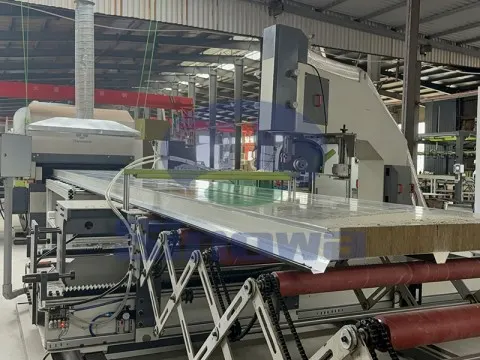
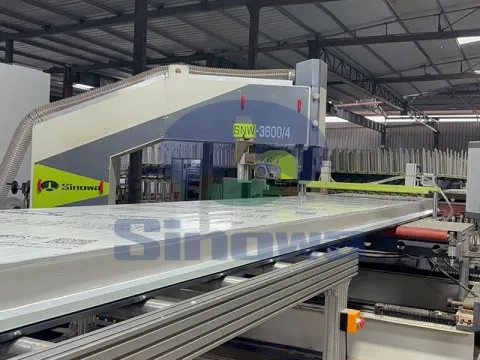
The precision cutting and edge trimming unit located in the middle and rear section of the production line realizes fixed-length processing and fine shaping of continuously molded panels. Driven by high-precision servo motors, the cutting system receives real-time length signals from the encoding sensing component and executes instantaneous fixed-length cutting actions. The cutting blade is made of high-hardness alloy materials, which can maintain sharp cutting performance during long-term continuous operation, ensuring smooth and burr-free panel sections. In addition to fixed-length cutting, the edge trimming mechanism conducts symmetrical trimming on the four sides of the panel to eliminate irregular edges generated during the composite molding process. For panels requiring special edge sealing structures, the production line is equipped with integrated edge wrapping components, which complete mechanical bending and compression sealing of metal edges in one step to enhance the airtightness and structural anti-collision performance of the panel edge. All cutting and trimming parameters can be adjusted through the central control system, enabling flexible switching of panel sizes and edge specifications to meet the customized production needs of different application scenarios.
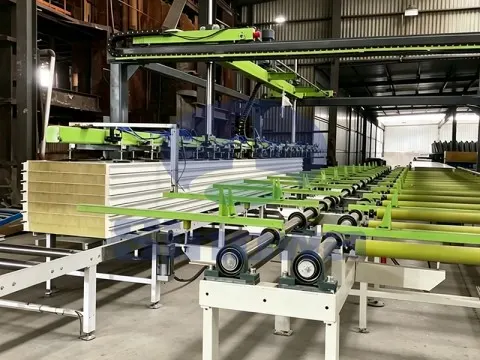
The final stage of the production line consists of finished product conveying, automatic stacking, and auxiliary environmental protection processing modules. The finished panel conveying mechanism adopts a buffer conveying structure to reduce the vibration impact on newly cured panels during transportation and prevent surface scratch damage. The automatic stacking device uses mechanical grabbing and layered stacking methods, with dynamic positioning correction technology to ensure neat stacking of panels without inclination or dislocation. The stacked finished products are arranged in an orderly manner, which simplifies subsequent manual handling and packaging procedures and improves the efficiency of finished product storage and transportation. In terms of environmental protection configuration, the production line is equipped with sealed dust collection and noise reduction structures. The dust collection system captures fine mineral wool fibers and adhesive dust generated during material processing through negative pressure adsorption, avoiding fiber diffusion and air pollution. The noise reduction structure composed of shock-absorbing base and sound insulation plates effectively reduces mechanical operation noise, keeping the noise level of the production area within a reasonable range and optimizing the on-site production working conditions.
The intelligent control system runs through the entire operation process of the advanced mineral wool sandwich panel making line, becoming the core brain to ensure stable and efficient production. The centralized control panel integrates real-time data monitoring, parameter adjustment, and fault alarm functions. Operators can intuitively view the operating speed, processing temperature, material consumption, and equipment operating status of each module through the visual display interface. The system supports one-key parameter setting and memory storage, which can quickly call up the matched production parameters for panels of different thicknesses and specifications, realizing rapid production switching and shortening the debugging time between production batches. In terms of safety control, the intelligent system is equipped with multi-point induction monitoring components. Once abnormal conditions such as material jamming, equipment overload, and temperature deviation occur, the system will automatically trigger an alarm and perform emergency shutdown to avoid equipment damage and production safety accidents. Moreover, the data statistics function of the control system can record daily production output, material utilization rate, and equipment operation energy consumption, providing accurate data support for production management and process optimization.
Compared with traditional ordinary production lines, the advanced mineral wool sandwich panel production line has prominent advantages in production efficiency, product performance, and operation cost. In terms of production efficiency, the continuous circulating production mode breaks the limitation of intermittent processing of traditional equipment, realizing high-speed and uninterrupted production. The coordinated operation of all functional modules effectively shortens the single-panel molding cycle and significantly improves the daily production capacity. In terms of product performance optimization, the precise material distribution and constant pressure curing technology make the mineral wool fiber distribution inside the panel more uniform, with stable density and excellent overall flatness. The bonding strength between layers is effectively improved, avoiding delamination and bulging problems that are prone to occur in low-quality panels during use. In terms of operation cost control, the optimized mechanical transmission structure reduces equipment wear energy consumption, and the intelligent material distribution system minimizes raw material waste. The highly automated operation mode reduces the number of on-site operators, lowering labor input costs for long-term production.
In practical industrial application scenarios, this advanced production line has strong production flexibility and environmental adaptability. It can adapt to the production requirements of panels with different thicknesses, densities, and surface styles by adjusting equipment parameters, covering diversified product demands from light-weight decorative insulation panels to heavy-duty fire-resistant structural panels. The produced mineral wool sandwich panels are widely applicable to industrial factory buildings, cold storage facilities, public buildings, and temporary engineering buildings. These panels maintain stable thermal insulation performance in high-temperature and low-temperature environments, and their excellent fire resistance can effectively block flame spread to improve building safety. In addition, the panels have good sound insulation and vibration damping effects, which can reduce external noise interference and optimize the internal acoustic environment of buildings. The weather resistance of composite structures enables the panels to resist ultraviolet aging and atmospheric erosion, extending the service life in outdoor harsh environments.
With the continuous upgrading of building energy conservation and environmental protection standards in the global construction industry, the market demand for high-performance thermal insulation composite panels continues to rise, which further promotes the technological iteration of mineral wool sandwich panel production lines. The future development direction of such production lines will focus on deeper intelligent optimization and energy-saving transformation. The introduction of artificial intelligence algorithm control will realize automatic identification and adaptive adjustment of raw material differences, further improving the intelligent level of production. The optimized heating circulation structure and energy recovery system will reduce heat loss during production, realizing low-energy consumption and green manufacturing. Meanwhile, the production line will expand the compatibility of new composite materials, realizing the combined application of mineral wool with other environmentally friendly thermal insulation materials to develop multi-functional composite panels that meet higher building standards. Driven by technological innovation, the advanced mineral wool sandwich panel making line will continue to empower the high-quality development of the building material industry, providing reliable and efficient production guarantees for the manufacturing of high-performance building insulation panels.
Sinowa is a professional manufacturer of sandwich panel machine in china, we provide diversified and high-performance sandwich panel production lines, including fully automatic continuous PU sandwich panel line and customized special lines to meet mass production and personalized order demands. These sandwich panel lines support processing multiple foam core materials, such as PU, PIR, mineral wool, rock wool and glass wool, covering different insulation and fireproof standards.
Featuring stable operation, high efficiency, energy saving and easy maintenance, our PU sandwich panel line deliver sandwich panels with excellent thermal insulation, fire resistance, sound insulation and lightweight durability. The finished panels are widely applied in industrial workshops, warehouse roofing and wall cladding, cold storage insulation, serving global construction and industrial insulation markets.
https://www.cnsinowa.com/sandwich-panel-machines/advanced-mineral-wool-sandwich-panel-making-line.html