sandwich panel line
The core design concept of the polyurethane sandwich panel production line for wall heating insulation focuses on balancing continuous large-scale production efficiency, precise technological parameter control, and targeted performance optimization for building wall thermal insulation needs. Unlike general-purpose sandwich panel production equipment used for simple partition or temporary enclosure purposes, this professional production line is specially adjusted and upgraded in terms of raw material processing procedures, polyurethane foaming reaction control, composite pressing forming process, and post-production curing treatment links, fully adapting to the special requirements of wall heating insulation projects such as long-term thermal resistance stability, low-temperature shrinkage resistance, structural pressure bearing capacity, and adaptability to different building wall base layers. Every functional module of the production line is closely connected and coordinated with each other, realizing the whole-process integrated operation from automatic feeding of surface base materials, accurate proportioning and mixing of polyurethane chemical raw materials, continuous on-site foaming and filling, integrated hot-press composite forming, automatic trimming and cutting, to final stable conveying and stacking of finished panels. This fully continuous integrated production mode effectively avoids quality instability problems such as uneven foaming density, insufficient interface bonding, inconsistent panel thickness, and internal hollowing that are prone to occur in intermittent and semi-manual production processes, ensuring that each batch of wall heating insulation polyurethane sandwich panels maintains stable and reliable thermal insulation performance and structural quality.
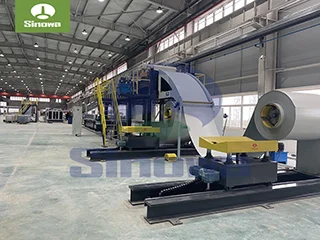
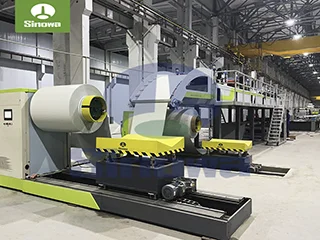
The front-end feeding and pretreatment module constitutes the basic starting point of the entire polyurethane sandwich panel production line for wall heating insulation, undertaking the key work of continuous supply and surface pretreatment of upper and lower surface base materials of the sandwich panel. Common surface base materials matched with wall heating insulation polyurethane sandwich panels include various metal decorative protective sheets and inorganic non-metal protective substrates with good weather resistance and mechanical strength, all of which need to be continuously and stably fed into the subsequent production process through professional unwinding and conveying equipment. The unwinding part of the production line is equipped with precise tension adjustment structures, which can flexibly adjust the feeding tension according to the thickness, hardness, and surface friction characteristics of different base materials, effectively preventing common feeding problems such as substrate stretching deformation, surface wrinkling, and conveying deviation during the continuous unwinding and advancing process. Stable tension control ensures that the surface base materials always maintain a flat and straight running state in the production line, which is a necessary prerequisite for ensuring the uniform thickness and flat appearance of the final finished sandwich panels. After the unwinding process, the surface base materials will go through a simple surface cleaning and pretreatment process inside the production line, removing surface dust, fine impurities, and residual oily substances generated during substrate production and transportation. This simple but essential pretreatment operation can significantly improve the bonding tightness between the surface base materials and the polyurethane foaming core layer in the subsequent composite process, enabling the interface between the core insulation layer and the surface protective layer to form a firm micro mechanical bonding structure, effectively avoiding delamination, peeling, and other quality defects that may occur after long-term use of the panels in building wall heating insulation environments.
The raw material proportioning and high-pressure mixing foaming module is the core functional part of the entire production line, directly determining the thermal insulation performance, foaming uniformity, internal compactness, and long-term dimensional stability of the polyurethane core layer of wall heating insulation sandwich panels. The polyurethane foaming system used for wall heating insulation is composed of two main chemical raw material components, and the production line is equipped with a fully automatic closed circulating material supply system and high-precision dynamic proportioning metering equipment. The metering device can accurately control the feeding ratio and flow rate of the two raw material components in real time according to the set process parameters, ensuring that the chemical reaction ratio of each foaming raw material always remains in the optimal state required for wall heating insulation foaming. Accurate proportioning control is crucial because any slight deviation in the ratio will directly affect the foaming reaction degree of polyurethane, resulting in problems such as excessive foam brittleness, insufficient bonding viscosity, high shrinkage rate after foaming and molding, or increased thermal conductivity of the core layer, which will seriously weaken the heating insulation effect and structural durability of the wall panels. After precise proportioning, the two raw materials are transported to the high-pressure mixing head of the production line through closed pipelines, where they undergo rapid and uniform high-pressure impact mixing. The high-speed mixing mode ensures that the chemical raw materials are fully fused in an instant and undergo uniform chemical foaming reactions, avoiding local uneven mixing, incomplete reaction, and inconsistent foaming expansion degree.
The mixed polyurethane foaming material is evenly and continuously poured between the upper and lower surface base materials that are being stably conveyed forward at a constant speed through the automatic pouring device of the production line. At this stage, the production line precisely controls the pouring position, pouring thickness, and pouring flow rate of the foaming material, ensuring that the polyurethane foaming material can fully and evenly fill the entire sandwich space between the upper and lower base materials without material accumulation, material shortage, or local hollowing. In the initial stage after pouring, the polyurethane material starts a rapid foaming and expansion reaction at a controlled temperature, gradually forming a fine and uniform closed-cell foam structure. The closed-cell rate of the polyurethane core layer formed by this professional production line process is maintained at a high level, which is the key to ensuring the excellent heating and thermal insulation effect of the wall panels. A high closed-cell structure can effectively lock static air inside the foam layer, greatly reduce the heat conduction and heat convection efficiency inside the panel, effectively block the indoor and outdoor heat transfer of the building wall in both cold winter and hot summer environments, reduce the energy consumption of building heating and temperature regulation, and create a stable and comfortable indoor living and working temperature environment for building users. At the same time, the fine and uniform closed-cell foam structure also gives the polyurethane core layer good compressive bearing capacity and anti-deformation performance, enabling the wall insulation panels to withstand the external pressure and structural load from the building wall for a long time without deformation, collapse, or damage to the internal insulation structure.
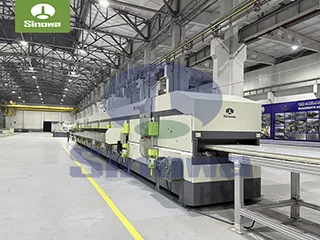
The continuous hot-press composite forming and constant-temperature curing module is an indispensable key link to realize the integrated molding of polyurethane sandwich panels for wall heating insulation and stabilize the overall structural performance of the panels. After the polyurethane foaming material is poured between the upper and lower surface base materials and initially expands and foams, the whole composite plate body is continuously sent to the long hot-press curing tunnel inside the production line through the conveying system. The interior of the hot-press tunnel is equipped with multi-section independent temperature control systems and uniform pressure applying structures, which can maintain constant and stable temperature and pressure conditions in different areas inside the tunnel according to the foaming reaction and curing molding characteristics of polyurethane materials. The proper hot-press pressure setting ensures that the upper and lower surface base materials and the polyurethane foaming core layer are closely compounded together under uniform pressure, the interface bonding is more firm and reliable, and the overall thickness of the sandwich panel is kept consistent without local thickness deviation or surface unevenness. The scientific constant-temperature curing environment provides a stable reaction temperature condition for the subsequent complete foaming reaction and molecular structure curing of the polyurethane core layer, enabling the polyurethane foam to gradually complete the final structural stabilization reaction inside the tunnel, form a stable three-dimensional network molecular structure, and thoroughly eliminate the problems of later shrinkage, deformation, and performance attenuation of the foam core layer.
The running speed of the production line is precisely matched with the foaming reaction time and curing time of polyurethane materials, realizing the perfect coordination between production rhythm and material reaction characteristics. The production line speed will not be too fast to cause insufficient foaming reaction and incomplete curing of the polyurethane core layer, nor too slow to affect continuous production efficiency and cause unnecessary material accumulation. Through the coordinated operation of constant-temperature curing and stable-speed conveying, the polyurethane sandwich panels complete all core processes from initial foaming to structural stabilization in the hot-press tunnel, and the overall performance of the panels tends to be stable and consistent. After being discharged from the hot-press curing tunnel, the preliminary molded sandwich panels have good overall rigidity, structural integrity, and interface bonding strength, and the basic heating insulation performance and mechanical performance of the panels have been fully formed, laying a good foundation for subsequent finishing processing and final finished product delivery.
The post-processing finishing and automatic cutting module of the production line is responsible for the final standardized shaping and size processing of the initially molded polyurethane sandwich panels for wall heating insulation. After the panels are discharged from the hot-press curing link, they will be automatically transported to the trimming and cutting area of the production line. In this link, the production line is equipped with high-precision automatic trimming equipment and fixed-length cutting devices, which can automatically trim the excess edge materials on both sides of the sandwich panels generated in the continuous composite production process to ensure that the edge dimensions of the panels are neat and uniform, and the edge structures are flat and smooth. The neat edge treatment not only improves the overall appearance quality of the finished wall insulation panels but also facilitates the seamless docking and installation of panels during on-site wall construction, avoiding installation gaps caused by irregular panel edges that affect the overall heating insulation and sealing effect of the building wall. The fixed-length cutting equipment can automatically cut the continuous long strip composite plates into finished panels of different standard sizes according to the preset size parameters of different building wall engineering needs, realizing flexible production and personalized customization of panel specifications to meet the diverse construction and installation requirements of different building types and different wall structural designs.
In addition to basic trimming and fixed-length cutting functions, the post-processing part of the production line also includes simple surface finishing and quality preliminary inspection procedures. The surface finishing equipment can slightly smooth the surface of the sandwich panels, remove minor surface burrs and uneven marks generated in the production process, and further improve the surface flatness and appearance quality of the finished panels. The online preliminary inspection device can automatically detect the overall thickness flatness, surface bonding integrity, and basic structural stability of the produced sandwich panels, and automatically screen out individual unqualified products with obvious quality deviations, ensuring that all finished panels entering the stacking and delivery link meet the basic quality requirements of wall heating insulation engineering. After the completion of finishing processing and preliminary quality inspection, the qualified finished polyurethane sandwich panels will be automatically stacked and arranged by the automatic stacking equipment at the end of the production line, which is convenient for subsequent unified packaging, transportation, and on-site construction and use.
The structural design and operation optimization of the polyurethane sandwich panel production line for wall heating insulation fully consider the long-term use environment and performance requirements of building wall heating insulation scenarios, making the produced panels have multiple comprehensive advantages that are difficult to achieve with traditional single insulation materials and ordinary composite panels. Relying on the precise foaming and integrated composite process of the professional production line, the polyurethane core layer of the finished panels has extremely low thermal conductivity, which can effectively isolate the heat exchange between the indoor heating space and the outdoor low-temperature environment in winter, reduce the loss of indoor heating heat through the wall, improve the indoor heating efficiency, and reduce the energy consumption of building heating equipment. In the high-temperature season in summer, the excellent thermal insulation performance of the panels can also block the external high-temperature heat from entering the room, reduce the load of indoor cooling equipment, and realize the dual energy-saving effect of winter heating insulation and summer heat insulation and cooling.
At the same time, the integrated composite molding process of the production line makes the surface protective layer and the polyurethane insulation core layer closely combined into an integral structure, so the wall heating insulation sandwich panels have good overall structural rigidity and impact resistance. During the long-term use of the building wall, the panels can resist the influence of external natural environments such as temperature change, humidity alternation, and wind pressure, without structural delamination, cracking, deformation, and other damage problems. The polyurethane foam core layer produced by the professional production line also has good moisture resistance and water impermeability, which can effectively prevent moisture and water vapor in the external wall environment from penetrating into the interior of the insulation layer, avoid the reduction of thermal insulation performance caused by moisture absorption of the insulation material, and ensure that the wall heating insulation effect remains stable and reliable for decades.
In the actual construction and application process, the polyurethane sandwich panels produced by this professional production line for wall heating insulation also have outstanding construction and installation advantages. Due to the high degree of integrated prefabrication in the factory by the production line, the panels have stable dimensions, neat edges, and consistent performance, and the on-site construction only needs simple fixed installation and seamless docking operation, without complex on-site mixing, painting, and multiple insulation layer construction processes. This not only greatly shortens the construction cycle of building wall insulation projects, improves the overall construction efficiency, but also effectively reduces the impact of on-site construction operations on the surrounding environment and construction personnel, and avoids the quality instability problems caused by on-site manual operation differences. Whether it is used for the exterior wall overall heating insulation transformation of old residential buildings, the exterior wall insulation and energy-saving construction of new high-rise residential buildings, or the interior wall heating insulation and comfortable decoration of commercial office buildings and public service buildings, the sandwich panels produced by this production line can well adapt to different construction scenarios and meet the high-standard requirements of modern buildings for wall heating insulation, energy conservation and emission reduction, and living comfort improvement.
With the continuous deepening of the construction industry's energy-saving and low-carbon development goals and the continuous improvement of people's requirements for building indoor living comfort, the market demand for high-quality wall heating insulation polyurethane sandwich panels will continue to rise, and the technical requirements for supporting professional production lines will also become higher and higher. The future development of polyurethane sandwich panel production lines for wall heating insulation will further move towards higher automation intelligence, more precise process parameter control, more energy-saving and environmentally friendly production operation modes, and more flexible personalized production adaptation. Through continuous technological upgrading and process optimization of the production line, the production quality consistency and production efficiency of wall heating insulation sandwich panels will be further improved, production energy consumption and material waste will be reduced, and the comprehensive performance of finished panels will be continuously optimized. This will not only better meet the growing market demand for high-performance building wall heating insulation materials but also make a greater contribution to promoting the high-quality development of the construction industry's energy-saving and thermal insulation field, reducing building energy consumption, and improving the overall thermal comfort level of various modern buildings.
https://www.cnsinowa.com/sandwich-panel-machines/polyurethane-sandwich-panel-production-line-for-wall-heating-insulation.html