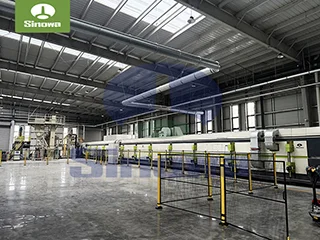
sandwich panel machine
The overall layout and infrastructure construction of the PU sandwich panel line is formulated based on the logical sequence of production procedures and industrial environmental management norms. The plant area is rationally divided into functional zones including raw material storage area, surface material processing area, foaming and composite molding area, curing and cooling area, finished product inspection area, and finished product stacking area. This partitioned layout effectively avoids cross-interference between different production stages, simplifies internal material transportation routes, and reduces unnecessary space occupation and labor consumption. The production workshop adopts an enclosed structural design with reasonable ventilation and temperature adjustment systems. Since the foaming reaction of polyurethane raw materials is highly sensitive to ambient temperature and humidity, the workshop maintains a stable internal environment throughout the year to ensure the consistency of chemical reactions during production. The ground of the workshop is treated with anti-corrosion and wear-resistant materials to adapt to long-term mechanical operation and material handling, while the drainage system is optimized to timely clean up residual raw materials and production wastewater, maintaining a clean and orderly production space.
Raw material selection and pretreatment constitute the fundamental guarantee for the quality of cold room PU sandwich panels. The main raw materials required for production include metal surface sheets, polyurethane foaming raw materials, and auxiliary bonding materials. Metal sheets used for cold room panels need excellent surface flatness, compressive resistance, and anti-corrosion performance to withstand external pressure, temperature changes, and humid corrosive environments inside cold rooms. Before formal processing, all metal sheets undergo strict pretreatment procedures, including surface cleaning, oil removal, and smooth polishing. These steps eliminate surface impurities and oxide layers, enhancing the bonding tightness between the metal sheet and the polyurethane core layer and preventing delamination during long-term use. Polyurethane foaming raw materials consist of multiple chemical components, and the proportional configuration of these components directly affects the cell structure, density, and thermal insulation performance of the core material. Professional batching equipment is applied to achieve precise raw material proportioning, ensuring uniform mixing of reaction components and laying a solid foundation for the formation of fine and closed cell structures inside the foam layer. Auxiliary materials such as edge sealing fillers and bonding adhesives are screened for weather resistance and low-temperature resistance to ensure the panels maintain stable physical properties in long-term low-temperature service environments.
The formal production process of cold room PU sandwich panels covers multiple continuous and interconnected processing stages, starting with the precision processing of surface metal sheets. Uncoiling equipment unfolds coiled metal sheets at a constant speed, and the sheets are then transmitted to cutting and forming machines. According to customized dimensional requirements for cold room construction, the PU sandwich panel machine completes fixed-length cutting, edge folding, and rib pressing of metal sheets. During this stage, the processing accuracy of sheet size and edge structure is strictly controlled, as precise edge shapes facilitate seamless assembly between panels during cold room installation and improve the overall airtightness of the cold storage space. After forming, the metal sheets are transported to the composite molding station, where upper and lower surface sheets are fixed in a specific mold or continuous production line to form a closed cavity for polyurethane foaming. The spacing between the two layers of metal sheets is accurately adjusted according to the designed panel thickness, ensuring uniform thickness of the intermediate thermal insulation core layer.
Foaming and composite molding is the core technological stage of PU sandwich panel production, determining the key performance indicators of finished panels. The well-mixed polyurethane raw materials are injected into the cavity between the two metal sheets through a high-pressure pouring system. The injection speed and material distribution path are precisely controlled to avoid material accumulation or empty gaps inside the cavity, enabling the raw materials to fill every corner of the interlayer space evenly. Following injection, the mold is closed and pressurized, with the internal temperature and pressure of the mold maintained within a stable range to accelerate the chemical foaming reaction of polyurethane. Under suitable temperature and pressure conditions, the liquid polyurethane raw materials expand rapidly, form dense closed cells, and gradually solidify into a rigid foam core layer. During the curing process, the foam material closely bonds with the inner surface of the metal sheets, forming an integrated composite structure with high overall adhesion strength. The closed-cell rate of the polyurethane core layer is strictly controlled in this process, as a high closed-cell structure can effectively reduce air and moisture penetration, thereby lowering the thermal conductivity of the panel and achieving superior thermal insulation effects suitable for cold room usage.
After completing the composite molding process, the semi-finished panels enter the curing and cooling stage to stabilize their internal structure. Freshly molded panels contain residual reaction heat and unstable internal molecular structures, so they need to be placed in a constant-temperature curing area for a certain period. Slow heat dissipation and natural curing help eliminate internal stress generated during foaming and pressurization, preventing panel deformation, warping, or cracking in subsequent low-temperature usage scenarios. After primary curing, the panels are transported to the cooling area for gradual cooling to room temperature. The graded cooling method avoids structural damage caused by drastic temperature changes, further consolidating the bonding performance between the core layer and surface sheets. Once curing and cooling are finished, the panels undergo trimming treatment, where excess edge materials and irregular parts are cut off to ensure neat panel edges and consistent overall dimensions, meeting the assembly standards of cold room engineering.
The PU sandwich panel production line has established a comprehensive quality inspection system covering the entire production process to screen out unqualified products and maintain stable product quality. Sampling inspections are conducted on raw materials before production, focusing on detecting the surface flatness and mechanical properties of metal sheets as well as the purity and reaction activity of polyurethane chemical components. Online monitoring equipment is installed in key production sections such as foaming and molding to record real-time data including mold temperature, pressurization time, and raw material injection volume. Abnormal parameter fluctuations trigger timely adjustment by operators to avoid batch quality defects. After panel molding, finished product inspections cover multiple indicators: dimensional accuracy is verified with precision measuring tools to ensure compliance with design specifications; surface inspection checks for scratches, depressions, and uneven coating on metal sheets; internal structure inspection assesses the compactness and cell uniformity of the polyurethane core layer. Additionally, simulated low-temperature environment tests are carried out on sampled panels to detect their thermal insulation stability and structural deformation resistance under long-term low-temperature conditions, ensuring the panels adapt to the extreme operating temperatures of various cold rooms.
Production efficiency and intelligent optimization are important development directions for modern polyurethane sandwich panel production line. The plant introduces automated linkage production lines to realize continuous operation of multiple processes including sheet uncoiling, forming, pouring, and molding. Mechanical automation replaces repetitive manual operations, effectively improving production output while reducing human errors caused by manual processing. The production system is equipped with a real-time data monitoring platform, which records production parameters of each batch of panels to facilitate production traceability and process optimization. Meanwhile, the plant rationally allocates human resources: professional technicians are responsible for equipment debugging, parameter setting, and process improvement; operational staff undertake routine equipment operation and workshop cleaning; quality management personnel conduct full-process inspection and data recording. The clear division of labor improves overall operational efficiency, forming a standardized and orderly production management model.
Energy consumption control and environmental protection management run through the entire production operation of the polyurethane sandwich panel line. In terms of energy utilization, energy-saving heating and pressurization equipment are adopted in the foaming process to reduce heat loss during temperature regulation. Waste heat generated by mechanical operation is recycled and applied to raw material preheating and workshop temperature maintenance, cutting down additional energy consumption. For environmental protection treatment, waste gas produced by polyurethane chemical reactions is collected through a sealed pipeline system and processed by purification equipment to eliminate harmful substances before discharge. Production waste such as leftover metal fragments and residual polyurethane materials is classified, recycled, and reused to maximize resource utilization. The plant strictly controls noise generated by mechanical operation by installing noise reduction structures on production equipment, maintaining a comfortable and safe working environment for staff while reducing the impact of production noise on the surrounding area.
The finished PU cold room sandwich panels have unique structural and performance advantages that make them highly adaptable to cold storage construction. The integrated composite structure of metal sheets and polyurethane foam gives the panels high compressive strength and bending resistance, enabling them to bear external loads such as snow pressure and wind pressure during cold room operation. The low thermal conductivity of the polyurethane core layer effectively blocks heat exchange between the inside and outside of the cold room, reducing the energy consumption of refrigeration equipment and maintaining stable low-temperature storage conditions. Moreover, the panel surface has good waterproof and moisture-proof properties, preventing moisture from penetrating into the core layer and avoiding insulation performance degradation caused by damp deformation. The standardized modular design of the panels simplifies on-site assembly procedures, shortens the construction cycle of cold rooms, and reduces the difficulty of later maintenance and renovation.
In terms of product application and market layout, the automatic sandwich panel production line continuously optimizes product structures to meet the differentiated demands of diverse cold room scenarios. Different panel thicknesses and surface treatments are customized for low-temperature freezing warehouses, constant-temperature fresh-keeping warehouses, and industrial low-temperature processing workshops. Panels with enhanced anti-corrosion treatments are provided for humid and corrosive storage environments, while thickened high-strength panels are developed for large-span high-space cold storage buildings. The plant maintains stable communication with engineering construction teams and cold chain operation enterprises to collect feedback on product usage, summarize practical application problems, and adjust production processes and material formulas accordingly. This market-oriented optimization mechanism enables products to continuously adapt to the upgrading needs of the cold chain industry and enhance market applicability.
Looking at the long-term development trend, the PU sandwich panel manufacturing plant for cold room production will further promote technological upgrading and sustainable development. In terms of production technology, more refined automatic control systems will be introduced to achieve intelligent regulation of raw material batching, foaming temperature, and molding pressure, further improving product consistency and yield. In terms of material optimization, environmentally friendly and low-carbon polyurethane raw materials will be researched and applied to reduce the environmental impact of the production process. In terms of production management, a more refined digital management system will be built to realize real-time monitoring of production progress, equipment operation status, and product quality data. With the continuous growth of the global cold chain logistics industry and the increasing demand for low-temperature storage infrastructure, professional polyurethane sandwich panel machine will keep optimizing production models, improving product performance, and providing reliable high-quality insulation materials for the construction of various cold room facilities, laying a solid foundation for the stable development of the cold chain industry.
https://www.cnsinowa.com/sandwich-panel-machines/pu-sandwich-panel-manufacturing-plant-for-cold-room-panel-production.html