 sandwich panel machine
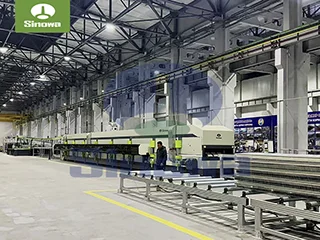
The overall structural design of the PU sandwich panel making machine follows a modular and synchronized operational logic, with every functional unit closely connected and precisely coordinated to maintain stable and uninterrupted production rhythm. The entire production system can be divided into multiple core functional modules according to the production sequence, including material unwinding and leveling unit, surface material forming unit, preheating treatment unit, high-pressure foaming and mixing unit, laminating and curing unit, fixed-length cutting unit, and finished product conveying and stacking unit. Each module undertakes independent processing tasks while maintaining synchronous speed and parameter matching with the whole line, effectively avoiding product defects such as uneven foam filling, inconsistent panel thickness, and weak bonding caused by asynchronous operation, and ensuring the uniformity and stability of each batch of finished wall panels.
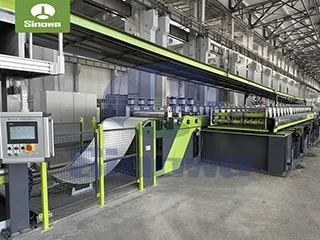
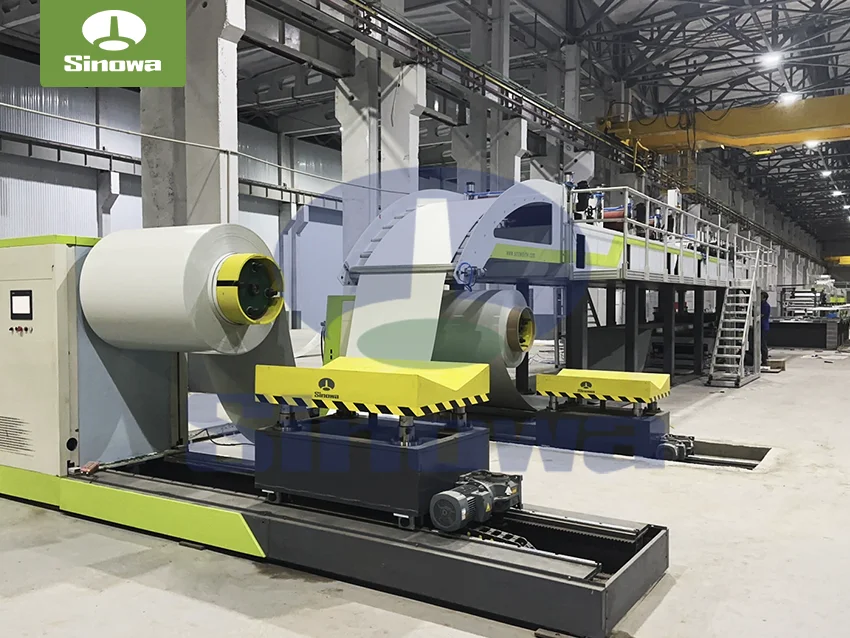
The initial stage of the production process starts with the feeding and pretreatment of surface materials, which are the outer protective and structural layers of PU sandwich wall panels. Common surface materials include metal sheets, aluminum substrates, and other composite decorative materials with good structural strength and weather resistance. These raw materials are usually stored in coil form to facilitate continuous feeding. The unwinding unit of the machine steadily releases coiled materials at a constant speed, and the subsequent leveling device eliminates wrinkles, bending deformation, and surface irregularities generated during coil storage and unwinding. This leveling process is essential for subsequent forming and lamination, as flat and smooth surface substrates can ensure uniform bonding contact with the PU foam core layer, avoiding gaps and peeling risks in the finished panels. After leveling, the surface materials enter the roll forming system, which adopts multi-station rolling groups to carry out gradual cold bending and shaping according to the preset wall panel profile standards. The gradual forming mode avoids structural damage and internal stress concentration on the surface materials, ensuring the dimensional accuracy and structural flatness of the panel outline, and laying a foundation for the assembly and installation of subsequent building wall systems.
Before the core material compounding process, the polyurethane sandwich panel machine is equipped with an independent preheating treatment unit, which is a key link to improve the bonding performance of sandwich panels. The preheating system precisely adjusts the surface temperature of the upper and lower surface substrates within a reasonable range through circulating heating and constant temperature control technology. Appropriate preheating can effectively activate the surface molecular activity of the substrates, enhance the adhesion between the surface materials and polyurethane foam, and avoid the common quality problem of core layer peeling in traditional sandwich panels produced without preheating treatment. Meanwhile, preheating can remove tiny moisture and dust attached to the surface of the substrates, further optimizing the composite environment of the core material and improving the overall compactness of the finished panel structure. The temperature control system of the preheating unit features high sensitivity and real-time adjustment, which can automatically adapt to different ambient temperatures and different types of surface materials, maintaining the stability of pretreatment effects in long-term continuous production.
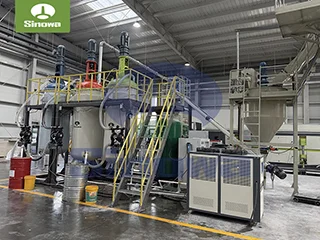
The foaming and mixing system is the core functional component of the PU sandwich panel machine, determining the thermal insulation performance, structural density, and overall stability of the finished wall panels. This system relies on precise metering and high-speed mixing technology to process two-component polyurethane raw materials, strictly controlling the proportion, flow rate, and mixing uniformity of raw materials. The internal high-pressure mixing structure enables rapid and full fusion of polyurethane raw materials, avoiding uneven mixing, local incomplete foaming, or excessive foaming. After mixing, the liquid polyurethane material is evenly injected between the upper and lower surface substrates through a precise injection device. The injection position and dosage are accurately controlled by the intelligent control system, ensuring that the liquid material can fully expand and fill the entire gap of the panel during the subsequent curing process without material shortage or overflow.
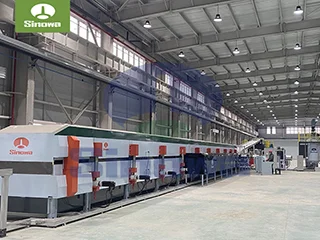
The foaming expansion process of polyurethane raw materials is completed in the closed laminating and curing unit of the machine. The double-belt laminating structure can provide stable and uniform pressure restraint for the expanding foam material, limiting the free expansion range of the foam and ensuring that the finished panel maintains accurate and consistent thickness specifications. The internal heating system of the laminating unit maintains a constant curing temperature environment, which accelerates the chemical reaction and solidification molding of polyurethane foam. In this process, the foam material gradually expands, fills the entire composite space, and forms a dense and uniform porous core layer, while achieving permanent bonding with the inner surfaces of the upper and lower substrates. The length of the laminating and curing section is scientifically designed to match the production speed, ensuring that the polyurethane core layer completes full foaming, curing, and bonding before leaving the laminating unit, so that the finished panel has integral structural strength and will not suffer from core layer collapse or loose bonding in subsequent use.
After completing lamination and curing, the continuous integrated sandwich panel is conveyed to the fixed-length cutting unit through a stable conveying system. The cutting unit adopts automatic tracking and fixed-length cutting technology, which can set arbitrary cutting dimensions according to actual production and construction needs. The high-precision cutting structure can complete smooth and neat cutting of the integral panel in an instant, without burrs, edge warping, or material deformation at the cutting section. The entire cutting process is completed automatically without manual intervention, which not only improves production efficiency but also ensures the consistency of panel size accuracy in large-scale production. After cutting, the finished panels enter the cooling and shaping conveying section, where the residual heat of the panels is evenly dissipated through natural air cooling or auxiliary heat dissipation structures, eliminating the internal temperature stress generated during high-temperature curing and further stabilizing the structural shape and performance of the panels.
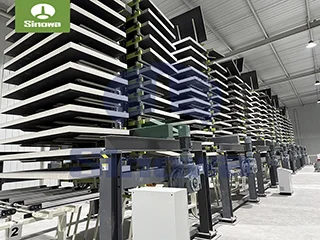
The final stage of production includes finished product output, automatic stacking and temporary storage. The qualified panels after cooling and shaping are stably conveyed to the stacking platform by the conveying device, and the automatic stacking mechanism neatly arranges the panels according to the set stacking specifications, which is convenient for subsequent transportation and centralized use. The whole process from raw material feeding to finished product stacking is completed in a fully automated cycle, realizing continuous and uninterrupted industrial production, which fundamentally breaks through the limitations of low output, large manual error, and unstable product quality of traditional intermittent production equipment.
Compared with traditional wall sandwich panel production equipment, the PU sandwich panel production line has prominent advantages in production efficiency, product quality control, and operational flexibility. In terms of production efficiency, the integrated continuous production mode greatly shortens the single-panel production cycle, and the synchronous operation of each functional module enables the equipment to maintain stable high-speed operation for a long time, effectively meeting the large-scale batch production needs of engineering and market orders. In terms of quality control, the whole production process is regulated by intelligent parameter systems, and key indicators such as foam density, panel thickness, bonding strength, and overall flatness are uniformly controlled by the equipment system, avoiding quality fluctuations caused by manual operation experience differences. The produced PU sandwich wall panels have uniform overall density, stable thermal insulation performance, strong structural integrity, and good compression and bending resistance, which can adapt to complex building use environments.
In terms of operational flexibility, this type of production line supports flexible adjustment of production parameters, which can adapt to the production of wall panels with different thickness specifications, different surface material types, and different foam density requirements. By simply adjusting the equipment parameters, it can switch production styles to meet the diversified needs of interior decoration walls, exterior building insulation walls, industrial plant enclosure walls, and temporary building wall materials. The modular structural design also facilitates daily maintenance and later upgrading of the equipment. Each functional module can be independently inspected, maintained, and replaced without affecting the overall operation of the production line, reducing equipment failure rate and maintenance cost, and improving the overall service life and operational stability of the equipment.
The products manufactured by polyurethane sandwich panel line has excellent comprehensive performance, making them widely applicable in multiple fields of the construction industry. The porous closed-cell structure of the polyurethane core layer endows the wall panels with ultra-low thermal conductivity, enabling excellent thermal insulation and heat preservation effects, which can effectively reduce the energy consumption of building heating and cooling, and conform to the global green building and energy-saving development trend. At the same time, the integral composite structure formed by high-pressure bonding of surface materials and PU core layer gives the panels good sound insulation, shock resistance, and wind pressure resistance. The lightweight characteristics of the panels reduce the self-weight of building structures, lower the requirements for building foundation bearing capacity, and effectively save overall construction costs and construction cycle.
In addition to structural and thermal insulation advantages, the finished PU sandwich wall panels also have good fire resistance, weather resistance, and corrosion resistance. The stable chemical properties of the polyurethane core material and the protective effect of the outer surface materials enable the panels to resist the erosion of external humid, high-temperature, and corrosive environments, avoiding problems such as mildew, deformation, and performance attenuation of traditional wall materials after long-term use. The surface of the panels is smooth and flat with good decorative performance, and no secondary decoration treatment is required in most use scenarios, which further simplifies the construction process and improves the construction efficiency of building walls.
With the continuous upgrading of construction industrialization and modular building technology, the market demand for standardized, high-performance, and customized PU sandwich wall panels is constantly increasing, which also promotes the continuous technological optimization and functional upgrading of PU sandwich panel wall panel making machines. Modern equipment is gradually developing toward higher intelligence, higher precision, and lower energy consumption. The upgraded intelligent control system can realize real-time monitoring, data recording, and automatic early warning of the entire production process, automatically adjusting production parameters according to real-time production conditions to ensure the optimal production state. The optimized mechanical structure reduces equipment operation energy consumption and material waste rate, realizing energy-saving and environmentally friendly production while ensuring output and quality.
In actual industrial production applications, the stable operation of the wall sandwich panel machine directly determines the economic benefits and product competitiveness of production enterprises. The high degree of automation reduces the dependence on manual labor, saves labor costs for enterprises, and the stable and consistent product quality reduces the rate of defective products and rework costs. The flexible production capacity enables enterprises to quickly respond to market order changes and customized production needs, improving market adaptability and operational flexibility. At the same time, the continuous production mode improves the utilization rate of production space and production time, maximizing the production efficiency and output value of unit production equipment.
In conclusion, the PU wall sandwich panel production machine is a highly integrated and efficient professional production equipment tailored for modern energy-saving building wall materials. Through scientific modular design, precise process control, and automated continuous production mode, it realizes standardized and large-scale manufacturing of high-performance PU sandwich wall panels. Its excellent production stability, flexible production capacity, and efficient production efficiency provide strong equipment support for the popularization and application of energy-saving and environmentally friendly sandwich wall panels in the construction industry. With the continuous development of green building concepts and modular construction technologies, this type of production equipment will continue to play an important role in promoting the upgrading of building material production technology and the high-quality development of the construction industry, and its market application prospects will become increasingly broad in the future.
https://www.cnsinowa.com/sandwich-panel-machines/pu-sandwich-panel-wall-panel-making-machine.html