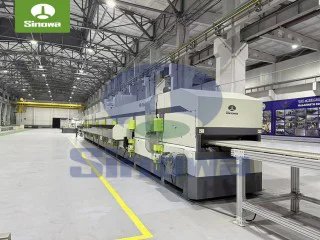
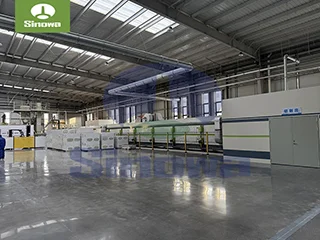
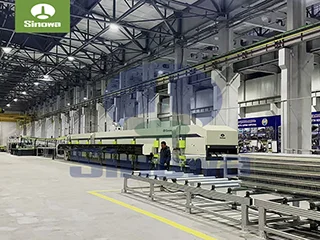
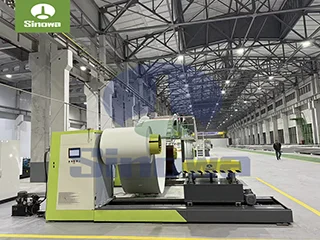
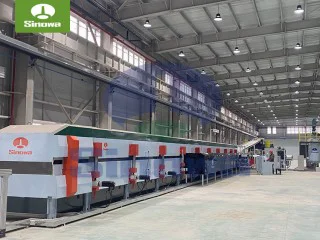
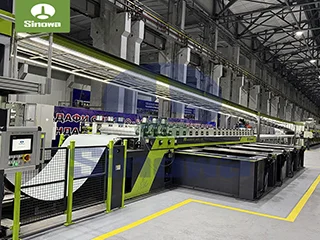
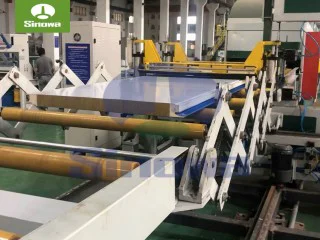
sandwich panel line
The PU sandwich panel for cold storage insulation is a typical composite material with a "sandwich" structure, consisting of two outer facing materials and a middle PU foam core. The outer facing materials are usually galvanized steel, color-coated steel, aluminum or stainless steel, which provide structural support and protection for the panel. The middle PU foam core, with its closed-cell structure and low thermal conductivity, is responsible for the main thermal insulation function. The PU sandwich panel line is a set of automated production equipment that integrates multiple processes such as raw material preparation, panel forming, foam injection, composite curing, and finished product processing. Its core function is to accurately and efficiently combine the facing materials and the PU core into a single integrated panel that meets the technical requirements of cold storage insulation. Unlike traditional manual or semi-automatic production methods, the modern PU sandwich panel line realizes the standardization and continuity of production, which not only improves production efficiency but also ensures the stability and consistency of product quality.
The production process of the PU sandwich panel line for cold storage insulation panels is a sophisticated systematic project that involves multiple links, each of which has strict technical requirements. The first step is raw material preparation, which is the foundation of ensuring product quality. For the facing materials, the coil materials such as galvanized steel or color-coated steel need to be uncoiled through the uncoiling system, and then subjected to processes such as leveling and fixed-length cutting according to the production requirements. The surface of the facing materials may also need to be pretreated, such as pressure embossing to form corrugated or trapezoidal shapes, which can enhance the structural rigidity of the panels. For the PU foam core material, the raw materials mainly include polyol and isocyanate, which need to be stored in special storage tanks at a constant temperature to ensure their chemical stability. In addition, auxiliary materials such as flame retardants and foaming agents are also prepared in proportion to meet the requirements of flame retardancy and foam density of the cold storage insulation panels.
After the raw material preparation is completed, the continuous sandwich panel production line enters the core process of panel forming and composite. First, the pretreated lower facing material is conveyed to the foaming station through the conveying system. At this station, the high-pressure foaming machine accurately mixes the polyol, isocyanate and other auxiliary materials in a certain proportion, and then uniformly injects the mixed liquid raw materials onto the lower facing material. The injection amount and uniformity of the foaming material are precisely controlled by the computer system to ensure that the thickness and density of the PU foam core are consistent. Immediately after the injection of the foaming material, the upper facing material is covered on the foaming material through the lamination system. At this time, the three-layer structure of upper facing material, PU foam and lower facing material enters the continuous laminating machine or flat pressing machine along with the conveying line.
The pressing and curing process is a key link in determining the bonding strength and flatness of the PU sandwich panel. In the laminating machine, the composite panel is subjected to a certain temperature and pressure for a specific period of time. Under the action of temperature and pressure, the PU foam raw material undergoes a rapid foaming reaction, filling the entire space between the upper and lower facing materials to form a dense closed-cell structure. At the same time, the adhesive in the foaming material and the facing material form a firm bond. The temperature, pressure and time parameters of this process are closely related to the performance of the PU foam. For example, an appropriate temperature can accelerate the foaming reaction and ensure the complete curing of the foam, while a reasonable pressure can prevent the generation of bubbles and gaps in the foam, ensuring the compactness of the core material. After the pressing and curing process, the composite panel enters the cooling zone for cooling and shaping. The cooling process is crucial to the dimensional stability of the panel. Rapid and uniform cooling can prevent the panel from warping or deforming due to thermal expansion and contraction, ensuring that the size of the panel meets the design requirements.
After cooling and shaping, the continuous panel is cut into finished products of specified lengths by the automatic cutting system. The cutting system usually includes band saws and circular saws, which can meet the cutting needs of different facing materials and ensure the flatness and neatness of the cutting surface. Subsequently, the finished panels undergo edge trimming, grooving or punching processes as needed. Edge trimming can remove the irregular parts of the panel edges to improve the appearance quality of the product; grooving is to facilitate the lap joint between panels during installation, ensuring the tightness of the connection; punching is to install accessories or realize ventilation functions. Finally, the finished products are subjected to quality inspection. The inspection items include appearance quality, dimensional accuracy, flatness, bonding strength and foam density. Unqualified products are sorted out and reprocessed, while qualified products are packaged and stored in the warehouse. The entire production process is fully automated, with minimal manual intervention, which not only improves production efficiency but also reduces the impact of human factors on product quality.
The PU sandwich panel production line for cold storage insulation panels has a series of outstanding technical characteristics that adapt to the special requirements of cold storage insulation panels. First of all, it has high automation and continuity. The entire production line from raw material uncoiling to finished product packaging is realized through automated control, which can realize continuous production for 24 hours, greatly improving production efficiency. The computer control system can accurately monitor and adjust various process parameters, such as the ratio of foaming materials, injection amount, pressing temperature and pressure, ensuring the stability and consistency of product quality. Secondly, it has strong customization capabilities. Cold storage facilities have different requirements for the thickness, size, facing material and core material performance of insulation panels according to different application scenarios (such as high-temperature cold storage, low-temperature cold storage, quick-freezing warehouse) and temperature ranges. The PU sandwich panel line can flexibly adjust production parameters to produce insulation panels of different specifications and performances. For example, for low-temperature cold storage below -25°C, the production line can produce panels with a thickness of more than 150mm and a higher density PU core to ensure sufficient thermal insulation performance; for high-temperature cold storage between 0°C and 10°C, it can produce panels with appropriate thickness to balance thermal insulation performance and cost.
In addition, the polyurethane sandwich panel production line adopts advanced foaming technology, which can significantly improve the performance of the PU foam core. The high-pressure foaming system makes the raw materials fully mixed under high pressure (usually 10-15MPa), forming a uniform and dense foam structure with a closed-cell rate of more than 90%. This closed-cell structure can effectively block heat transfer, reduce thermal conductivity, and ensure the excellent thermal insulation performance of the panel. Compared with traditional low-pressure foaming technology, high-pressure foaming can increase the bonding strength between the foam core and the facing material by more than 50%, eliminating the risk of delamination during use. At the same time, the production line is equipped with environmental protection equipment, such as dust removal devices and non-methane total hydrocarbon treatment equipment, which can effectively control the emission of pollutants during the production process and meet environmental protection requirements.
The PU sandwich panel produced by the PU sandwich panel machine has important application value in cold storage facilities. First of all, it can significantly improve the thermal insulation effect of cold storage. The PU foam core has a very low thermal conductivity, usually between 0.022-0.024W/(m·K), which is much lower than other common insulation materials such as extruded polystyrene (XPS). This means that under the same thermal insulation effect, the thickness of the PU sandwich panel can be reduced by 30% compared with XPS panels, which can significantly increase the effective storage volume of the cold storage. For example, in a -18°C cold storage, using a 100-150mm thick PU sandwich panel can effectively maintain the internal low temperature environment and reduce cold loss. Secondly, it can reduce the energy consumption of cold storage. The excellent thermal insulation performance of the PU sandwich panel can reduce the heat transfer between the inside and outside of the cold storage, thereby reducing the load of the refrigeration system. Practice has shown that replacing traditional insulation materials with PU sandwich panels can reduce the energy consumption of cold storage by 15%-30%. For a large-scale cold storage, this can save a lot of electricity costs every year, improving the economic benefits of the enterprise.
In addition, the PU sandwich panel has high structural strength and durability, which can ensure the long-term stable operation of cold storage facilities. The PU foam core has a compressive strength of 150-300kPa, which is suitable for low-temperature corridors and loading platforms that need to bear equipment. The outer facing material, after special surface treatment, has good corrosion resistance and weather resistance, and can withstand the erosion of harsh environments such as high humidity and low temperature. Under normal use conditions, the service life of the PU sandwich panel can reach 15-20 years, which is much longer than that of XPS panels (8-12 years). The PU sandwich panel also has the advantage of quick installation. Due to the standardized production of the production line, the panels have high dimensional accuracy and are equipped with special lap joints. During on-site installation, they can be quickly assembled without complex construction processes, which can shorten the construction period of cold storage and reduce labor costs.
With the continuous development of the cold chain industry and the continuous improvement of environmental protection and energy-saving requirements, the continuous PU sandwich panel production line for cold storage insulation panels is also facing new development trends. One of the important trends is the development towards green and low-carbon. In recent years, the concept of green development has been deeply rooted in people's hearts, and the cold chain industry has put forward higher requirements for the environmental protection performance of insulation materials and production processes. Some advanced PU sandwich panel lines have begun to adopt environmentally friendly foaming agents (such as n-pentane foaming systems) to replace traditional foaming agents that are harmful to the ozone layer, reducing environmental impact. At the same time, the recycling and reuse of raw materials have also become the focus of research and development. For example, some production lines use recycled polyester materials to produce polyol, which can reduce the consumption of non-renewable resources and realize the recycling of resources.
Another development trend is the integration of intelligence and digitalization. Modern continuous PU sandwich panel line is increasingly equipped with advanced sensor technology and Internet of Things (IoT) systems, which can realize real-time monitoring and data collection of the entire production process. The computer control system can analyze and process the collected data, automatically adjust production parameters, and optimize the production process. For example, through the monitoring of foam density and bonding strength, the system can automatically adjust the ratio of foaming materials and pressing pressure to ensure the stability of product quality. The intelligent production line can also realize remote operation and maintenance, reducing the difficulty of equipment management. In addition, the production line is developing towards multi-functional integration. In addition to producing PU sandwich panels, it can also produce composite panels with other core materials (such as rock wool) by adjusting production processes and equipment, to meet the diverse needs of different cold storage scenarios. For example, for cold storage that requires high fire resistance, the production line can produce rock wool-PU composite panels, which combine the excellent fire resistance of rock wool and the good thermal insulation performance of PU.
The development of the polyurethane sandwich panel line is also closely related to the innovation of materials and processes. In terms of materials, the research and development of high-performance PU materials will continue to advance, such as improving the flame retardancy and thermal stability of PU foam, and developing PU materials that can adapt to ultra-low temperature environments (-65°C and below). In terms of processes, the optimization of foaming technology and pressing technology will further improve the performance of products and reduce production costs. For example, the development of new high-pressure foaming technology can make the foam structure more uniform, further reducing the thermal conductivity of the core material. The application of new pressing equipment can realize more precise control of temperature and pressure, improving the bonding strength and flatness of panels.
In conclusion, the PU sandwich panel manufacturing line for cold storage insulation panels is an important equipment in the cold chain industry, which provides high-quality, efficient and reliable insulation panel products for cold storage facilities through standardized, automated and precise production processes. Its technical characteristics such as high automation, strong customization capabilities and advanced foaming technology ensure the excellent performance of PU sandwich panels in thermal insulation, energy saving, structural strength and durability. With the continuous development of the cold chain industry, the PU sandwich panel line will develop towards green, low-carbon, intelligent and multi-functional directions, making greater contributions to the upgrading and development of the cold chain industry. In the future, with the continuous innovation of technology and the continuous improvement of production processes, the polyurethane sandwich panel machine will further improve production efficiency and product quality, reduce environmental impact, and promote the sustainable development of the cold chain industry.
https://www.cnsinowa.com/sandwich-panel-machines/pu-sandwich-panel-line-for-cold-storage-insulation-panels.html