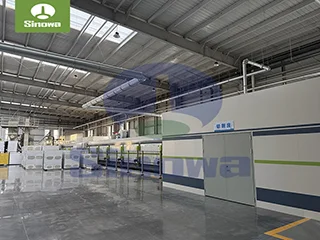
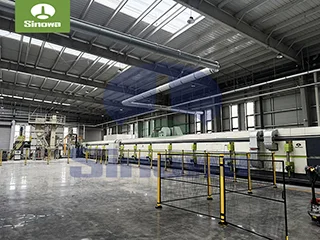
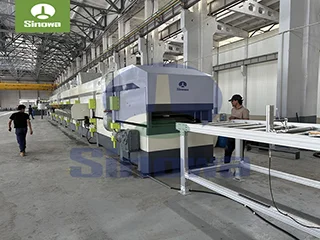
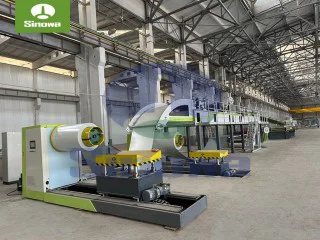
 sandwich panel line
At the heart of the production line is a seamless workflow that transforms raw materials into finished panels through continuous processing. The core components of the line work in tandem to handle each stage of production, from unwinding and preparing the outer facing materials to foaming, curing, cutting, and stacking the final products. The integration of automation not only boosts production efficiency but also minimizes human error, ensuring that each panel meets the required specifications for foam density, thickness, and surface finish. High-density foam panels require stricter process control compared to standard panels, as the foam’s density directly impacts its mechanical properties and insulation performance. This demands precise regulation of temperature, pressure, and material ratios throughout the production cycle.
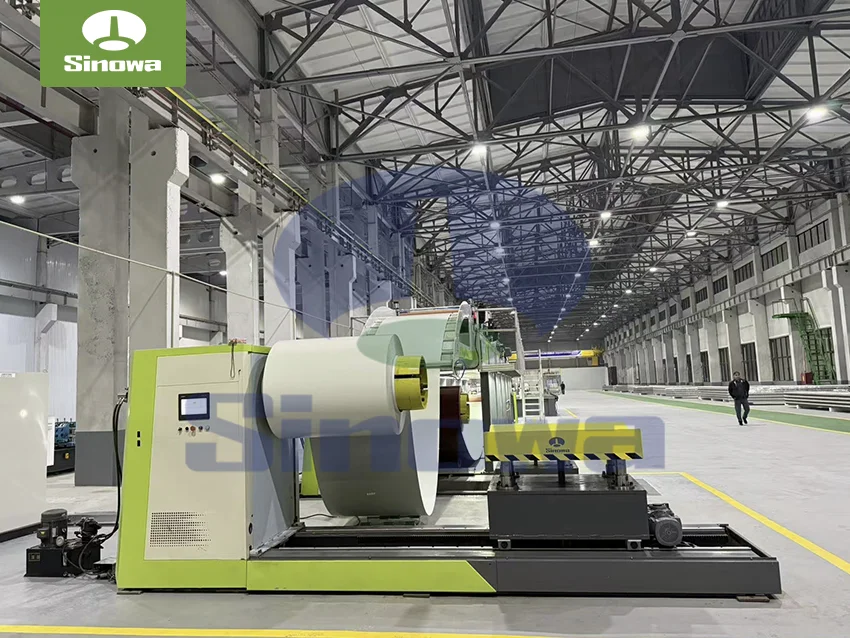
The production process commences with the unwinding of the outer facing materials, which typically include coated metal sheets such as galvanized steel, aluminum, or other corrosion-resistant alloys. These facing materials serve as the structural shell of the sandwich panel, providing protection against environmental factors while supporting the high-density foam core. The unwinding system is equipped with tension control mechanisms to ensure the sheets are fed into the line smoothly and evenly, preventing wrinkles or deformation that could compromise the final product’s quality. For panels requiring decorative surfaces, the unwinding stage may be followed by an embossing process, where rollers imprint patterns such as brick, marble, or wood textures onto the metal sheets. This step adds aesthetic value without sacrificing the structural integrity of the facings, expanding the panels’ applicability in architectural projects.
After unwinding and optional embossing, the facing materials undergo surface treatment to enhance adhesion with the PU foam core. This critical step involves cleaning the inner surfaces of the sheets to remove oils, dirt, or contaminants that could weaken the bond between the facings and the foam. One common method is the use of a corona treatment system, which uses high-frequency energy to modify the surface properties of the metal, improving the wettability and adhesion of the foam. This ensures that the high-density foam forms a strong, permanent bond with the facings, creating a composite structure that acts as a single unit rather than separate layers. Proper surface treatment is essential for preventing delamination, especially in panels used in high-humidity or temperature-fluctuating environments.
Following surface treatment, the upper and lower facing sheets are fed into the roll forming machine, which shapes them into the desired profile. The roll forming system uses a series of adjustable rollers to bend the metal sheets into specific cross-sectional shapes, such as corrugated, trapezoidal, or flat profiles, depending on the application requirements. For high-density foam panels, the roll forming process must be precise to ensure that the spacing between the upper and lower facings is consistent, as this directly determines the thickness of the foam core. The rollers are designed to apply uniform pressure, preventing material fatigue or deformation while maintaining the flatness of the sheets. Many modern roll forming systems feature quick-change components, allowing manufacturers to switch between different panel profiles with minimal downtime, enhancing production flexibility.
Once the facing sheets are formed, they move to the foaming station, where the high-density PU foam is injected between them. The foaming system is a key component of the production line, consisting of material storage tanks, high-pressure pumps, mixing heads, and distribution nozzles. The foam is produced by reacting isocyanates with polyols in the presence of catalysts, blowing agents, and other additives. For high-density foam, the ratio of these components is carefully controlled to achieve a foam density typically ranging from 38 to 42 kg/m³, though this can be adjusted based on specific performance requirements. The blowing agent plays a crucial role in determining the foam’s cell structure; for high-density applications, blowing agents that produce small, uniform closed cells are preferred, as they enhance the foam’s insulation properties and structural strength.
The mixing head of the foaming system ensures that the components are blended thoroughly before being injected into the cavity between the facing sheets. High-pressure mixing is essential for creating a homogeneous foam mixture, which results in consistent density and cell structure throughout the core. The foam is injected in a controlled manner to fill the entire cavity without leaving gaps or air pockets, which could weaken the panel’s structure. After injection, the foam begins to expand and cure, bonding with the inner surfaces of the facing sheets. The curing process is accelerated by a pre-heating system, which maintains the optimal temperature range of 30 to 60 ℃ for foam expansion and hardening. This controlled heating ensures that the high-density foam cures uniformly, developing its full structural strength and insulation properties.
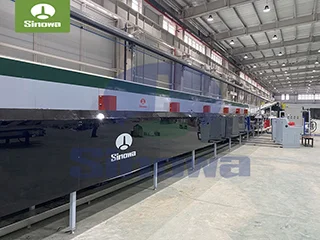
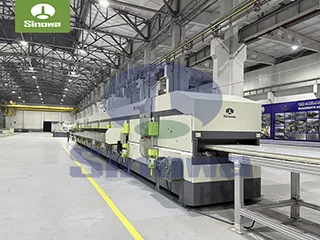
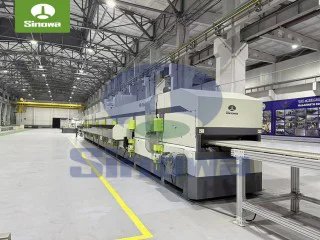
Following foaming and initial curing, the composite panel moves through a double belt conveyor system, which applies uniform pressure and maintains the panel’s shape during the final curing stage. The conveyor belts are made of durable materials capable of withstanding high temperatures and pressures, ensuring that the panel remains flat and the foam core bonds fully with the facings. The length of the conveyor system is designed to provide sufficient time for the foam to cure completely, which is critical for high-density foam panels to achieve their maximum strength and dimensional stability. Some production lines incorporate a hot air circulating heating tunnel along the conveyor path, further optimizing the curing process by maintaining a consistent temperature profile. This ensures that even thick panels cure uniformly, preventing internal stresses that could lead to warping or cracking.
Once the foam is fully cured, the panel is transported to the cutting station, where it is trimmed to the required length using a tracking flying saw or cutter. This cutting equipment is synchronized with the production line’s speed, ensuring precise length control with minimal tolerance. The cutting process must be clean and accurate to avoid damaging the panel’s edges or compromising the foam core’s integrity. High-quality cutting systems use sharp blades or saws that make smooth cuts, reducing the need for post-processing and ensuring that the panels are ready for installation. Some advanced systems feature automatic length adjustment, allowing manufacturers to produce panels of varying lengths without stopping the line, improving production efficiency.
After cutting, the finished panels undergo a cooling process to bring them to ambient temperature, ensuring dimensional stability before stacking and packaging. The cooling system may use forced air or water cooling, depending on the production line’s design and the panel’s thickness. Proper cooling prevents thermal expansion or contraction that could alter the panel’s dimensions, ensuring that each panel meets the specified tolerances. Once cooled, the panels are automatically stacked using a robotic stacking system, which arranges them in neat bundles to prevent damage during storage and transportation. The stacking system is equipped with sensors to ensure that the panels are aligned correctly, and some systems include protective padding between layers to avoid surface scratches.
Quality control is an integral part of the entire production process, with multiple checkpoints throughout the line to monitor key parameters. Sensors and monitoring devices track the thickness of the foam core, the temperature and pressure during foaming and curing, the flatness of the facing sheets, and the accuracy of the cutting length. Any deviations from the set specifications trigger alerts, allowing operators to make immediate adjustments. For high-density foam panels, additional quality checks may include testing the foam’s density, compression strength, closed-cell ratio, and thermal conductivity. These tests ensure that the panels meet the performance requirements for their intended application, whether in cold storage facilities, industrial warehouses, or commercial buildings.
The high-density PU foam panels produced by this line offer a range of superior properties that make them suitable for diverse applications. Their exceptional thermal insulation performance, characterized by low thermal conductivity, reduces energy consumption for heating and cooling systems, making them an eco-friendly choice for sustainable buildings. The closed-cell structure of the foam provides excellent water resistance, preventing moisture absorption and mold growth, which is particularly beneficial in humid environments such as cold storage rooms and livestock facilities. Additionally, the panels’ high strength-to-weight ratio allows for lightweight construction without compromising structural integrity, reducing the overall load on building foundations and enabling faster installation.
In the construction sector, these panels are widely used for external walls, roofs, and partitions in industrial warehouses, manufacturing facilities, shopping centers, and prefabricated buildings. Their quick installation capability reduces construction time and labor costs, making them a cost-effective solution for large-scale projects. In the cold chain industry, high-density PU foam panels are the material of choice for cold storage rooms, refrigerated trucks, and containerized cold boxes, as their insulation properties help maintain stable temperatures, preserving perishable goods. The panels also find applications in the industrial sector, where they are used for sound insulation walls in factories and clean room enclosures in pharmaceutical and electronics plants, thanks to their soundproofing capabilities and ability to maintain a controlled environment.
The production line’s design allows for customization to meet specific project requirements, with adjustable parameters for panel thickness, length, width, and foam density. Manufacturers can produce panels with thickness ranging from 30 mm to 250 mm, catering to different insulation and structural needs. The choice of facing materials and surface finishes also offers flexibility, with options for different colors, patterns, and corrosion resistance levels. This customization capability makes the production line adaptable to a wide range of markets, from residential construction to industrial and commercial applications.
Efficiency and sustainability are key considerations in modern production lines for high-density PU foam panels. Many lines are designed with energy-saving features, such as efficient heating systems and variable-speed motors, which reduce energy consumption and operational costs. The use of environmentally friendly blowing agents, such as pentane, minimizes the impact on the ozone layer and reduces greenhouse gas emissions, aligning with global sustainability goals. Additionally, the continuous production process minimizes material waste, as any offcuts or defective panels can be recycled or repurposed, further enhancing the line’s environmental performance.
Maintenance of the production line is essential to ensure consistent performance and longevity. Regular inspections and servicing of key components, such as the foaming machine, roll forming rollers, and cutting equipment, prevent breakdowns and reduce downtime. Lubrication of moving parts, cleaning of mixing heads, and calibration of sensors and monitoring devices are part of routine maintenance procedures. Many modern production lines are equipped with diagnostic systems that monitor equipment performance in real-time, identifying potential issues before they escalate into major problems. This proactive maintenance approach ensures that the line operates at peak efficiency, delivering high-quality panels with minimal interruptions.
In conclusion, the production line for high-density PU foam sandwich panels represents a perfect blend of automation, precision engineering, and material science. Each component and process is designed to maximize the performance of the final product, ensuring that the panels offer superior insulation, strength, and durability. From the unwinding of raw materials to the stacking of finished products, the line operates seamlessly to deliver consistent quality at high efficiency. As the demand for sustainable, high-performance building materials continues to grow, these production lines will play an increasingly important role in meeting the needs of the construction, industrial, and cold chain sectors. Their ability to produce customized panels with exceptional properties makes them a valuable asset for manufacturers looking to stay competitive in a rapidly evolving market.
https://www.cnsinowa.com/sandwich-panel-machines/pu-sandwich-panel-production-line-for-high-density-foam-panels.html