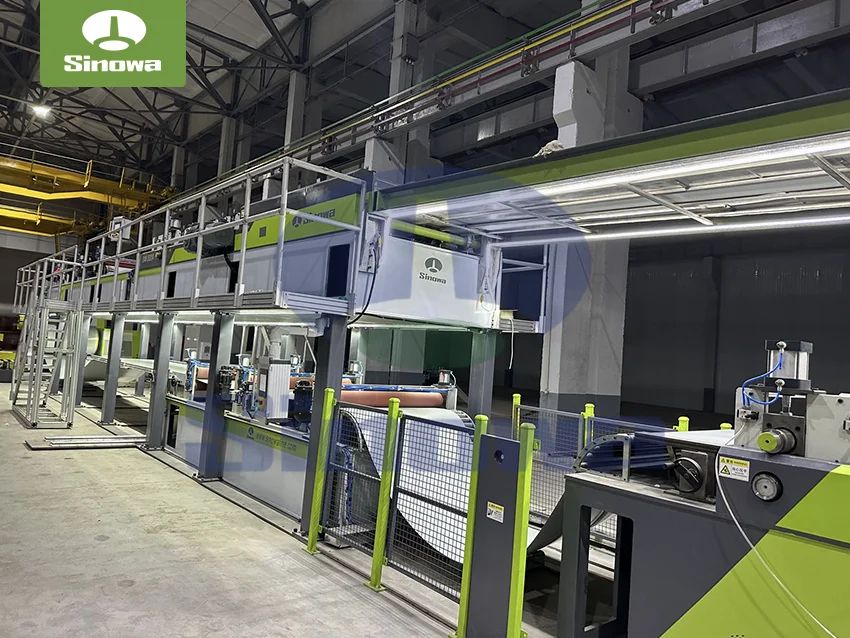
 sandwich panel machine
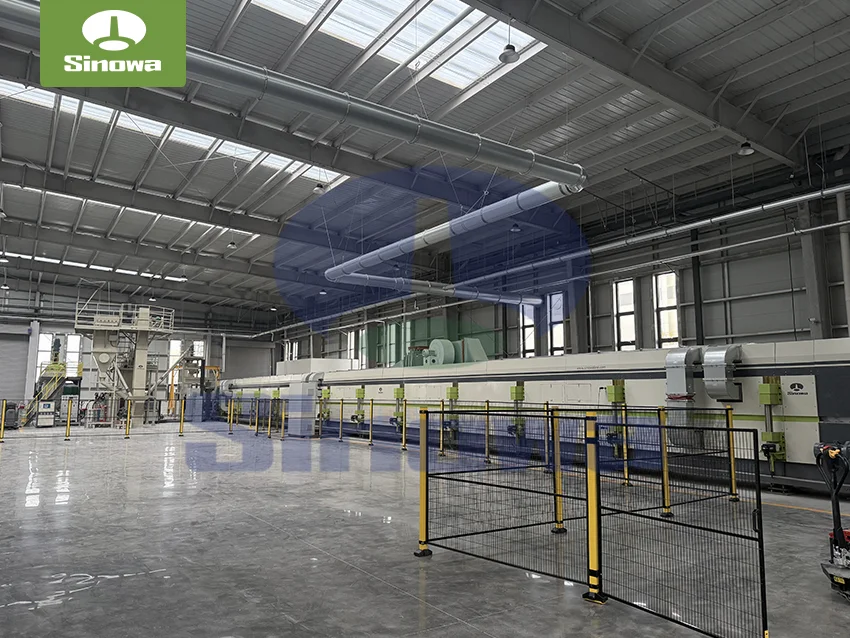
The color steel profiled sandwich panel machine adopts a linear modular integrated layout, with all functional units arranged in strict accordance with the sequential logic of panel production, ensuring seamless connection between each processing link without redundant material handling and waiting procedures. The whole production line can be divided into six core functional modules according to production sequence: raw material unwinding and leveling module, continuous roll forming module, automatic core material conveying and laying module, precise gluing and composite pressing module, online fixed-length cutting and edge trimming module, and automatic finished product conveying and stacking module. All modules are linked synchronously by a unified central control system, realizing coordinated operation of mechanical transmission, temperature adjustment, pressure control and speed matching. Unlike single-function processing machinery that only completes roll forming or cutting separately, this integrated production line unifies metal surface processing, internal insulation core material compounding and finished product shaping into one closed-loop production system, which fundamentally reduces manual participation links, avoids quality fluctuations caused by human operation errors, and improves the overall continuity and stability of panel manufacturing. In actual factory operation, the whole line can run stably for a long time under continuous working conditions, adapting to uninterrupted batch production demands of building material manufacturers and meeting the growing market demand for color steel sandwich panels in peak construction seasons.
The front-end raw material unwinding and leveling module is the starting point of the entire production workflow, undertaking the stable feeding and stress elimination of upper and lower color steel coils. Color coated steel coils used for panel surface layers are rolled and stored for a long time after production, which will generate inherent internal stress and subtle surface bending deformation. If such steel plates directly enter subsequent forming and composite processes without pretreatment, the final finished panels will suffer from warping, surface wrinkling and uneven overall flatness, affecting later building assembly effects and overall structural tightness. The hydraulic unwinding device equipped in this module can stably support steel coils of different outer diameters and weights, and is built with an adaptive tension adjustment structure. During continuous material output, the system automatically adjusts unwinding tension in real time according to the operating speed of the rear-end forming unit, preventing steel plate stretching deformation caused by excessive tension or material deviation and stacking caused by insufficient tension. After unwinding, the color steel plates pass through a multi-group roller leveling mechanism, which eliminates internal stress step by step through repeated rolling from multiple directions, restores the flat state of the steel plates, and retains the complete anti-corrosion and color coating on the steel plate surface without scratching or peeling. Meanwhile, this module reserves matched feeding ports for different types of insulation core materials, realizing synchronous feeding of metal surface materials and internal core materials, and laying a foundation for synchronous composite processing in the later stage.
The continuous roll forming module is the key unit that shapes the appearance profile and structural strength of finished panels, distinguishing profiled sandwich panels from ordinary flat composite panels. Flat color steel plates processed by the front leveling unit are sent into the precision roll forming group composed of dozens of segmented forming rollers. Different from stamping forming which completes shape changing at one time and easily causes local metal fatigue and coating damage, the equipment adopts gradual cold roll forming technology. The flat steel plate undergoes slow and segmented bending and extrusion through roller sets with different profile designs, completing the processing of trapezoidal waves, corrugated arcs and other common roof and wall profiles step by step. This gradual processing mode protects the organic coating on the surface of color steel plates completely, maintains the original anti-rust and weather resistance performance of the metal surface, and avoids hidden structural cracks inside the steel plate. By replacing matched roller molds and adjusting the spacing and extrusion pressure of forming rollers, the same production line can switch freely between multiple panel profile specifications without large-scale equipment reconstruction, realizing flexible production of diversified panel products to adapt to different building needs: high-wave profiled panels are suitable for building roof systems with higher waterproof and drainage requirements, while low-wave profiled panels are more applicable to building wall enclosure systems requiring smooth appearance and convenient splicing. The entire forming process keeps synchronous speed matching with front-end feeding equipment, ensuring no material accumulation or disconnection between links, and the dimensional error of formed profiles is controlled within an extremely small range to guarantee accurate assembly of panels on construction sites.
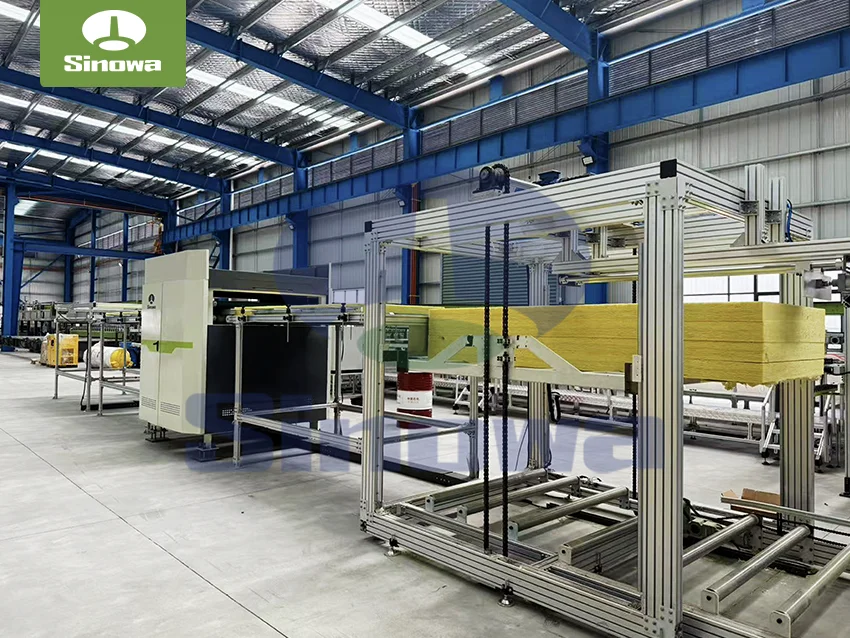
Following the roll forming process, the automatic core material conveying and laying module accurately arranges insulation core materials between upper and lower profiled color steel plates. Common matching core materials include foam insulation materials and fibrous fireproof insulation materials, both of which have lightweight characteristics and excellent heat insulation performance, reducing the overall self-weight of building panels while blocking indoor and outdoor heat exchange. The core material conveying system adopts closed belt conveying structure to avoid core material scattering and dust overflow during high-speed operation, improving on-site production environment. Before formal laying, the equipment carries out automatic thickness calibration on core materials, trimming uneven parts on core material surfaces to ensure consistent thickness of insulation layers inside each sandwich panel. Uniform core material laying is critical to finished panel quality: uneven core thickness will lead to unbalanced internal stress of composite panels, resulting in panel bending after long-term outdoor use, while complete coverage of core materials can avoid hollow areas inside panels and guarantee consistent thermal insulation performance of the whole panel. The conveying speed of core materials is automatically synchronized with the running speed of upper and lower steel plates by the central control system, realizing one-to-one matching of metal plates and core materials without position deviation in the composite area.
The precise gluing and composite pressing module is the core component determining the overall bonding strength and service life of sandwich panels, directly affecting the delamination resistance, wind pressure resistance and overall structural durability of finished panels in long-term outdoor service. After core materials are laid in place, the automatic gluing system carries out quantitative and uniform adhesive coating on the bonding surfaces between upper steel plate, core material and lower steel plate. The gluing system supports adaptive adjustment of glue amount and coating density according to different core material characteristics: for porous fibrous core materials, appropriate permeable gluing mode is adopted to make adhesive penetrate into core material surface pores and form mechanical occlusion bonding structure; for dense closed-cell foam core materials, full-surface uniform gluing is adopted to balance bonding firmness and adhesive consumption. The equipment eliminates manual gluing operation thoroughly, solving common defects in manual production such as uneven glue coating, missing glue areas and excessive glue accumulation, which easily cause panel delamination, bulging and unstable bonding strength. After gluing, the three-layer structure composed of upper profiled steel plate, insulation core material and lower steel plate enters the constant-temperature composite pressing area. The pressing unit provides stable and balanced vertical pressure and constant curing temperature, discharging residual air between layers completely to eliminate internal gaps. Constant temperature environment accelerates adhesive curing reaction, making the three layers form an integral inseparable composite structure in a short time. After composite pressing, the overall rigidity and impact resistance of panels are significantly improved, and layered separation will not occur even under long-term outdoor wind load, temperature difference alternation and mechanical extrusion.
The post-processing module includes online flying cutting, edge trimming and automatic finished product stacking, completing final shaping and sorting of continuous long composite panels. Different from traditional static cutting equipment that needs to stop production for cutting, the sandwich panel production machine adopts dynamic flying cutting technology, which realizes fixed-length cutting while panels keep moving forward continuously. This design avoids production pause caused by cutting operation, maintains uninterrupted production rhythm of the whole line and greatly improves overall production efficiency. Operators can set arbitrary cutting length parameters through the central control interface according to actual construction order demands, and the cutting tool can track panel operating speed intelligently to ensure flat and burr-free cutting sections without secondary manual polishing. The follow-up edge trimming device cuts off redundant materials on both sides of panels to unify the overall width of finished products, ensuring consistent overall dimensions of each batch of panels. Finally, finished panels are transported to the stacking area by automatic conveyor belts, and the mechanical stacking mechanism completes orderly horizontal stacking automatically. The whole post-processing process requires no manual carrying and sorting, reducing labor input in the finished product link and lowering the risk of panel surface scratch damage caused by manual handling.
The full-line intelligent central control system acts as the brain of the color steel profiled sandwich panel making machine, managing all operating parameters and equipment status of each functional module uniformly. The system adopts integrated programmable control mode with a visual touch screen interactive interface, allowing operators to complete one-click start, parameter setting, production data viewing and equipment status monitoring simply. All core production parameters including feeding speed, forming pressure, gluing volume, pressing temperature, cutting length and stacking quantity can be adjusted digitally on the interface, and the system will automatically realize synchronous matching of operating parameters of all front and rear modules without manual debugging of single equipment separately. During formal production, the control system monitors real-time operating data of motors, transmission parts, temperature sensors and pressure sensors in each link. Once abnormal conditions such as material jamming, temperature deviation, pressure fluctuation and motor overload occur, the system will send real-time early warning signals and execute automatic emergency protection actions to stop equipment operation appropriately, preventing mechanical damage and mass production of defective products. In addition, the system can record daily production output, equipment operating duration and abnormal failure data automatically, providing complete data support for factory production schedule arrangement, equipment regular maintenance and production process optimization.
Compared with traditional semi-automatic discrete production equipment, the integrated color steel profiled sandwich panel manufacturing machine has comprehensive advantages in production efficiency, product quality stability, production cost control and site space utilization. In terms of production efficiency, the continuous assembly line mode removes all intermediate material turnover and waiting links, and the hourly output of the integrated line is several times that of separate forming and composite equipment, perfectly adapting to large-scale centralized order production. In terms of quality stability, full-process automated operation reduces human intervention to the minimum, making the thickness, bonding strength, profile size and surface flatness of each finished panel highly consistent, avoiding quality differences between different batches of products. In terms of cost control, precise quantitative gluing and fixed-length cutting designs reduce waste of adhesive, color steel plates and core materials effectively, lowering overall raw material consumption; meanwhile, high automation reduces the number of on-site operators required for the whole line, cutting long-term labor costs for manufacturers. In terms of site layout, the compact linear integrated structure occupies smaller factory floor space, facilitating standardized and orderly planning of production workshops and optimizing overall factory space utilization.
Panels produced by this professional equipment have comprehensive performance advantages matching modern green building standards, thus covering a wide range of construction application scenarios. The composite structure of metal surface and lightweight core material makes the panels lightweight but high in strength, which can reduce the self-weight of building enclosure structures effectively, lower the bearing load of building main structures and save foundation construction investment. Built-in insulation core materials block indoor and outdoor heat transfer efficiently, cutting building heating and cooling energy consumption significantly and meeting global building energy conservation and emission reduction requirements. Meanwhile, the integrated composite structure has excellent sound insulation, rainwater waterproofing and outdoor weather resistance, capable of resisting long-term ultraviolet irradiation, temperature difference changes and wind and rain erosion without surface fading, panel deformation or internal delamination. Such panels are widely applied in enclosure walls and roofs of industrial workshops and logistics warehouses, dust-free purification workshops with strict indoor environment requirements, rapid-assembly temporary construction buildings, large-scale exhibition venues and rural prefabricated residential buildings. With the global acceleration of prefabricated building popularization, the market demand for such high-efficiency composite panels keeps rising, further driving the market demand for matched automatic panel production machines.
Reasonable daily and regular maintenance is essential to prolong the service life of color steel profiled sandwich panel production line and maintain long-term stable operating accuracy. Daily routine maintenance focuses on cleaning and inspection: operators need to clean residual core material debris and adhesive stains on roller surfaces, conveyor belts and cutting tools after daily shutdown, preventing hard impurities from scratching color steel plates and affecting forming accuracy in subsequent production. Operators also need to check the tightness of transmission chains and belts every day to avoid material slipping caused by loose transmission parts. Regular maintenance conducted every fixed production cycle includes lubrication of all rotating bearings and transmission shafts, calibration of forming roller gaps and cutting tool positions, and detection of temperature and pressure sensors in the composite pressing area. Timely maintenance can avoid gradual deviation of equipment operating accuracy caused by long-term high-load operation, reduce unexpected equipment failure downtime, and ensure that the equipment maintains consistent production accuracy in long-term batch production. Standardized maintenance management not only reduces equipment repair and replacement costs, but also guarantees long-term stable output of high-quality finished panels.
Looking into the future, driven by intelligent manufacturing and green industrial upgrading, color steel profiled sandwich panel line will develop towards higher intelligence, stronger multi-product compatibility and lower energy consumption. The next generation of equipment will be equipped with automatic material deviation correction and intelligent defect detection functions, realizing real-time online identification of subtle defects such as incomplete gluing and profile forming errors, and removing defective products automatically without manual inspection. In terms of production compatibility, upgraded equipment can realize faster switching between different core materials and panel profiles, supporting customized small-batch diversified panel production to meet personalized construction design demands. In terms of energy conservation, optimized heating and transmission structures will reduce overall equipment operating energy consumption and production noise, fitting the development trend of green industrial production. In addition, modular equipment design will be further popularized, making equipment installation, disassembly, maintenance and functional expansion more convenient, and improving the adaptability of production lines to different factory scales and workshop environments.
In conclusion, the color steel profiled sandwich panel machinery is indispensable core equipment in the manufacturing chain of modern lightweight building insulation materials. It connects metal cold forming technology, composite bonding technology and intelligent automatic control technology organically, solves multiple pain points of traditional panel production including low efficiency, unstable quality and high labor cost, and promotes the standardized and high-efficiency development of the color steel sandwich panel manufacturing industry. With the continuous advancement of global prefabricated construction and green building policies, the upgrading iteration of such panel production equipment will continue to advance, providing more efficient, energy-saving and flexible manufacturing solutions for building material manufacturers, and supporting the high-quality development of the entire prefabricated construction industry from the equipment end.
https://www.cnsinowa.com/sandwich-panel-machines/color-steel-profiled-sandwich-panel-machine.html