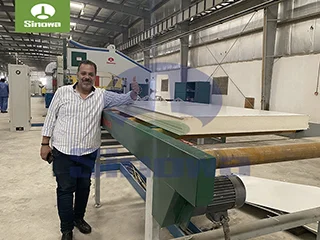
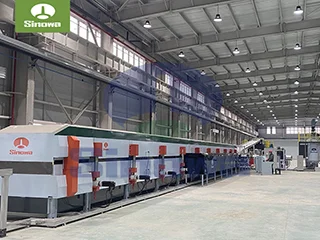
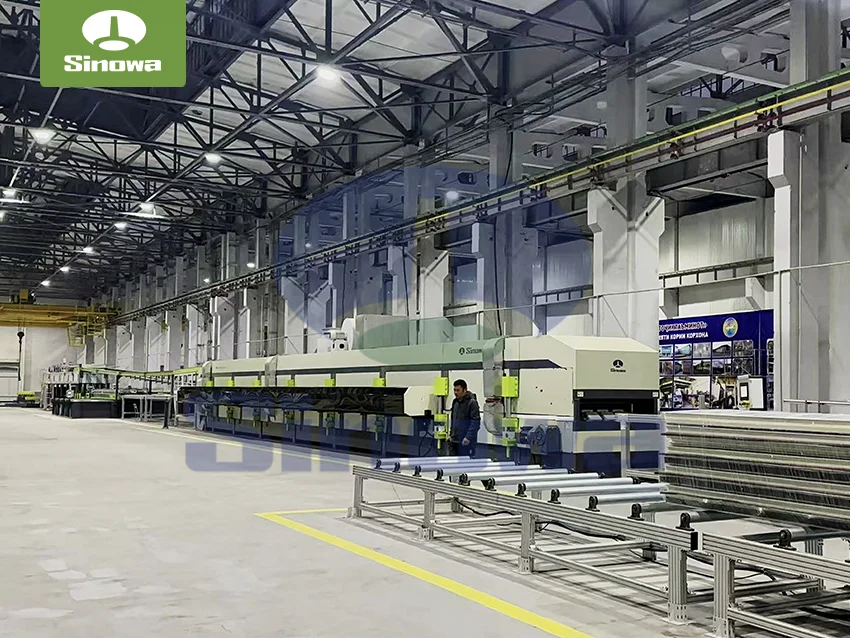
 sandwich panel machine
The core operational logic of the PU sandwich panel machine with sound insulation foam core lies in its integrated continuous molding process, which organically combines metal surface layer processing, polyurethane foam foaming, core layer forming, and composite pressing into a streamlined production workflow. The entire production process is automated and interconnected, eliminating the instability and quality deviations caused by segmented manual operation. At the initial stage of production, the equipment first carries out precise unwinding, leveling, and surface pretreatment of the outer layer materials, which are usually high-toughness metal sheets with smooth and wear-resistant surfaces. This pretreatment step ensures the flatness and surface uniformity of the outer protective layer, laying a solid foundation for the subsequent composite bonding and overall structural stability of the panel. Meanwhile, the internal raw material supply system of the machine accurately conveys polyurethane raw materials to the foaming unit, where the materials undergo uniform mixing and controllable foaming reactions under set environmental conditions.
What distinguishes this equipment from ordinary polyurethane sandwich panel production line is its exclusive optimization for sound insulation foam core molding. The polyurethane foam core produced by conventional equipment often has uneven cell structure and inconsistent density, which leads to limited and unstable sound absorption and noise reduction effects. In contrast, the sound insulation-focused production system adopts precision proportional control and constant-temperature foaming technology, which enables the formation of a uniform closed-cell microstructures inside the foam core. These dense and tiny closed air pockets serve as natural sound energy dissipation structures. When sound waves propagate to the panel, the foam core can effectively trap and consume sound wave energy through internal reflection, friction, and attenuation, greatly suppressing the transmission of airborne noise. The viscoelastic properties of the polyurethane foam further enhance the damping effect on medium and high-frequency noise, solving the problem of poor sound insulation of traditional single-layer panels and ordinary composite panels.
In the formal composite molding stage, the polyurethane sandwich panel line adopts multi-stage constant-pressure pressing and low-temperature curing technology to ensure the tight integration of the outer surface layer and the sound insulation foam core. The pressing system maintains stable and uniform pressure distribution throughout the panel molding process, avoiding local delamination, hollowing, or uneven core thickness that may affect structural strength and acoustic performance. The matched curing system provides a gentle and constant-temperature curing environment, allowing the polyurethane foam to complete sufficient cross-linking reaction, which solidifies the stable closed-cell structure and locks in the excellent sound insulation performance of the core layer. This integrated one-time molding process not only improves the overall structural compactness of the sandwich panel but also ensures the consistency of sound insulation indicators for each batch of products, realizing standardized and large-scale production of high sound insulation composite panels.
The panels produced by this professional polyurethane sandwich panel machine possess far more comprehensive performance than ordinary building panels in terms of acoustic environment optimization. The unique closed-cell foam core structure can effectively block the transmission of external noise sources, including traffic noise, mechanical operation noise, and environmental wind and rain noise, while reducing the internal sound reverberation of enclosed spaces. In practical application scenarios, this structural feature enables the panels to form a resonant sound absorption and insulation system between the outer rigid protective layer and the inner soft foam core. The rigid outer layer reflects most of the high-frequency sound waves, while the foam core absorbs and attenuates low and medium-frequency sound waves, forming a three-dimensional noise reduction mechanism that covers multiple frequency bands. This synergistic acoustic performance makes the panels highly adaptable to various spaces with strict noise control requirements.
Beyond outstanding sound insulation capability, the equipment's production advantages also endow the finished panels with multiple auxiliary practical properties that enhance their overall application value. The precise foaming and molding process makes the foam core have extremely low water absorption, as the closed-cell structure can effectively isolate moisture and water vapor penetration. This moisture-proof characteristic prevents the foam core from mildewing, swelling, or deforming due to humid environments, ensuring the long-term stability of sound insulation and structural performance. In addition, the integrated composite structure formed by the machine’s high-pressure bonding process gives the panels excellent overall rigidity and impact resistance. Despite the lightweight overall quality of the panels, they can withstand external wind pressure, mechanical friction, and daily structural vibration, adapting to complex outdoor and industrial service environments.
The production efficiency of the PU sandwich panel line with sound insulation foam core fully meets the market demand for large-scale engineering construction and standardized industrial supporting facilities. The continuous circulating production mode enables the equipment to operate stably for a long time without frequent shutdown adjustments. As long as the raw material supply is maintained continuously, the machine can complete uninterrupted molding, pressing, curing, and cutting of panels, realizing high-volume output of finished products. The built-in fine-tuning system of the equipment can flexibly adjust the thickness of the foam core and the overall specification of the panels according to different application needs, realizing diversified production of multiple specifications on a single device. This flexible production mode avoids the need for multiple sets of equipment for different product types, effectively reducing production space occupancy and equipment input costs for manufacturers.
The intelligent control system configured for the foam core sandwich panel line further optimizes production accuracy and operational convenience. The whole production process is monitored and adjusted in real time through an integrated control unit, which automatically corrects deviations in raw material ratio, foaming temperature, pressing pressure, and panel cutting size. This intelligent control mode completely avoids the errors caused by manual experience differences, ensuring that every produced panel has consistent core density, uniform thickness, and stable acoustic performance. The real-time monitoring function of the system can also track the operating status of each production unit, timely identify abnormal operating conditions, and reduce the probability of defective products and equipment failure, greatly improving the overall yield and production continuity.
In terms of application scenarios, the high-performance sound insulation PU sandwich panels produced by this machine cover a wide range of civil construction, commercial space, and industrial fields. In civil residential construction, the panels are used for interior partition walls, exterior wall cladding, and roof structures, effectively isolating outdoor community noise and indoor mutual interference noise, creating a quiet and comfortable living space. In commercial public buildings such as office buildings, exhibition halls, and shopping malls, the panels optimize the indoor acoustic environment, reducing the impact of pedestrian flow and equipment operation noise on public space experience, and improving the comfort of office and consumer environments.
In industrial production environments, the equipment's products play an even more critical role in noise reduction and environmental optimization. Many industrial workshops, equipment rooms, and factory auxiliary spaces face persistent high-decibel mechanical noise. The sound insulation sandwich panels can be used for factory wall enclosure, equipment noise reduction cover, and workshop partition facilities, effectively isolating industrial noise inside and outside the workshop, protecting the physical health of on-site operators, and reducing noise pollution to the surrounding environment. At the same time, the lightweight and easy-installation characteristics of the panels can shorten the construction cycle of industrial noise reduction projects and reduce the difficulty of on-site construction.
In special public facility scenarios such as transportation hubs and cultural venues, the panels also show unique application advantages. High-speed waiting halls, station corridors, and cultural performance venues require extremely high indoor quietness and sound clarity. The multi-band sound insulation performance of the PU foam core panels can effectively suppress background noise, ensure the clarity of public broadcasting and sound transmission, and meet the strict acoustic environment standards of high-standard public spaces. In addition, the panels have good weather resistance, can adapt to high-temperature, low-temperature, and humid and dry alternating environments, and will not have performance attenuation such as sound insulation decline and structural aging after long-term outdoor and long-time service.
From the perspective of industry development, the popularization and upgrading of the PU sandwich panel production line with sound insulation foam core have promoted the iterative upgrading of the entire composite panel manufacturing industry. Traditional building panels often have single functions, either focusing on thermal insulation without outstanding sound insulation effects, or pursuing structural strength with poor environmental adaptability. This professional equipment integrates multiple superior performances through precise process optimization, realizing the integration of sound insulation, thermal preservation, moisture resistance, and structural stability of building panels. It provides high-quality basic materials for the construction of green and low-noise modern buildings, and also promotes the standardized and refined development of the noise reduction material manufacturing industry.
The equipment's environmental protection performance is also an important reason for its wide market recognition. The polyurethane raw materials used in the production process are scientifically proportioned, and the fully closed foaming and molding process will not produce excess waste and harmful volatile substances. The finished panels do not contain harmful components, can be recycled and reused in the later stage of service life, and conform to the development trend of green manufacturing and energy-saving building industry. Meanwhile, the excellent thermal insulation performance of the closed-cell foam core can reduce the energy consumption of building temperature regulation, realizing the dual value of environmental protection and energy saving while solving the noise problem.
In terms of sandwich panel equipment maintenance and service life, the modular structural design makes the daily operation and maintenance of the machine more convenient. Each functional unit of the equipment is independently arranged and easy to disassemble and inspect. Daily cleaning, component inspection, and wear part replacement can be completed quickly, reducing the time cost of equipment maintenance. The key operating components are made of high-strength and wear-resistant materials, which can adapt to long-term high-load continuous production, ensuring stable long-term operation of the equipment. This reliable operational stability enables manufacturers to maintain consistent product quality and production capacity for a long time, providing stable support for market supply and project construction.
With the continuous improvement of social requirements for building comfort, industrial environmental standards, and public space acoustic quality, the market demand for high-performance sound insulation composite panels is constantly increasing, which also puts forward higher requirements for the precision, efficiency, and functional diversification of panel production equipment. The PU sandwich panel production machine with sound insulation foam core, with its professional acoustic optimization process, stable production performance, and wide application adaptability, has become a core equipment supporting the upgrading of the building materials industry. In the future, with the continuous innovation of automation and material technology, this type of equipment will further realize higher precision molding, more diversified product customization, and more energy-saving production operation, providing more high-quality and efficient solutions for noise reduction and environmental optimization in construction, industry, and public facility fields.
https://www.cnsinowa.com/sandwich-panel-machines/pu-sandwich-panel-machine-with-sound-insulation-foam-core.html