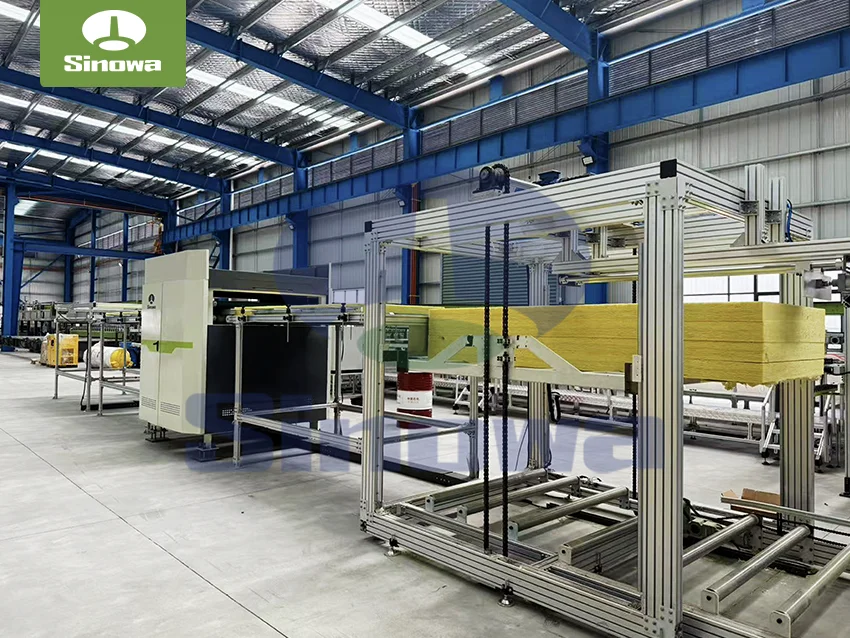
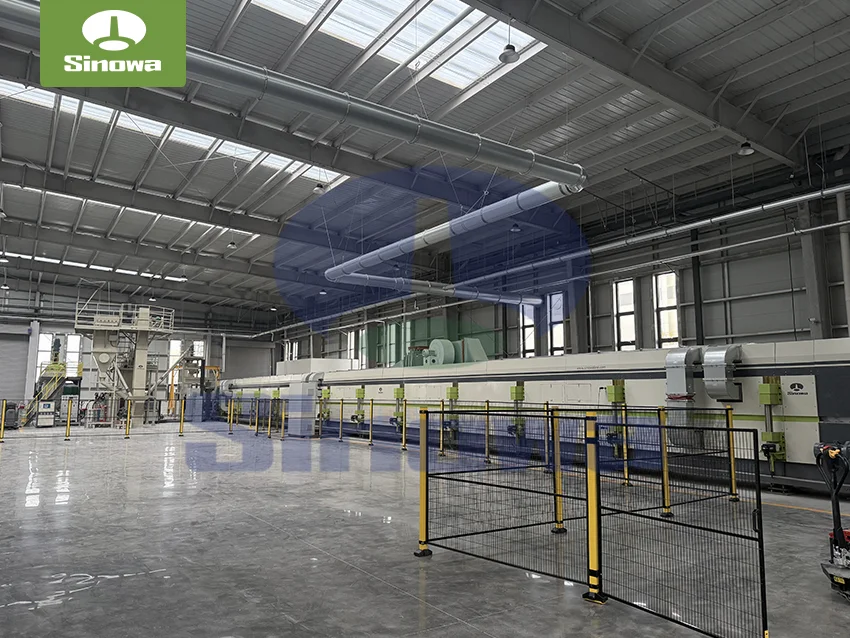
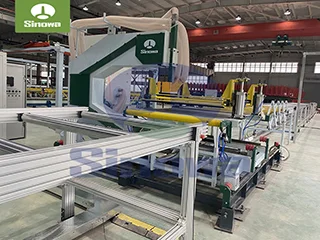
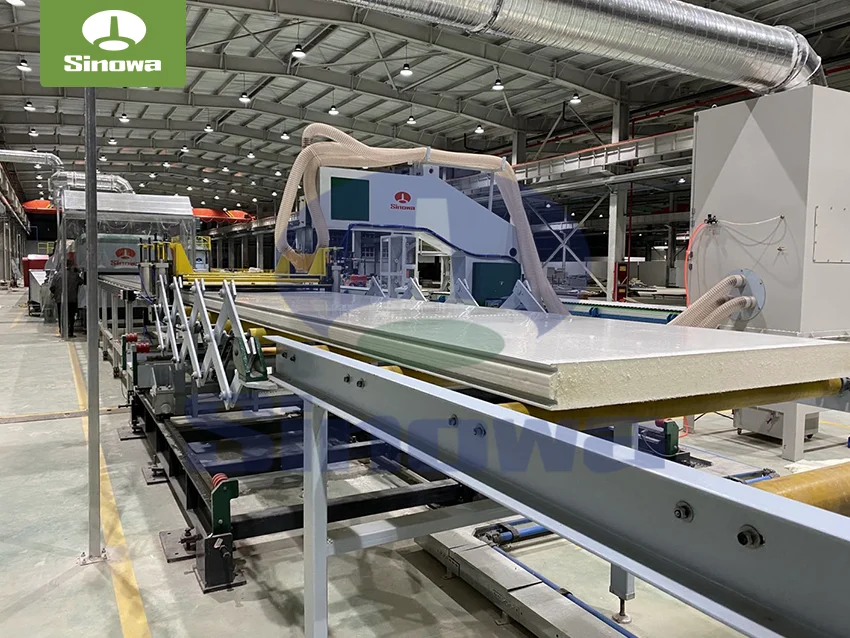
 sandwich panel line
The operational logic of the cold room-focused PU sandwich panel production line starts with systematic raw material preparation and automated feeding, the foundational stage that determines the basic quality consistency of finished panels. Surface facing materials, commonly high-strength metal sheets with excellent anti-corrosion and weather resistance, are loaded into uncoiling and flattening units. These units automatically release coiled materials at a constant speed and eliminate surface wrinkles, uneven tension, and structural irregularities through multi-stage roller leveling, ensuring the flatness and dimensional uniformity of the outer layer of each panel. Meanwhile, two-component polyurethane raw materials are stored in independent temperature-stabilized tanks, where precise temperature regulation maintains the optimal fluidity and chemical activity of the liquid raw materials. This temperature control mechanism prevents chemical degradation, uneven mixing ratios, and abnormal foaming reactions caused by ambient temperature fluctuations, laying a stable foundation for the subsequent foam forming process. All feeding parameters are dynamically adjusted through automated control systems to match continuous production speed, avoiding material accumulation or supply interruption that may cause production discontinuity and panel quality deviation.
High-pressure proportional mixing and uniform material spraying constitute the core functional stage that shapes the thermal insulation performance of cold room PU panels. The polyurethane raw materials are delivered to the high-pressure mixing head via precision metering pumps, which strictly control the delivery ratio and flow rate of the two components to ensure full and uniform chemical fusion. Accurate proportional matching is essential for cold room panel production, as minor ratio deviations will lead to inconsistent foam density, incomplete curing, or fragile foam structures, resulting in reduced thermal insulation capacity and poor structural stability of the panels. After intensive mixing inside the closed mixing head, the homogeneous liquid polyurethane mixture is sprayed evenly on the surface of the lower facing material through reciprocating sweeping movement of the spray nozzle. The spraying range, thickness, and uniformity are precisely calibrated to form a continuous and flat liquid material layer, which can fully fill the space between upper and lower facing materials in the subsequent lamination process without voids or thin areas that may form thermal bridges and weaken the cold room’s temperature locking effect.
Laminating and pressure maintaining curing are key processes that integrate surface facing materials and polyurethane foam cores into a unified composite structure. After the liquid polyurethane material is sprayed, the upper and lower facing materials with the intermediate foam raw material layer are synchronously guided into the double-track laminating conveyor system. This system features parallel heatable conveyor belts that apply constant and uniform pressure across the entire width and length of the panel, effectively bonding the foam core with the inner surfaces of the two facing materials. Different from ordinary building sandwich panel production, the curing temperature and pressure parameters of cold room panel lines are specially optimized for low-temperature resistance and anti-deformation performance. In the long constant-temperature curing tunnel, the liquid polyurethane mixture undergoes gradual foaming, expansion, and polymerization reactions, with the foam structure slowly stabilizing and forming a dense, closed-cell micro structure. This closed-cell structure is the core guarantee of the panel's excellent thermal insulation and moisture-proof performance, as it can effectively block air convection and water vapor penetration, preventing frost formation, condensation, and heat exchange inside cold rooms during long-term operation.
The continuous curing process is precisely controlled in terms of time, temperature, and pressure to avoid common defects such as insufficient foaming, over-expansion, uneven core density, and delamination between layers. Sufficient and stable curing enables the polyurethane foam core to achieve ideal mechanical strength and dimensional stability, ensuring that the panels will not deform, shrink, or crack under long-term low-temperature working conditions. The integrated lamination and curing design eliminates intermittent gaps in traditional segmented production, enabling the formation of seamless continuous panel blanks. This continuous structural feature avoids weak connection points present in spliced panels, further enhancing the overall tightness and thermal insulation integrity of cold room enclosure structures. Throughout the curing stage, real-time monitoring systems track temperature distribution and pressure changes in each section of the tunnel, automatically adjusting operating parameters to offset the impact of minor environmental changes and maintain consistent production quality.
Precision cutting and post-forming processing are the final stages of standardized panel production, converting continuous cured panel blanks into finished products with specified dimensions. Equipped with a high-precision flying cutting system, the polyurethane sandwich panel production line completes fixed-length cutting in a moving state without stopping the continuous production process, effectively improving production efficiency while ensuring flat and burr-free cutting sections. The cutting system supports flexible adjustment of panel length specifications to meet the diverse dimensional requirements of different cold room scales and structural designs. After cutting, edge trimming and fine shaping processes are carried out to optimize the flatness and assembly accuracy of panel edges. The standardized edge structure enables tight splicing between panels during cold room installation, reducing assembly gaps and air leakage risks, which is crucial for maintaining the low-temperature stability of cold storage spaces and reducing long-term energy consumption.
The inherent process advantages of the professional PU sandwich panel line for cold rooms endow finished panels with superior comprehensive performance compared with ordinary insulation panels. The closed-cell polyurethane foam formed by precise continuous production has extremely low thermal conductivity, which can effectively inhibit heat transfer between the internal low-temperature environment and the external ambient temperature of the cold room. This excellent thermal insulation performance greatly reduces the operating load of cold room refrigeration equipment, realizing stable temperature control and long-term energy-saving operation. In addition, the integrally formed composite structure of the panels features high overall rigidity and impact resistance. The tight bonding between the metal facing and the foam core enables the panels to bear certain external loads without structural damage, adapting to the long-term static load and environmental pressure of cold room enclosure structures.
Moisture resistance and air tightness are another core advantage of panels produced by this dedicated polyurethane sandwich panel line. The dense closed-cell foam structure does not absorb water vapor, avoiding insulation performance attenuation caused by moisture penetration. In humid and variable ambient environments, the panels can maintain stable physical and thermal performance for a long time, preventing problems such as internal foam mildew, insulation failure, and structural corrosion that often occur in inferior insulation panels. This characteristic is particularly important for cold rooms that operate continuously throughout the year, as it effectively extends the service life of cold room facilities and reduces frequent maintenance and replacement costs. Meanwhile, the automated continuous production process minimizes manual intervention errors, ensuring that every batch of panels maintains consistent density, thickness, bonding strength, and thermal insulation parameters, realizing standardized and large-scale production of high-quality cold room insulation materials.
The structural design of the PU sandwich panel machine fully considers the adaptability and scalability of cold room engineering applications. The adjustable production parameters enable the equipment to manufacture panels with different thicknesses and core densities, meeting the insulation needs of low-temperature cold storage, ultra-low temperature freezing storage, and constant-temperature fresh-keeping warehouses. Panels with thicker core layers are suitable for ultra-low temperature working environments with strict heat insulation requirements, while moderately sized panels can be applied to conventional fresh-keeping cold rooms, achieving precise matching between product performance and application scenarios. In addition, the production process can optimize the surface flatness and edge structure of panels according to the installation characteristics of cold rooms, making on-site assembly more convenient and efficient, and improving the overall construction efficiency of cold room projects.
From the perspective of industrial production efficiency, the fully automated integrated design of the cold room sandwich panel production line realizes seamless connection of all production links from raw material input to finished product output. The continuous operation mode eliminates the waiting and transition time of segmented production, greatly improving unit-time output capacity. The intelligent parameter control system realizes automatic error correction and stable operation, reducing defective product rates and material waste. The standardized production logic ensures that the performance of each panel is stable and reliable, avoiding quality fluctuations caused by manual operation differences. For cold chain engineering enterprises and insulation material manufacturers, this production line not only improves production scale and efficiency but also stabilizes product quality, helping to improve the overall construction quality and operational stability of cold room infrastructure.
In practical industrial applications, panels produced by professional polyurethane sandwich panel machine have become the preferred enclosure materials for modern cold room construction, covering food cold storage, pharmaceutical low-temperature storage, chemical low-temperature workshops, and logistics refrigeration warehouses. The excellent thermal insulation, structural stability, moisture resistance, and assembly flexibility of the panels perfectly match the core demands of cold room facilities for constant temperature, low energy consumption, and long service life. With the continuous development of the cold chain industry and the improvement of energy-saving and environmental protection requirements, the technical optimization of cold room-specific PU sandwich panel production lines is also advancing continuously. The iterative upgrading of production processes further improves the compactness and uniformity of foam structures, enhances the bonding fastness of composite layers, and optimizes the overall dimensional accuracy of panels, providing more reliable material support for high-efficiency and energy-saving cold room construction.
The operational stability of the coldroom sandwich panel line itself also determines the long-term sustainability of panel production. The whole machine adopts a reasonable mechanical structure and stable transmission system, which can maintain continuous and stable operation for a long time and adapt to high-intensity industrial production scenarios. The modular structural design facilitates daily inspection and maintenance of key components such as the mixing system, curing tunnel, and cutting device, reducing equipment failure rates and downtime losses. The scientific and environmentally friendly production process avoids unnecessary material consumption and environmental pollution during the production process, conforming to the green development trend of modern industrial manufacturing while ensuring product performance and quality.
In summary, the dedicated continuous PU sandwich panel production line for cold room panels is a highly professional, automated, and efficient industrial manufacturing system. Through precise chemical mixing, constant-temperature pressure curing, continuous composite molding, and precision finishing processes, it stably produces high-performance insulation panels that meet the special working conditions of cold rooms. The panels produced by this line have irreplaceable advantages in thermal insulation, structural stability, moisture resistance, and assembly performance, which can effectively improve the operational efficiency of cold room facilities, reduce energy consumption, and extend the service life of cold chain infrastructure. As the core production equipment in the field of cold room insulation materials, this production line plays a vital supporting role in the standardized construction, efficient operation, and sustainable development of the global cold chain industry, continuously providing high-quality basic materials for low-temperature storage and refrigeration engineering fields.
https://www.cnsinowa.com/sandwich-panel-machines/pu-sandwich-panel-line-for-cold-room-panels.html