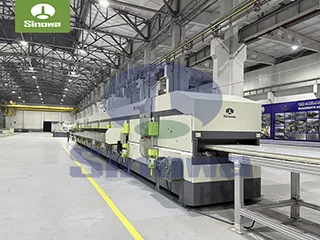
sandwich panel line
Different from ordinary discontinuous production equipment, the continuous PU sandwich panel production line for roof insulation panels adopts a modular integrated design, with multiple functional units operating in synchronous coordination to complete the full-process manufacturing of roof-specific sandwich panels. The overall operation logic of the production line focuses on precise parameter control and stable material compounding, realizing the integrated processing of surface material forming, PU foam core filling, high-pressure lamination, constant-temperature curing and fixed-length cutting. This streamlined production mode completely avoids the quality instability and low efficiency problems caused by intermittent manual intervention in traditional production methods, and can adapt to the customized production requirements of different roof panel specifications, meeting the diverse construction needs of flat roofs, sloped roofs and large-span roof structures.
The entire production process starts with the pretreatment of surface facing materials, which are mostly high-strength metal sheets with anti-corrosion coatings, featuring excellent tensile resistance, weather resistance and surface flatness suitable for outdoor roof exposure environments. The coiled surface materials are stably uncoiled through the automatic uncoiling unit of the production line, and the built-in guiding and correcting devices ensure that the materials are fed smoothly without deviation or deformation. Subsequently, the surface materials enter the roll forming unit with multi-group forming stations, which gradually shapes the flat sheet materials into the special structural profiles required for roof panels. The unique profiling design of roof panels includes waterproof grooves, lap joints and anti-pressure structures, which are precisely formed through gradual rolling to ensure the assembly tightness and structural bearing capacity of subsequent roof laying. In this stage, the polyurethane sandwich panel machine adopts stepless speed regulation and precise forming parameter matching, which can adjust the forming radian and structural size according to different roof design standards, ensuring the uniformity and consistency of each batch of panel profiles.
After the surface materials are formed and shaped, they enter the preheating treatment link, which is a key process to enhance the bonding performance between the surface layer and the PU foam core. The constant-temperature heating system of the production line can maintain a stable surface temperature of the sheet materials, eliminating the influence of ambient temperature on the bonding effect. Preheating can effectively activate the surface activity of the profiled sheets, remove subtle moisture and impurities on the surface, and create optimal bonding conditions for the subsequent PU foam filling. This process improvement avoids the common problems of hollowing, delamination and weak bonding of traditional sandwich panels after long-term use, and greatly improves the overall structural integrity and service life of roof panels.
The PU foam mixing and pouring unit is the core functional module that determines the thermal insulation performance of roof panels. The production line is equipped with a high-precision dynamic mixing system, which fully mixes the two-component polyurethane raw materials in accurate proportion through professional metering and conveying devices. Different from manual mixing or simple mechanical mixing methods, the automatic mixing system realizes uniform fusion of raw materials without dead angles, ensuring the consistency of foam density and cell structure of each part of the panel core. The mixed polyurethane raw materials are evenly poured between the upper and lower profiled surface layers through a multi-point pouring process. Combined with the running speed of the production line and the set panel thickness, the pouring dosage and distribution range are accurately controlled, so that the liquid PU raw materials can fully fill the cavity between the surface layers.
With the continuous operation of the conveyor system, the poured semi-finished panels enter the double-belt pressing and curing unit, which is the most critical link for the forming and performance stabilization of roof insulation panels. The double-belt pressing system provides uniform and continuous pressure covering the entire panel width and length, effectively controlling the expansion range and thickness of the PU foam core, preventing local bulging or uneven thickness of the panels. At the same time, the closed constant-temperature curing environment in the unit provides stable thermal conditions for the foaming and polymerization reaction of polyurethane materials. In this environment, the PU raw materials complete foaming expansion, cell forming and molecular curing reactions, forming a fine and uniform closed-cell structure. This dense closed-cell structure is the fundamental reason why PU roof panels have ultra-low thermal conductivity, which can effectively block indoor and outdoor heat transfer and achieve efficient thermal insulation and temperature regulation effects.
The curing time and temperature parameters of the production line can be intelligently adjusted according to different panel thicknesses and usage scenarios. Thicker roof panels used for high-standard thermal insulation buildings require longer curing cycles to ensure complete polymerization of the foam core and firm bonding with the surface layer, while conventional thin panels can complete rapid curing to improve production efficiency. After full curing, the composite structure formed by the upper and lower metal surface layers and the middle PU foam core has excellent overall rigidity, with the surface layer providing mechanical protection and structural support, and the foam core undertaking thermal insulation, sound insulation and buffer shock absorption functions. The composite structure perfectly combines the strength of metal materials and the thermal insulation advantages of polymer foam materials, making up for the single performance defects of traditional single-layer roof materials.
After curing and forming, the panels enter the fixed-length cutting and finishing unit of the production line. The high-precision cutting device automatically completes fixed-length cutting according to preset dimensional parameters, with smooth and neat cutting sections without burrs or deformation. The automatic edge trimming and finishing mechanism further processes the lap joints and edges of the roof panels, ensuring that the size and structure of the finished products fully meet the on-site installation standards. The entire cutting and finishing process is automatically completed by the equipment, which not only improves production efficiency, but also avoids dimensional errors caused by manual operation, ensuring the interchangeability and assembly accuracy of each roof panel. After finishing, the finished panels are automatically output and stacked through the conveying and stacking system, realizing continuous and unmanned production from raw material input to finished product output.
The advanced structural design and intelligent control system of the PU sandwich panel production line endow roof insulation panels with outstanding comprehensive performance, which is far superior to traditional roof thermal insulation materials in multiple dimensions. In terms of thermal insulation performance, the closed-cell PU foam core formed by precise production process has extremely low thermal conductivity, which can effectively isolate external high temperature in summer and prevent indoor heat loss in winter, significantly reducing the energy consumption of building heating and cooling systems. For large-span industrial workshops, logistics warehouses and large commercial venues with high energy consumption, the application of such roof panels can greatly optimize building energy consumption indicators and meet the requirements of green building energy conservation standards.
In terms of structural performance, the roof panels produced by this professional continuous PU sandwich panel line have reasonable stress distribution and strong overall stability. The integrated composite structure formed by high-pressure lamination and constant-temperature curing will not produce delamination or cracking under conventional external forces, and has good wind resistance, snow pressure resistance and seismic performance. The special lap joint structure of roof panels formed by precise profiling can effectively prevent rainwater penetration, solve the common water leakage problem of traditional roof insulation layers, and improve the waterproof and weather resistance of the roof system. In addition, the lightweight feature of PU sandwich panels reduces the overall load of the building roof, which can reduce the structural design pressure of the building and save the comprehensive construction cost of the project.
In terms of production adaptability, this professional roof panel production line has strong flexible production capacity. By adjusting the operating parameters of each functional module, it can produce roof insulation panels with different thicknesses, widths and structural types, covering the needs of low-rise buildings, high-rise buildings, large-span industrial buildings and special environmental buildings. Whether it is conventional thermal insulation roof panels for temperate regions or high-strength thermal insulation panels suitable for high-cold and high-temperature areas, the production line can complete standardized production through parameter optimization. At the same time, the continuous production mode greatly improves the production output, which can meet the demand for large-scale panel supply in large construction projects and shorten the overall construction cycle of the project.
In terms of operational economy and environmental protection, the optimized design of the PU sandwich panel line reduces material waste and energy consumption in the production process. The precise raw material metering and pouring system avoids excessive consumption of polyurethane raw materials, and the efficient thermal circulation system of the curing unit reduces invalid energy loss. The PU foam core materials produced by the equipment have stable chemical properties, no volatile harmful substances, and good environmental protection performance. The finished roof panels have a long service life, and the materials can be recycled and reused after building renovation and demolition, which conforms to the development trend of low-carbon and circular economy in the construction industry. In addition, the integrated forming roof panels do not need secondary thermal insulation and waterproof construction during on-site installation, which simplifies the construction process, reduces manual construction costs, and shortens the construction cycle of roof engineering.
With the continuous improvement of building energy-saving standards and the rapid development of prefabricated building technology, the market demand for high-performance roof insulation sandwich panels is constantly upgrading, which also promotes the continuous technological iteration of PU sandwich panel machine. Modern production lines are gradually developing towards higher automation, intelligent parameter adjustment and more diversified product adaptation. The integrated control system can realize real-time monitoring and automatic adjustment of production parameters such as forming speed, pouring volume, curing temperature and pressing pressure, ensuring that the production process is always in the optimal state and the product quality is more stable and reliable.
In practical engineering applications, roof insulation panels produced by professional polyurethane sandwich panel production line has been widely used in various construction scenarios. In industrial construction, they are used in factory workshops, storage warehouses and industrial supporting buildings, providing stable thermal insulation and environmental control conditions for production and storage spaces. In commercial construction, they are applied to shopping malls, exhibition halls and office buildings, balancing building aesthetics, energy conservation and practicality. In public infrastructure and new energy construction fields, such as stadiums, station buildings and photovoltaic roof supporting projects, the lightweight, high-strength and energy-saving advantages of PU roof panels are fully exerted, becoming an important support for high-quality building construction.
In conclusion, the professional polyurethane sandwich panel line for roof insulation panels is an important equipment connecting advanced building material technology and modern green construction. Through scientific and reasonable process design, precise mechanical control and integrated production mode, it realizes efficient and standardized production of high-performance roof insulation panels. The produced panels have excellent thermal insulation, waterproof and weather resistance, structural stability and economic applicability, solving many pain points of traditional roof thermal insulation systems. With the continuous advancement of construction industrialization and energy-saving renovation, this type of production equipment will continue to play an important role in the field of building envelope manufacturing, continuously outputting high-quality roof insulation materials for the construction industry, and promoting the sustainable and high-quality development of the entire construction industry chain.
https://www.cnsinowa.com/sandwich-panel-machines/pu-sandwich-panel-line-for-roof-insulation-panels.html