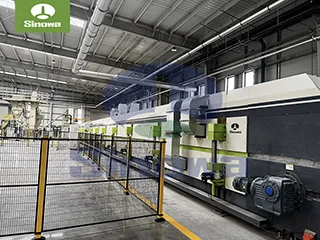
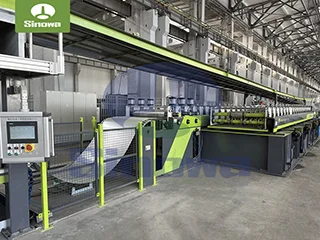
sandwich panel line
The PU sandwich panel production line for heat-resistant panels is a complex integration of multiple subsystems, each designed to perform specific functions that contribute to the overall quality of the end product. At the heart of this production line lies the material preparation system, which is responsible for ensuring that all raw materials meet the strict specifications required for heat-resistant applications. The primary raw materials include the face sheets, polyurethane resin, curing agents, flame retardants, and other additives. The face sheets, typically made of galvanized steel, galvalume, or aluminum, are selected for their high-temperature resistance, corrosion resistance, and mechanical strength. These face sheets come in the form of coils, which need to be properly handled and processed before entering the composite stage. The material preparation system includes decoiling equipment, which unrolls the coil sheets smoothly and continuously, and leveling devices that correct any deformations or unevenness in the sheets, ensuring a flat and uniform surface for subsequent processing. Additionally, the system incorporates pre-cutting mechanisms that trim the sheets to the approximate width required for the final panels, minimizing material waste and improving production efficiency.
Another critical component of the continuous sandwich panel line is the PU foam mixing and pouring system, which plays a decisive role in determining the heat-resistant properties of the sandwich panels. Unlike standard PU foam, the foam used in heat-resistant panels requires a specialized formulation with enhanced thermal stability. This formulation typically includes high-quality polyols, isocyanates, flame retardants, and heat stabilizers that can withstand elevated temperatures without significant degradation. The mixing system is designed to blend these components in precise proportions, ensuring a homogeneous mixture that will form a foam core with consistent density and heat-resistant performance. Advanced mixing equipment utilizes high-pressure injection technology, which not only ensures thorough mixing but also controls the reaction rate of the PU components. The pouring system, equipped with movable nozzles guided by precision rails, distributes the mixed PU foam evenly onto the lower face sheet. This even distribution is crucial because any inconsistencies in the foam layer can lead to weak points in the panel, compromising its structural integrity and heat resistance. The pouring system is also synchronized with the movement of the production line, ensuring a continuous and uniform foam layer of the desired thickness.
Following the foam pouring stage is the composite pressing system, which bonds the upper face sheet, foam core, and lower face sheet into a single integrated structure. This system consists of a series of roller presses or a continuous laminating machine that applies controlled pressure and temperature to the sandwich structure. The pressure applied is carefully calibrated to ensure optimal adhesion between the face sheets and the foam core, eliminating any air gaps that could reduce thermal insulation efficiency and structural strength. The temperature control is equally important, as it facilitates the curing of the PU foam. For heat-resistant panels, the curing process must be precisely managed to ensure that the foam forms a dense, cross-linked structure with maximum thermal stability. The composite pressing system often includes multiple temperature zones, allowing for gradual and uniform curing of the foam, which helps to prevent internal stresses and ensure the dimensional stability of the panels. After passing through the pressing system, the composite panel enters a cooling zone, where it is gradually cooled to room temperature. This cooling process is essential to solidify the foam core completely and lock in the structural properties of the panel, preventing warping or deformation.
The final stages of the production line include the cutting, trimming, and quality inspection systems. The cutting system uses high-precision saws or cutting tools to trim the continuous composite panel into individual panels of the required length. This cutting process must be precise to ensure that the panels have straight edges and accurate dimensions, which is critical for easy installation and proper fitting on-site. The trimming system then removes any excess material or uneven edges from the panels, further enhancing their appearance and dimensional accuracy. Quality inspection is a rigorous process that ensures each panel meets the specified standards for heat resistance, structural strength, and overall quality. Inspectors check for defects such as delamination, uneven foam density, surface imperfections, and dimensional deviations. Specialized testing equipment may be used to measure the thermal conductivity, compressive strength, and heat resistance of the panels, ensuring that they can perform reliably in high-temperature environments. Panels that fail to meet the quality standards are rejected or reworked, ensuring that only high-quality products leave the production line.
The production of heat-resistant PU sandwich panels is not only dependent on advanced equipment but also on strict process control and technical optimization. One of the key technical considerations is the formulation of the PU foam. The foam's density, cell structure, and chemical composition directly affect its heat resistance. A higher density foam with a closed-cell structure typically offers better thermal stability and heat resistance, as the closed cells trap air and prevent heat transfer. The addition of flame retardants and heat stabilizers further enhances the foam's ability to withstand high temperatures, reducing the risk of combustion and thermal degradation. Process parameters such as mixing ratio, pouring temperature, pressing pressure, and curing time must be carefully monitored and adjusted to ensure consistent foam quality. For example, variations in the mixing ratio of polyols and isocyanates can lead to foam with inconsistent density and poor thermal performance, while incorrect curing temperatures can result in incomplete curing and reduced structural strength.
Another important aspect of process optimization is the selection and treatment of face sheets. The face sheets must be able to withstand high temperatures without warping, discoloration, or loss of strength. Galvanized steel and galvalume sheets are often preferred for their excellent heat resistance and corrosion resistance. These sheets may undergo additional surface treatments, such as pre-painting with high-temperature-resistant coatings, to further enhance their thermal stability and durability. The adhesion between the face sheets and the foam core is also critical for the overall performance of the panel. To improve adhesion, the surface of the face sheets may be roughened or treated with primers that promote bonding with the PU foam. This ensures that the face sheets and foam core form a strong, integrated structure that can withstand thermal cycling and mechanical stress.
The heat-resistant PU sandwich panels produced by these advanced production lines offer a wide range of advantages that make them suitable for various demanding applications. Their exceptional thermal insulation properties help to reduce energy consumption by minimizing heat transfer between the interior and exterior of buildings or industrial facilities. This is particularly beneficial in high-temperature environments, where maintaining a stable internal temperature is crucial for operational efficiency and worker comfort. The lightweight nature of the panels makes them easy to transport and install, reducing labor costs and construction time. Despite their light weight, the panels exhibit excellent structural strength and load-bearing capacity, making them suitable for use as wall cladding, roof panels, and partition walls in industrial buildings, warehouses, power plants, and other high-temperature facilities.
One of the primary applications of heat-resistant PU sandwich panels is in industrial manufacturing facilities, such as steel mills, foundries, and glass factories, where temperatures can reach extremely high levels. These panels are used to construct walls and roofs, providing thermal insulation and protecting the interior environment from the intense heat generated by production processes. They also help to reduce heat loss, improving the energy efficiency of the facilities and lowering operating costs. Another important application is in power plants, particularly in areas such as boiler rooms and turbine halls, where high temperatures and thermal radiation are common. The heat-resistant panels provide a safe and durable enclosure, protecting equipment and personnel from the harsh thermal environment.
Heat-resistant PU sandwich panels are also widely used in the construction of commercial and public buildings that require enhanced fire safety and thermal performance. For example, in shopping malls, airports, and railway stations, these panels can be used as partition walls and ceiling panels, providing fire resistance and thermal insulation. Their quick installation time makes them ideal for large-scale construction projects, where minimizing construction time is essential. Additionally, these panels are suitable for use in cold storage facilities, where they not only provide thermal insulation to maintain low temperatures but also offer resistance to the thermal cycling that occurs when the facility is opened and closed.
The development of PU sandwich panel line for heat-resistant panels has been driven by the growing demand for high-performance, energy-efficient, and durable building materials. Advances in technology have led to the integration of intelligent control systems into these production lines, allowing for real-time monitoring and adjustment of process parameters. These intelligent systems use sensors to measure temperature, pressure, and material flow, and feed this data back to a central control unit, which automatically adjusts the parameters to ensure consistent product quality. This automation not only improves production efficiency but also reduces the risk of human error, leading to more reliable and high-quality products.
In addition to automation, there is a growing focus on sustainability in the production of heat-resistant PU sandwich panels. Manufacturers are exploring the use of eco-friendly raw materials, such as bio-based polyols, which reduce the reliance on fossil fuels and lower the carbon footprint of the panels. Recycling and waste reduction are also important considerations, with production lines being designed to minimize material waste and facilitate the recycling of scrap materials. These sustainable practices not only benefit the environment but also meet the increasing demand for green building materials in the construction industry.
Despite the many advantages of polyurethane sandwich panel production line for heat-resistant panels, there are still challenges that need to be addressed. One of the main challenges is the high initial investment required for the advanced equipment and technology needed to produce these panels. This can be a barrier for small and medium-sized manufacturers looking to enter the market. Another challenge is the need for skilled operators who can effectively manage and maintain the complex production lines. Training programs and knowledge sharing are essential to address this skills gap and ensure that manufacturers can fully utilize the capabilities of their production equipment.
Looking to the future, the PU sandwich panel machine for heat-resistant panels is expected to continue evolving, with further advancements in automation, material technology, and sustainability. The integration of artificial intelligence and machine learning into control systems will enable more predictive and adaptive process control, further improving product quality and production efficiency. New materials and formulations will be developed to enhance the heat resistance, fire safety, and durability of the panels, expanding their range of applications. Additionally, the trend towards sustainable production will continue, with manufacturers adopting more eco-friendly practices and materials to meet the growing demand for green building solutions.
In conclusion, the PU sandwich panel production line for heat-resistant panels is a sophisticated and advanced system that plays a crucial role in meeting the demand for high-performance building materials in demanding environments. From material preparation to final quality inspection, each stage of the production process is carefully designed and controlled to ensure that the panels exhibit exceptional heat resistance, thermal insulation, and structural strength. The integration of intelligent technology and sustainable practices is driving the evolution of these production lines, making them more efficient, reliable, and environmentally friendly. As the construction and industrial sectors continue to grow and demand higher standards for energy efficiency and durability, the importance of these production lines will only increase, contributing to the development of safer, more efficient, and more sustainable buildings and facilities around the world.
https://www.cnsinowa.com/sandwich-panel-machines/pu-sandwich-panel-production-line-for-heat-resistant-panels.html