sandwich panel line
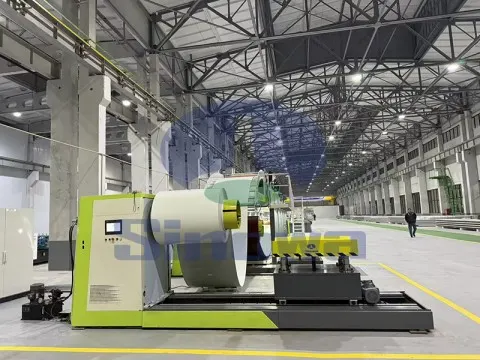
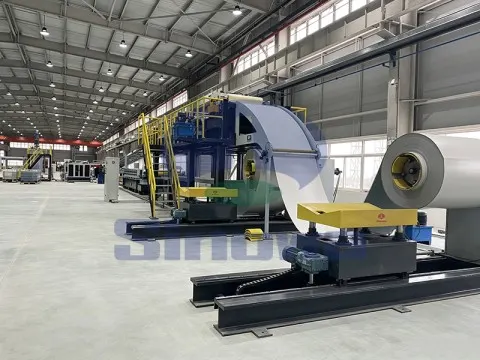
A complete polyurethane sandwich panel production line covers multiple interconnected functional modules, and professional manufacturers carry out meticulous structural design and parameter debugging for every link in the production workflow to ensure the continuity and stability of the entire production process. The upstream part of the production line mainly includes raw material feeding and pretreatment units, which are responsible for the orderly transportation and surface treatment of upper and lower surface materials. Common surface materials include metal color steel plates, aluminum alloy sheets, and other rigid substrates, as well as flexible decorative sheets applicable to special scenarios. During the pretreatment stage, the equipment completes surface dust removal, flatness correction, and surface activation treatment of the substrates, eliminating impurities and surface defects that may affect the bonding tightness between the substrate and the polyurethane core material. This pretreatment process lays a solid foundation for the subsequent composite molding process, effectively avoiding quality problems such as degumming and warping of finished panels in long-term use. Manufacturers optimize the structural layout of the feeding unit based on the physical characteristics of different substrates, configuring adjustable tension control components to prevent substrate deformation or wrinkling during high-speed transmission, and maintain consistent feeding accuracy throughout continuous production.
The raw material metering and mixing system constitutes the core functional unit of the entire production line, and it is also the key technological link that manufacturers keep optimizing in long-term research and development. Polyurethane foam is formed by the chemical reaction of multiple raw materials including polyether polyol, curing agent, and foaming agent. Professional production lines are equipped with high-precision metering pump groups to accurately control the proportion of various raw materials. Strict proportional matching ensures the uniformity of foam density and the stability of physical properties, avoiding inconsistent thermal insulation performance and local structural hollowing caused by uneven raw material mixing. The high-speed mixing head adopted in the equipment realizes instantaneous homogeneous mixing of raw materials, and the mixed raw materials are evenly coated on the steadily moving bottom substrate through the reciprocating swinging of the distributing device. Manufacturers reasonably adjust the mixing speed and discharging range according to the required core material thickness and foam density of different panels, realizing flexible switching of production parameters and expanding the application coverage of a single production line.
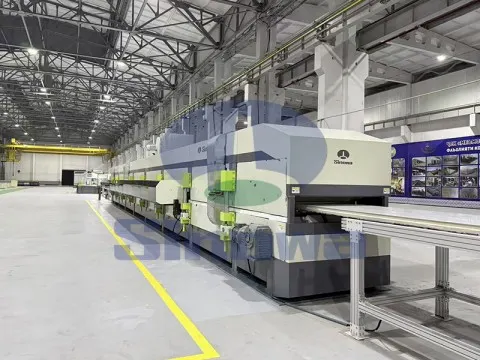
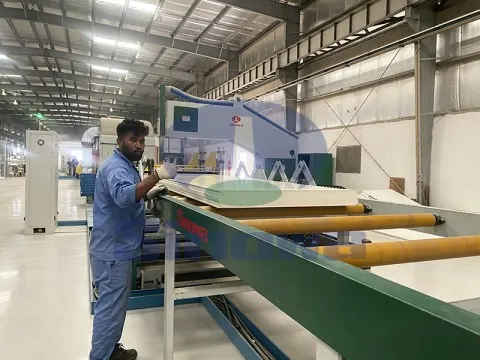
The continuous composite molding unit is the central part for the forming of polyurethane sandwich panels, and most high-performance production lines adopt a double-belt molding structure independently developed and optimized by manufacturers. After the raw material liquid is coated on the bottom substrate, the upper substrate is automatically overlapped under the precise transmission of the conveyor device, and then enters the closed heating and pressure preservation cavity of the double-belt machine. In the sealed cavity, precise temperature control elements maintain a constant reaction temperature suitable for polyurethane foaming and curing. The foaming raw materials expand steadily under constant temperature conditions, and the stable pressure provided by the upper and lower pressing plates ensures that the foam is closely bonded to the upper and lower substrates without gaps or bubbles. The internal circulation temperature control system of the pressing plates can stabilize the temperature fluctuation range within a tiny interval, ensuring that each batch of panels undergoes consistent curing reactions. The structural strength and thermal insulation uniformity of finished panels are effectively guaranteed through this constant-temperature and constant-pressure integrated molding process.
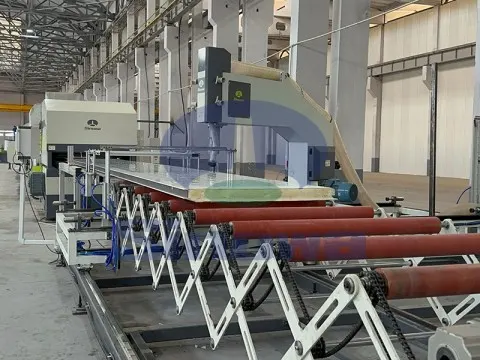
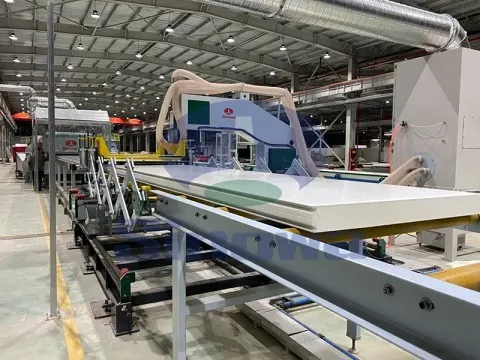
After the initial molding and curing of composite panels, the production line enters the finishing and post-processing stage, which includes edge trimming, fixed-length cutting, surface protection, and finished product stacking. The edge trimming devices installed on both sides of the production line accurately polish and cut the edges of the composite panels to eliminate irregular burrs generated during the molding process and ensure the neatness of the panel edges. The intelligent cutting system realizes automatic fixed-length cutting according to preset dimensional parameters, with extremely high positioning accuracy to meet the standardized size requirements of engineering construction and industrial manufacturing. Subsequently, the surface film-coating unit automatically attaches protective films to the outer surface of the panels to prevent surface scratches and corrosion during transportation and storage. Finally, the finished panel stacking device completes automatic sorting and stacking, reducing manual handling links and lowering the risk of panel damage caused by human operation. Manufacturers integrate these post-processing modules into a streamlined production system, realizing seamless connection between processes and greatly improving the overall production continuity.
Excellent polyurethane sandwich panel line manufacturers have outstanding advantages in equipment structural design and performance optimization, and they always take production stability, energy consumption control, and operation convenience as the core optimization directions. In terms of mechanical structure, the main frame of the production line adopts high-strength welded structural parts, which can resist vibration and structural deformation during long-term high-load operation. The key transmission components are made of wear-resistant alloy materials to extend the service life of the equipment and reduce the frequency of component replacement. In terms of intelligent control, the entire production line adopts a centralized programmable control system, and operators can adjust production parameters such as feeding speed, raw material ratio, curing temperature, and cutting size through a human-computer interaction interface. The system is equipped with an automatic monitoring module, which can real-time collect operating data of each unit and trigger abnormal alarms for parameter deviation, equipment jamming, and other faults, providing reliable guarantee for safe and stable production.
In terms of energy consumption and environmental protection optimization, professional manufacturers actively adapt to the global green production trend and carry out targeted technological upgrades for production lines. The heating system of the molding cavity adopts an optimized heat circulation structure to reduce heat loss and improve energy utilization efficiency. The raw material conveying pipeline is equipped with a sealing structure to prevent volatile substances generated during raw material mixing from leaking into the external environment. In addition, the production line is designed with a waste recycling and processing unit, which can collect leftover materials generated by trimming and cutting, realizing centralized processing and secondary utilization of waste materials. This series of environmental optimization designs not only reduces the energy consumption cost of enterprise production but also minimizes the environmental impact of the production process, conforming to the sustainable development concept of modern industrial production.
In terms of market application adaptation, reliable polyurethane sandwich panel line manufacturers can provide differentiated equipment configuration solutions according to the production positioning of different customers. For small and medium-sized processing enterprises focusing on lightweight building panels, manufacturers configure compact integrated production lines with moderate production speed and flexible space layout, which are easy to install and maintain, and can meet the production demand of small-batch and multi-type panels. For large industrial manufacturing enterprises that pursue high output, the manufacturers provide high-speed continuous production lines with an intelligent linkage system. The optimized transmission structure enables the continuous production speed to reach the advanced level of the industry, and the supporting automatic feeding and stacking systems greatly reduce manual intervention. In addition, aiming at special application scenarios such as low-temperature cold storage, fire-resistant workshops, and decorative buildings, manufacturers adjust the raw material metering system and molding pressure parameters of the production line to support the production of functional panels with high thermal insulation and fire resistance, enriching the product diversity of downstream enterprises.
The after-sales service and technical support system is an important part of the core competitiveness of polyurethane sandwich panel line manufacturers. A complete service system runs through the whole cycle of equipment selection, installation, commissioning, operation, and maintenance. In the early stage of cooperation, professional technical teams conduct production site surveys for customers, reasonably plan the equipment layout scheme according to the plant space and production process flow, and provide personalized equipment configuration suggestions. During the equipment installation period, the manufacturer sends professional engineers to complete on-site assembly and debugging to ensure that all functional units operate in coordination and meet the preset production standards. After the equipment is put into use, the manufacturers provide long-term technical guidance and daily maintenance training to help operators master equipment operation specifications and simple fault elimination methods. The spare parts reserve system ensures the rapid supply of vulnerable parts, shortening the equipment downtime caused by component replacement.
With the continuous development of the global construction industry and the continuous expansion of the application boundary of composite materials, the market demand for polyurethane sandwich panels maintains a steady growth trend, which also puts forward higher iterative requirements for supporting production line equipment. Polyurethane sandwich panel line manufacturers need to keep up with the material technology upgrading trend, continuously carry out technological innovation in raw material mixing accuracy, intelligent control level, energy-saving transformation, and special panel production adaptation. In the future industry development, intelligent linkage and digital monitoring will become the mainstream development direction of production lines. More manufacturers will apply digital twin technology and remote monitoring systems to realize real-time tracking and data analysis of the entire production process, providing data support for production optimization and quality improvement. At the same time, combined with the green industrial development policy, the environmental protection performance of production lines will be further optimized to realize low-carbon, low-pollution, and high-efficiency production mode.
In conclusion, polyurethane sandwich panel line manufacturers play a vital connecting role in the composite material industrial chain, linking raw material processing and finished panel manufacturing. Through continuous optimization of mechanical structure, intelligent control, environmental protection performance, and service system, these manufacturers provide reliable production equipment for downstream enterprises in various industries. Whether for conventional building thermal insulation panels or special functional composite panels, high-quality production line equipment is the fundamental guarantee for stable product quality and efficient production. In the context of increasingly fierce market competition, manufacturers need to always adhere to technological innovation as the core, take customer demand as the guidance, continuously improve the comprehensive performance and application scope of production lines, and promote the healthy and high-quality development of the global polyurethane sandwich panel manufacturing industry, while creating more practical value for downstream production enterprises and terminal engineering construction fields.
Sinowa is a professional manufacturer of sandwich panel machine in china, we provide diversified and high-performance sandwich panel production lines, including fully automatic continuous PU sandwich panel line and customized special lines to meet mass production and personalized order demands. These sandwich panel lines support processing multiple foam core materials, such as PU, PIR, mineral wool, rock wool and glass wool, covering different insulation and fireproof standards.
Featuring stable operation, high efficiency, energy saving and easy maintenance, our PU sandwich panel line deliver sandwich panels with excellent thermal insulation, fire resistance, sound insulation and lightweight durability. The finished panels are widely applied in industrial workshops, warehouse roofing and wall cladding, cold storage insulation, serving global construction and industrial insulation markets.
https://www.cnsinowa.com/sandwich-panel-machines/polyurethane-sandwich-panel-line-manufacturer.html