sandwich panel line
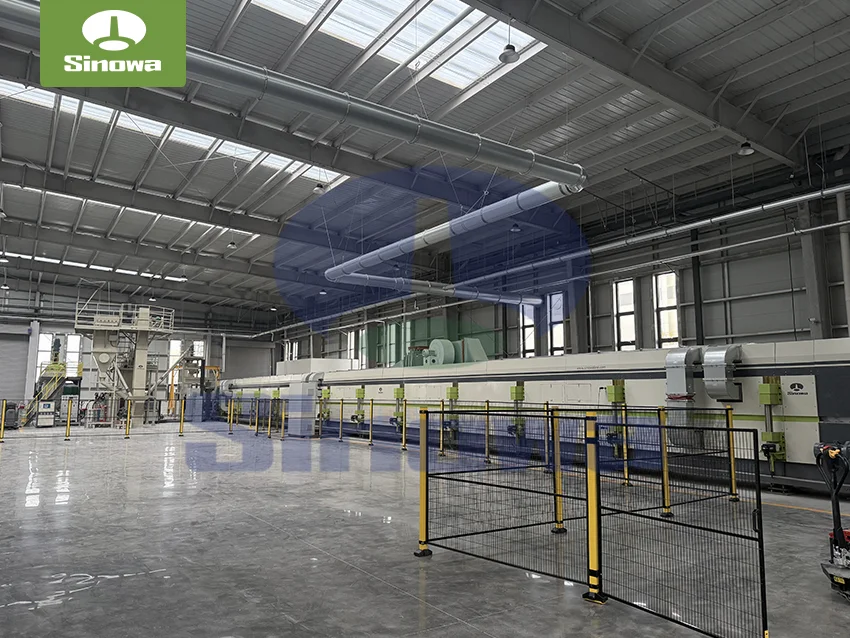
The overall spatial layout of a polyurethane sandwich panel line factory is scientifically planned to adapt to the continuous flow of raw materials, semi-finished products and finished products. The production workshop occupies the core area of the factory, with functional areas such as raw material storage, finished product stacking, power distribution and waste disposal reasonably distributed around it, effectively avoiding cross interference between different production links. Raw material storage areas are designed with targeted environmental control measures to maintain stable temperature and ventilation conditions, which is particularly critical for polyurethane chemical raw materials. The chemical components used for foam molding are sensitive to temperature and humidity fluctuations, and a stable storage environment can prevent raw material deterioration and performance attenuation, ensuring the consistency of subsequent foaming reactions. Meanwhile, the storage area for surface materials such as metal sheets and non-metal decorative plates is equipped with moisture-proof and anti-collision protection structures to keep the surface materials flat and intact before processing, eliminating adverse effects on the bonding quality and appearance of finished panels.
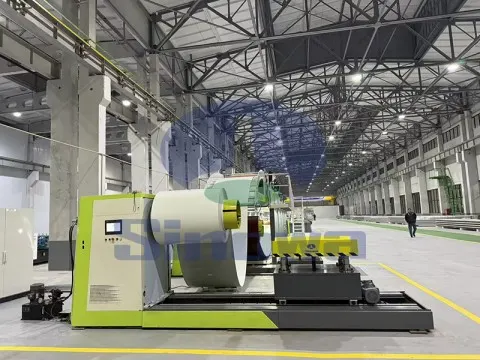
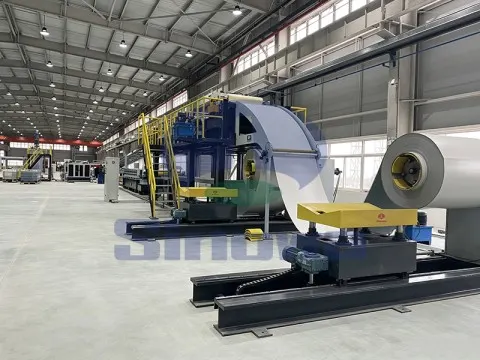
The internal production line constitutes the core functional unit of the entire factory, and a complete polyurethane sandwich panel production line consists of multiple interconnected mechanical units, each undertaking an independent and indispensable processing task. The front-end part of the production line is responsible for the unwinding and pretreatment of surface materials. Rolled surface materials are fixed on professional unwinding equipment, and the equipment adopts a stable transmission structure to realize uniform discharging at a constant speed. During the unwinding process, the surface of the base material will go through cleaning and flattening procedures to remove surface dust, oil stains and subtle wrinkles. This pretreatment process lays a solid foundation for the subsequent bonding between the surface material and the polyurethane foam layer, effectively improving the bonding firmness and overall flatness of the composite panel. For different types of surface substrates, the factory can adjust the operating parameters of pretreatment equipment to adapt to the surface characteristics of metal, composite fiber and other materials, expanding the application scope of production equipment.
Following the surface material pretreatment process is the raw material proportioning and foaming injection link, which is the most critical procedure that determines the thermal insulation performance and structural stability of polyurethane sandwich panels. Inside the factory’s chemical feeding system, different polyurethane raw materials are transported to the mixing device through sealed pipelines. The automated mixing structure accurately controls the mixing ratio and flow rate of various raw materials, realizing uniform fusion of chemical components. Strict temperature control is implemented throughout the mixing and conveying process to ensure that the chemical reaction rate of polyurethane raw materials remains within a reasonable range. After sufficient mixing, the liquid composite material is evenly sprayed between the upper and lower surface materials through a high-precision injection device. The injection position and material output are precisely regulated by an intelligent control system, so that the polyurethane raw materials can be evenly distributed in the molding area without local accumulation or shortage, laying the premise for forming a uniform and dense foam core layer.
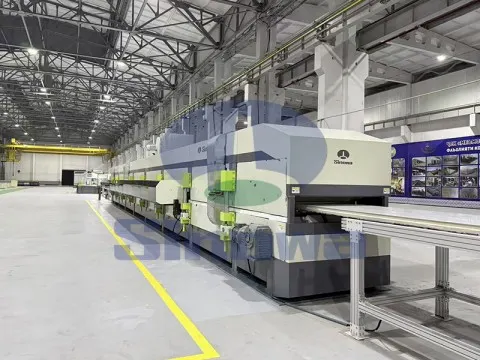
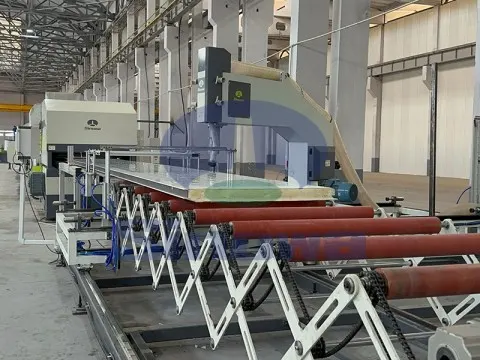
The composite molding unit comes after the foaming injection process, undertaking the tasks of pressing, curing and shaping the preliminary composite plates. The molding equipment is equipped with multi-group pressing rollers with adjustable spacing, which can adapt to the production requirements of sandwich panels with different thickness specifications. Under constant pressure and stable transmission speed, the upper and lower surface materials are tightly bonded with the liquid polyurethane material, and the foaming reaction proceeds stably in the closed pressing space. With the gradual completion of the chemical reaction, the polyurethane material expands and solidifies to form a microporous foam structure with low thermal conductivity. The factory optimizes the internal temperature of the molding section through an intelligent temperature circulation system to accelerate the curing reaction of polyurethane, shorten the molding cycle, and maintain the uniformity of the internal pore structure of the foam layer. Reasonable pressure parameter settings can effectively avoid problems such as hollowing, delamination and uneven thickness of the composite panels, ensuring that each batch of products has consistent structural indicators.
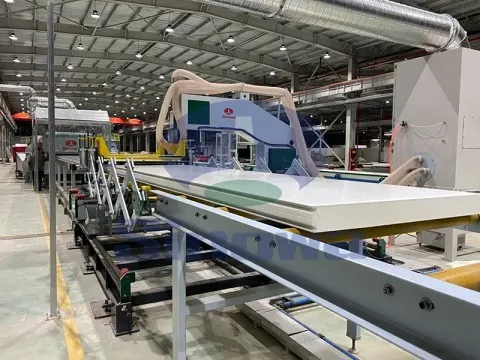
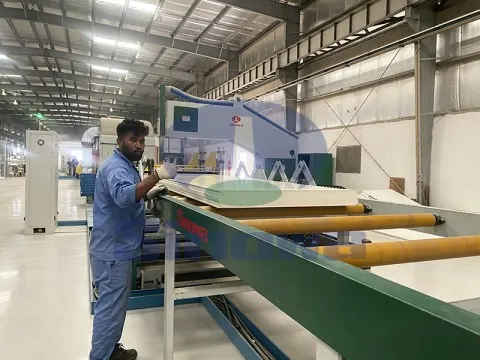
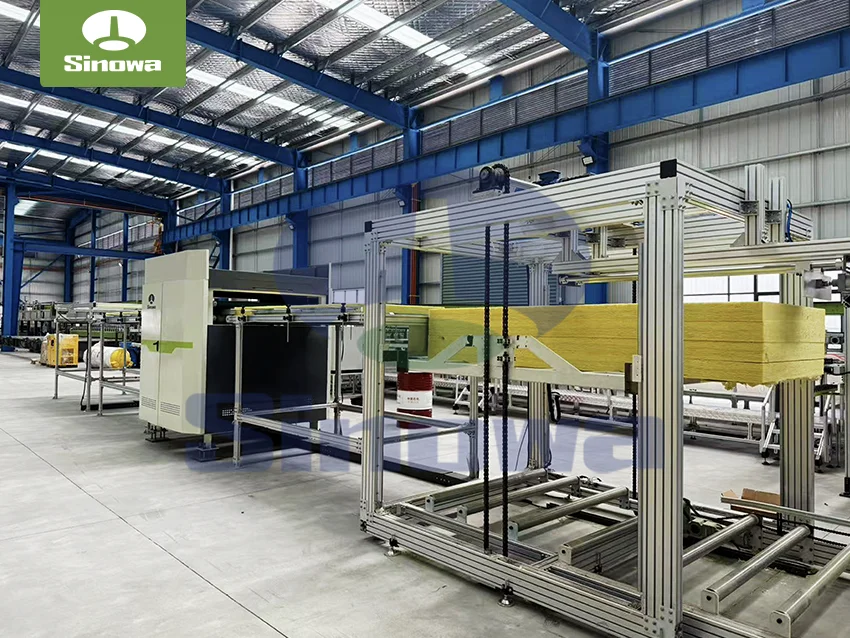
After completing composite molding and primary curing, the semi-finished panels are transported to the cutting and trimming section of the production line for precision processing. The continuous moving semi-finished products are measured in real time by an intelligent sensing device, and the cutting equipment automatically completes fixed-length cutting according to preset dimensional parameters. The cutting tool adopts high-hardness wear-resistant materials, which can realize smooth cutting without burrs on the edges of the panels. In addition to fixed-length cutting, this link also includes edge trimming and groove processing to polish the rough edges of the panels and process assembly grooves that meet installation requirements. The automated processing mode replaces traditional manual cutting, effectively improving the dimensional accuracy of finished products and reducing the error rate of product specifications. Meanwhile, the cutting waste generated during the processing will be centrally collected through a special conveying pipeline, which is convenient for subsequent centralized disposal and resource recycling, conforming to the factory’s energy-saving and environmentally friendly production concepts.
The post-processing area of the factory undertakes the final surface inspection, reinforcement treatment and packaging storage of finished panels. Professional staff and intelligent detection equipment jointly complete the quality inspection work. The detection items cover surface flatness, bonding tightness, foam compactness and dimensional tolerance of the panels. Defective products with minor flaws are sent to the repair area for secondary processing, while unqualified products are marked and isolated to prevent them from entering the finished product stacking area. For panels used in special application scenarios, the factory can complete additional surface treatment processes such as anti-corrosion coating and waterproof film covering in the post-processing link to enhance the environmental adaptability of the products. After passing all quality inspections, the finished panels are stacked neatly by automated handling equipment, and the surface is covered with dust-proof and moisture-proof packaging materials. The finished product warehouse maintains a dry and ventilated storage environment, and the stacking height is strictly limited to avoid permanent deformation of the panels caused by excessive pressure.
The daily operation and management of a polyurethane sandwich panel line factory focuses on equipment maintenance, production parameter optimization and personnel standardized management. The production line runs in a continuous automated operation mode, and the intelligent control center in the factory can monitor the operating status of all mechanical units in real time, including equipment operating speed, internal temperature, material flow and other key data. Once abnormal parameter fluctuations are detected, the system will issue a prompt and automatically adjust the operating state to ensure the stability of the production process. The factory formulates a regular equipment maintenance plan, with professional maintenance personnel conducting daily inspection, lubrication and wear maintenance of transmission parts, sealing components and cutting tools. Regular deep disassembly and maintenance are carried out on mixing and foaming equipment to prevent pipeline blockage and component aging caused by raw material residue, prolonging the service life of the entire production line.
Personnel management is another important part of factory operation. All on-site operators receive professional pre-job training to master equipment operation specifications, raw material management standards and safety operation guidelines. The factory divides personnel into different posts such as production monitoring, equipment maintenance, quality inspection and warehousing management, realizing clear job division and mutual coordination. During the production process, operators regularly record production data, including raw material consumption, daily output and product qualification rate, providing data support for subsequent production optimization and process improvement. In terms of safety management, the factory is equipped with complete safety protection facilities, and the production area is posted with safety operation guidelines. Staff wear standardized protective equipment during work to avoid potential safety hazards caused by chemical raw materials and mechanical operation.
In terms of production technology optimization, polyurethane sandwich panel line factories keep pace with the development trend of the building material industry and continuously upgrade production processes. Many factories optimize the foaming formula of polyurethane raw materials to reduce the thermal conductivity of the foam core layer while improving the compression resistance and aging resistance of the material. In terms of mechanical structure optimization, the production line adopts energy-saving transmission motors and efficient temperature circulation systems to reduce energy consumption per unit of products and realize low-carbon production. In addition, the factory improves the production flexibility of the production line by adjusting the modular structure of the equipment, enabling the same production line to manufacture sandwich panels with different thicknesses, surface materials and structural types, meeting the diversified customization needs of downstream customers.
Polyurethane sandwich panels produced by such factories have a wide range of application scenarios, covering civil buildings, industrial plants, cold chain logistics and special enclosure engineering. In the construction field, these panels are used for exterior wall thermal insulation, roof waterproof insulation and interior partition decoration of buildings, effectively reducing building energy consumption and simplifying construction procedures. In cold chain storage and transportation facilities, the excellent low-temperature resistance and thermal insulation properties of polyurethane foam can maintain a stable internal temperature of cold storage spaces and transportation containers, reducing energy loss during refrigeration operation. In temporary construction facilities such as prefabricated houses, the lightweight and high-strength characteristics of sandwich panels facilitate rapid assembly and disassembly, improving construction efficiency. The diverse application demands in different fields also drive factories to continuously optimize production technology and product performance to adapt to complex and changeable market requirements.
Facing the increasingly stringent global environmental protection policies and market competition rules, polyurethane sandwich panel line factories are constantly promoting green transformation and industrial upgrading. In terms of raw material selection, factories prefer low-pollution and low-volatile chemical raw materials to reduce harmful gas emissions during the production process. The waste generated in the production process is classified and treated, and recyclable waste materials are reprocessed and reused to improve the utilization rate of raw materials. At the same time, the factory optimizes the exhaust gas and wastewater treatment system in the production link to ensure that all discharge indicators meet industrial environmental protection standards. In terms of industrial upgrading, factories introduce digital management systems to realize the integrated management of production data, personnel scheduling and inventory statistics, improving the overall operational efficiency of the factory.
In conclusion, polyurethane sandwich panel line factories play an irreplaceable fundamental role in the modern building material manufacturing industry. Through scientific factory layout, mature continuous production processes, standardized operation management and continuous technological optimization, these factories efficiently produce high-performance composite panels that meet the needs of multiple industries. From raw material storage and pretreatment to foaming molding, cutting processing and finished product storage, every production link reflects the rigorous industrial manufacturing logic. With the continuous development of the construction industry and the increasing global emphasis on energy conservation and environmental protection, such factories will further explore innovative production technologies, optimize production operation modes, and provide more reliable and diversified thermal insulation composite materials for the global market. The steady development of polyurethane sandwich panel line factories will also continuously promote the upgrading of the building material industry and contribute to the realization of energy-saving and low-carbon development goals in the construction field.
Sinowa is a professional manufacturer of sandwich panel machine in china, we provide diversified and high-performance sandwich panel production lines, including fully automatic continuous PU sandwich panel line and customized special lines to meet mass production and personalized order demands. These sandwich panel lines support processing multiple foam core materials, such as PU, PIR, mineral wool, rock wool and glass wool, covering different insulation and fireproof standards.
Featuring stable operation, high efficiency, energy saving and easy maintenance, our PU sandwich panel line deliver sandwich panels with excellent thermal insulation, fire resistance, sound insulation and lightweight durability. The finished panels are widely applied in industrial workshops, warehouse roofing and wall cladding, cold storage insulation, serving global construction and industrial insulation markets.
https://www.cnsinowa.com/sandwich-panel-machines/polyurethane-sandwich-panel-line-factory.html