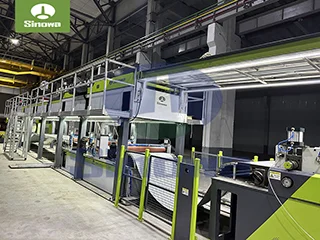
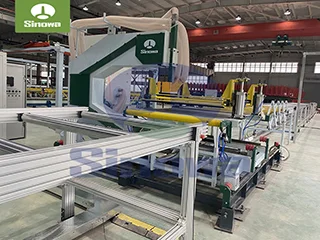
sandwich panel line
The fundamental structure of PIR sandwich panels for modular buildings consists of three core components: two outer facings and a central PIR foam core. The outer facings, typically made from thin-gauge metal sheets such as galvanized steel, galvalume, or aluminum, serve as the primary structural layer, providing rigidity, impact resistance, and protection against environmental factors. These facings are often treated with protective coatings to enhance corrosion resistance, UV stability, and aesthetic appeal, with finishes that can be tailored to suit different architectural requirements. The central PIR core, formed through a chemical reaction between isocyanates and polyols with the addition of catalysts and blowing agents, is the key to the panel’s thermal insulation properties. This core is a rigid, closed-cell foam that bonds tightly to the outer facings during production, creating a composite structure where each component works in synergy to deliver superior performance compared to individual materials.
The production line for these panels follows a sequential process that ensures precision, consistency, and optimal bonding between layers. The process begins with the preparation of the outer facings, which are uncoiled from large rolls and fed into a series of shaping machines. These machines form the metal sheets into the desired profile—flat or with subtle waves—to enhance structural rigidity and facilitate interlocking during installation. The facings are then cleaned and preheated to ensure proper adhesion with the PIR core; preheating helps activate the bonding agents and promotes uniform foam expansion. Meanwhile, the PIR foam components are precisely mixed in a high-pressure metering system, where the isocyanate, polyol, catalyst, and blowing agent are combined in exact proportions to achieve the desired foam density, thermal conductivity, and mechanical properties. The mixed foam is then sprayed or injected between the two moving outer facings as they travel through a continuous press.
The pressing stage is critical to the panel’s structural integrity, as it ensures uniform thickness, proper bonding between the core and facings, and the elimination of air gaps. The panels pass through a series of calibrated rollers or a hydraulic press that applies consistent pressure and maintains controlled temperature conditions, allowing the PIR foam to cure and set. Curing time is carefully monitored to ensure the foam reaches its full mechanical strength and thermal performance—too rapid curing can lead to weak bonding or structural inconsistencies, while prolonged curing reduces production efficiency. After curing, the panels are cut to customized lengths using precision saws, with dimensional tolerances closely controlled to ensure compatibility with modular building components. The cut panels then undergo quality checks to verify thickness, flatness, bond strength, and core density, ensuring only panels that meet strict performance criteria proceed to packaging and delivery.
The structural performance of PIR sandwich panels is a result of the composite action between the outer facings and the PIR core. The metal facings resist bending and tensile forces, while the rigid PIR core provides compressive strength and distributes loads evenly across the panel surface. This combination allows the panels to support significant loads, including self-weight, wind loads, and live loads, making them suitable for both wall and roof applications in modular buildings. The bond strength between the core and facings is particularly important, as it prevents delamination under stress—high-quality panels exhibit strong adhesion that withstands temperature fluctuations, moisture exposure, and mechanical stress over time. Compressive strength is another key structural property, with typical PIR cores offering sufficient resistance to support forklift loads and other heavy equipment during installation and use. Additionally, the panels exhibit excellent dimensional stability, with minimal expansion or contraction under extreme temperature changes, ensuring the modular structure remains intact and airtight.
Thermal performance is one of the most notable advantages of PIR sandwich panels, driven by the closed-cell structure of the PIR core. The closed cells trap air within the foam, minimizing heat transfer through conduction, convection, and radiation. The thermal conductivity of PIR foam is extremely low, typically below 0.023 W/(m·K), making it far more efficient than many other insulation materials. This high thermal efficiency reduces energy consumption for heating and cooling in modular buildings, lowering operational costs and improving indoor comfort. The panels also provide effective condensation control, as their low thermal conductivity prevents surface temperatures from dropping below the dew point, reducing the risk of moisture buildup and mold growth. In cold storage or refrigerated modular units, this thermal performance is critical to maintaining consistent internal temperatures with minimal energy input.
Fire performance is a critical consideration in modular construction, and PIR sandwich panels offer favorable properties in this regard. The PIR core is inherently flame-retardant, with a high oxygen index that resists ignition and slows the spread of fire. When exposed to fire, the foam chars on the surface, forming a protective layer that insulates the remaining core and delays structural failure. This charring effect helps maintain the panel’s integrity for a longer period, providing valuable time for evacuation and fire containment. Additionally, the closed-cell structure of the PIR core limits the release of smoke and toxic gases compared to other foam insulation materials, enhancing safety in the event of a fire. These properties make PIR sandwich panels suitable for use in a wide range of modular buildings, including residential, commercial, and industrial applications where fire safety is a priority.
Other performance attributes of PIR sandwich panels include excellent water and moisture resistance, chemical resistance, and acoustic insulation. The closed-cell structure of the PIR core prevents water absorption, with typical water absorption rates below 1%, ensuring the panel’s thermal and structural performance remains unaffected by moisture exposure. This makes the panels suitable for use in coastal areas, humid environments, and modular buildings exposed to the elements. The panels also resist damage from most chemicals, making them suitable for industrial modular facilities such as chemical storage units and processing plants. Acoustically, the PIR core absorbs sound waves, reducing noise transmission between rooms and from the external environment, improving the acoustic comfort of modular buildings used for residential, office, or educational purposes.
PIR sandwich panels for modular buildings are available in a variety of configurations, tailored to specific applications and performance requirements. The primary distinction between panel types lies in the thickness of the core and the material of the outer facings. Core thickness can range from 40mm to 300mm, with thicker cores offering higher thermal insulation and compressive strength. Thinner cores (40mm to 75mm) are commonly used for internal partitions and low-temperature insulation needs, while thicker cores (100mm to 300mm) are ideal for external walls, roofs, and cold storage units where maximum thermal efficiency is required. The outer facings can be customized based on material, thickness, and finish—galvanized steel is the most common choice for its balance of cost, strength, and corrosion resistance, while aluminum is preferred for lightweight applications and stainless steel for environments requiring high hygiene or chemical resistance.
Panel widths are typically standardized to facilitate modular assembly, with 1000mm being a common width, though custom widths can be produced to meet specific design requirements. Lengths are highly customizable, ranging from 2000mm to 13500mm or longer, depending on shipping constraints and modular design needs. Some panels feature interlocking joints, such as cam-lock systems, which simplify installation and enhance the airtightness and water resistance of the modular structure. These interlocking systems allow panels to be quickly joined without the need for additional fasteners, reducing installation time and labor costs. Additionally, panels can be produced with flat or profiled facings—profiled facings provide increased structural rigidity and aesthetic variety, while flat facings are suitable for applications where a smooth surface is required, such as cleanrooms.
The versatility of PIR sandwich panels makes them suitable for a wide range of modular building applications across various industries. One of the most common uses is in cold storage and refrigerated modular units, where the panels’ exceptional thermal insulation and moisture resistance ensure consistent internal temperatures. These units are used in the food and beverage industry, pharmaceuticals, and logistics for the storage and transportation of perishable goods. PIR sandwich panels are also widely used in industrial modular buildings, such as warehouses, manufacturing facilities, and workshops. Their structural strength, durability, and thermal efficiency make them ideal for these environments, where they can withstand heavy loads, harsh weather conditions, and temperature fluctuations.
In commercial construction, PIR sandwich panels are used for modular offices, retail stores, and hospitality buildings. Their quick installation time accelerates project completion, allowing businesses to occupy the space sooner. The panels’ thermal efficiency reduces energy costs for heating and cooling, while their acoustic insulation improves customer and employee comfort. Residential modular buildings, including apartments, houses, and temporary housing, also benefit from PIR sandwich panels. The panels provide excellent thermal and acoustic insulation, creating a comfortable living environment, and their lightweight nature reduces the overall weight of the modular structure, lowering foundation costs.
Cleanrooms and hygiene-critical modular facilities, such as laboratories, hospitals, and pharmaceutical manufacturing units, rely on PIR sandwich panels for their smooth, easy-to-clean surfaces and resistance to moisture and chemicals. The panels’ airtight properties help maintain the controlled environment required in these facilities, preventing contamination and ensuring compliance with strict hygiene standards. Additionally, PIR sandwich panels are used in temporary and emergency modular buildings, such as disaster relief shelters, construction site offices, and military barracks. Their quick installation, durability, and portability make them ideal for these applications, where rapid deployment and reliability are essential.
The use of PIR sandwich panels in modular construction also offers significant environmental benefits. The panels’ high thermal efficiency reduces energy consumption and carbon emissions over the building’s lifecycle. Additionally, the production process of PIR foam can be optimized to use eco-friendly blowing agents with low global warming potential, minimizing environmental impact. The prefabricated nature of modular buildings, combined with the durability of PIR sandwich panels, reduces construction waste and extends the building’s lifespan, contributing to sustainable construction practices. Many PIR sandwich panels are also recyclable at the end of their service life, further reducing their environmental footprint.
As modular construction continues to grow in popularity due to its efficiency, cost-effectiveness, and sustainability, the demand for high-performance PIR sandwich panels is expected to increase. Advances in production line technology are continually improving the quality and performance of these panels, with innovations in foam formulation, bonding techniques, and automation enhancing their structural, thermal, and fire properties. These advancements are expanding the range of applications for PIR sandwich panels, making them an even more versatile and essential material in modern modular construction.
In conclusion, the production line for PIR sandwich panels for modular building boards is a sophisticated process that combines precision engineering and material science to create high-performance composite materials. The panels’ unique structure, exceptional performance properties, and diverse configurations make them ideal for a wide range of modular applications, from cold storage and industrial facilities to residential and commercial buildings. Their thermal efficiency, structural strength, fire resistance, and durability not only improve the performance and comfort of modular buildings but also contribute to sustainable construction practices. As the modular construction industry evolves, PIR sandwich panels will remain a key material, driven by ongoing innovations in production technology and growing demand for efficient, sustainable building solutions.
https://www.cnsinowa.com/sandwich-panel-machines/pir-sandwich-panel-production-line-for-modular-building-boards.html