sandwich panel machine
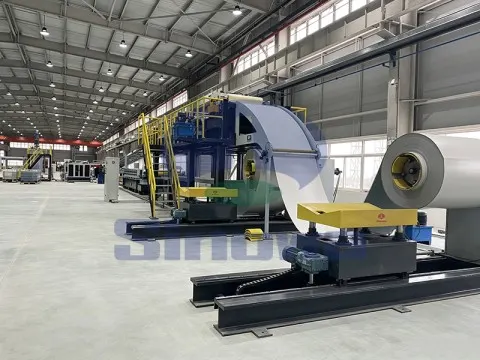
To fully grasp the value of the PU sandwich panel manufacturing machine with servo control, it is critical to first understand the core composition and functional design of the equipment. The machine is a fully integrated, continuous production line that unifies multiple interconnected workstations, each calibrated to perform a specialized task in the panel fabrication journey. At its core, the system consists of raw material uncoiling units, profile forming stations, precision feeding mechanisms, PU foam mixing and injection assemblies, laminating and curing modules, trimming and cutting units, and finished panel conveying and stacking components. Every moving part, adjustable mechanism, and processing station is governed by the servo control system, which acts as the central nervous system of the entire machine. This control framework is not a simple on-off or speed-regulating system; instead, it is a closed-loop control architecture that delivers real-time feedback, ultra-precise position control, stepless speed regulation, and synchronous coordination across all operational modules. Servo motors, paired with high-precision encoders and drive controllers, replace traditional hydraulic or variable-frequency drive systems in key processing links, offering instantaneous response to control signals, minimal backlash, and sub-millimeter level positioning accuracy—traits that are indispensable for producing high-quality PU sandwich panels with consistent thickness, flatness, and core density.
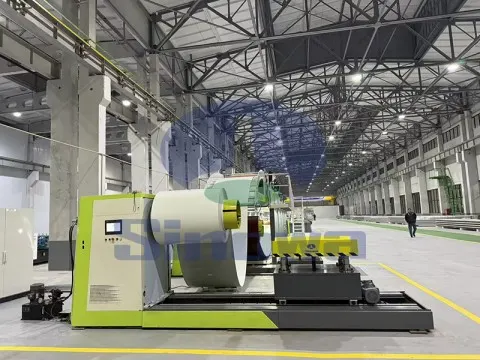
The operational workflow of the machine is a seamless, automated sequence, with the servo control system orchestrating each step to perfection, starting with the handling of outer skin materials. Typically, PU sandwich panels feature metal outer skins, such as galvanized steel or aluminum coils, which are loaded onto the uncoiling stations at the front end of the production line. The servo control system regulates the uncoiling speed and tension with pinpoint precision, ensuring that the metal sheets are fed into the profile forming station smoothly, without wrinkling, stretching, or misalignment. Traditional uncoiling systems often struggle with tension fluctuations, leading to uneven skin surfaces and compromised panel aesthetics, but the servo-driven tension control mechanism maintains a constant pulling force throughout the uncoiling process, adapting automatically to variations in coil diameter and material thickness. As the metal sheets enter the profile forming section, the servo motors control the rotation and positioning of the forming rollers, shaping the sheets into standardized profiles with consistent rib heights, edge folds, and dimensional accuracy. This level of precision is vital, as even minor deviations in profile shape can disrupt the subsequent lamination process and weaken the structural integrity of the final panel.
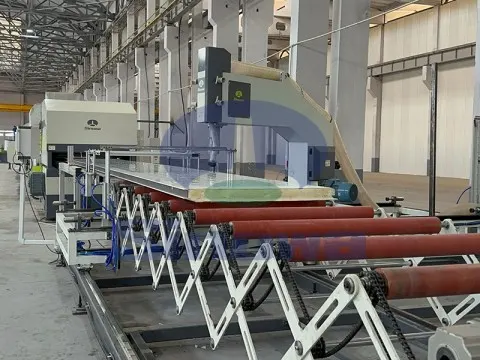
Following profile forming, the outer skin sheets are conveyed to the laminating and foam injection zone, the heart of the PU sandwich panel manufacturing process, where the servo control system’s impact is most pronounced. In this stage, the two formed outer skins are guided into a dual-track laminating mechanism, with a precisely calibrated gap between them to accommodate the PU foam core. The servo system controls the height and parallelism of the upper and lower tracks with exceptional accuracy, ensuring that the panel thickness remains uniform across the entire length and width of the production run, regardless of production speed or material variations. Simultaneously, the PU foam mixing and injection unit operates under strict servo control, regulating the flow rate, mixing ratio, and injection pressure of the polyol and isocyanate raw materials. The servo-driven metering pumps deliver the two chemical components in an exact, consistent ratio, eliminating fluctuations that could result in incomplete foaming, uneven core density, or poor bonding between the foam core and outer skins. This precise chemical dosing is critical, as it directly impacts the panel’s thermal insulation performance, compressive strength, and fire resistance—key performance metrics that define the quality of PU sandwich panels in practical applications.
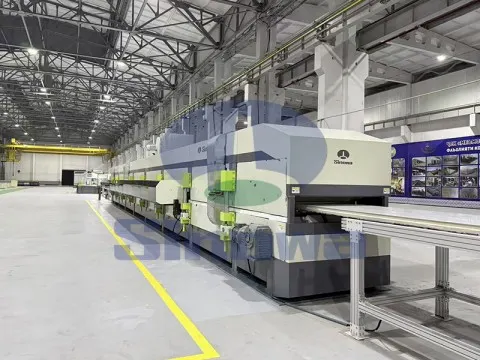
As the PU foam is injected between the outer skins, the laminating system moves the semi-finished panel through a controlled curing zone, where temperature and conveying speed are both managed by the servo control system. The servo motors regulate the conveying speed of the laminating tracks synchronously, ensuring that the panel moves through the curing zone at an optimal pace to allow sufficient time for the foam to expand, cure, and bond securely with the outer skins without rushing or delaying the production cycle. Unlike conventional systems that rely on manual speed adjustments or basic frequency conversion, the servo system maintains perfect synchronization between the injection process and conveying speed, preventing foam overflow, uneven distribution, or under-curing. This synchronization also enables the machine to operate at variable production speeds without sacrificing product quality, allowing manufacturers to adjust output rates based on order volumes, material types, and production schedules, a level of flexibility that is highly valuable in dynamic manufacturing environments.
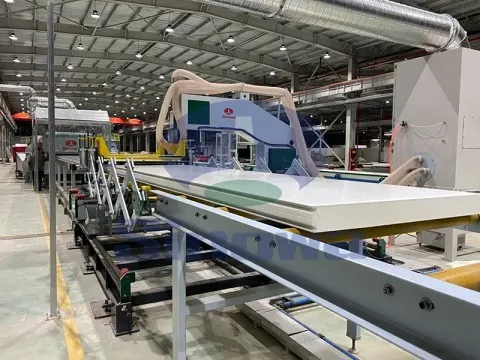
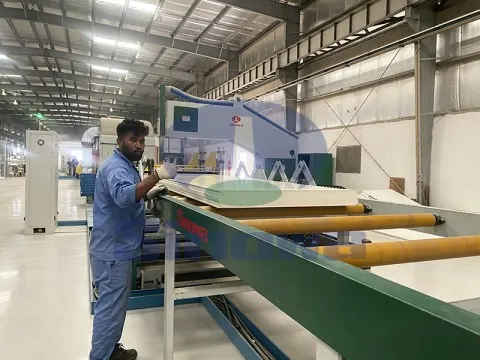
Once the PU foam core is fully cured and bonded with the outer skins, the finished panel moves to the trimming and cutting stations, where the servo control system continues to deliver precision and efficiency. The trimming unit removes excess material from the panel edges, ensuring clean, straight, and uniform side profiles, while the cutting unit slices the continuous panel into customized lengths as required by end-users. The servo-driven cutting mechanism features dynamic tracking capabilities, adjusting the cutting position and speed in real time to match the conveying speed of the panel, eliminating the need for intermittent production stops and enabling continuous, uninterrupted cutting. This dynamic tracking not only boosts overall production efficiency but also ensures that each cut is precise, with no burrs, uneven edges, or dimensional errors. Traditional cutting systems often suffer from misalignment or inconsistent cut lengths when operating at high speeds, but the servo control system’s real-time feedback and position locking capabilities eliminate these issues, ensuring that every finished panel meets strict dimensional tolerances.
Beyond the core production workflow, the PU sandwich panel manufacturing machine with servo control offers a host of operational advantages that set it apart from traditional manufacturing equipment. One of the most significant benefits is enhanced energy efficiency, as servo motors consume power only when actively performing tasks, unlike hydraulic systems that continuously consume energy to maintain pressure or conventional motors that run at fixed speeds regardless of load demands. This targeted power consumption reduces overall energy usage during production, lowering long-term operational costs and aligning with sustainable manufacturing practices. Additionally, the closed-loop design of the servo control system minimizes mechanical wear and tear, as the precise, controlled movements reduce friction, vibration, and impact on machine components. This translates to extended service life for the equipment, reduced maintenance requirements, and less frequent downtime for repairs, maximizing the overall uptime and productivity of the production line.
Another key advantage is the machine’s exceptional adaptability to diverse production requirements, made possible by the programmable nature of the servo control system. Manufacturers can easily adjust critical production parameters—including panel thickness, profile shape, foam density, production speed, and cut length—through the system’s control interface, without the need for extensive mechanical retooling or manual adjustments. This flexibility allows a single production line to manufacture a wide range of PU sandwich panel variants, catering to different applications such as exterior wall cladding, roof insulation, cold storage room construction, industrial partition walls, and refrigerated transportation components. Whether producing thin panels for residential construction or thick, heavy-duty panels for large-scale cold chain facilities, the servo-controlled machine can quickly reconfigure to meet specific specifications, making it a highly cost-effective investment for manufacturers serving diverse market segments.
The servo control system also simplifies machine operation and reduces reliance on skilled labor, a critical benefit in modern manufacturing where labor availability and training costs are key considerations. The system features an intuitive control interface that centralizes all operational parameters, allowing operators to monitor production status, adjust settings, and troubleshoot minor issues with minimal training. Real-time data feedback from the servo encoders and sensors provides instant visibility into production metrics, such as running speed, panel thickness, and material consumption, enabling operators to identify and address potential issues before they impact product quality. Furthermore, the system’s high degree of automation reduces the need for manual intervention at every production stage, from raw material feeding to finished panel stacking, minimizing human error and ensuring consistent production quality. Even less experienced operators can manage the machine efficiently, as the servo control system handles the complex, precision-critical tasks that would otherwise require highly skilled technicians.
In terms of product quality, the impact of the servo control system is undeniable, as it eliminates the variability inherent in manual or semi-automated production processes. Every PU sandwich panel produced by the machine features uniform thickness, flat surface finish, consistent foam core density, and precise dimensional accuracy, meeting strict quality standards for both domestic and international markets. The consistent bonding between the foam core and outer skins ensures superior structural strength, enabling the panels to withstand external pressures, temperature fluctuations, and environmental wear, while the uniform thermal insulation properties guarantee reliable energy efficiency in building and cold chain applications. This consistent quality not only enhances the reputation of manufacturers but also reduces the rate of defective products, minimizing material waste and further optimizing production costs.
Maintenance and upkeep of the servo-controlled PU sandwich panel manufacturing machine are also streamlined compared to traditional equipment, thanks to the system’s built-in diagnostic capabilities and robust design. The servo control system continuously monitors the performance of all motors, sensors, and mechanical components, detecting anomalies such as abnormal vibration, temperature spikes, or positioning errors in real time. Early fault detection allows maintenance teams to perform targeted repairs and replacements before minor issues escalate into major breakdowns, reducing unplanned downtime and extending the machine’s service life. Additionally, the absence of complex hydraulic systems eliminates common maintenance pain points such as fluid leaks, filter replacements, and pressure calibration, further simplifying routine upkeep. Regular maintenance tasks, such as lubrication, component inspection, and software updates, are straightforward and can be scheduled during planned production breaks, ensuring minimal disruption to manufacturing operations.
As the global demand for energy-efficient, sustainable building materials continues to surge, the role of the servo-controlled PU sandwich panel manufacturing machine becomes increasingly pivotal. The construction industry’s shift towards green building practices, coupled with the rapid expansion of the cold chain logistics sector driven by global trade and food safety requirements, has created a sustained need for high-quality PU sandwich panels. Traditional manufacturing equipment struggles to keep pace with this demand, both in terms of production volume and product quality, but the servo-controlled machine offers the scalability, precision, and efficiency needed to meet market expectations. Manufacturers that invest in this advanced equipment gain a competitive edge, able to deliver large volumes of consistent, high-performance panels while maintaining cost-effective operations and adapting quickly to changing market trends and customer requirements.
Looking ahead, the evolution of the PU sandwich panel manufacturing machine with servo control system is set to continue, with ongoing advancements in control technology, artificial intelligence, and industrial automation further enhancing its capabilities. Future iterations of the machine are likely to feature smarter, AI-integrated servo systems that can self-optimize production parameters based on real-time material data, production efficiency metrics, and quality feedback, further reducing manual input and maximizing operational efficiency. Enhanced connectivity features will also enable remote monitoring and control, allowing manufacturers to oversee production processes, diagnose issues, and adjust settings from off-site locations, adding another layer of operational flexibility. Despite these technological advancements, the core value of the servo control system—delivering precision, efficiency, and consistency in PU sandwich panel production—will remain unchanged, solidifying the machine’s status as an indispensable asset in the manufacturing landscape.
In conclusion, the PU sandwich panel machine integrated with a servo control system represents a paradigm shift in the production of high-performance building and insulation materials. By combining advanced mechanical design with state-of-the-art closed-loop servo control technology, this equipment addresses the key limitations of traditional manufacturing methods, offering unparalleled precision, operational flexibility, energy efficiency, and productivity. From the initial uncoiling of raw materials to the final cutting and stacking of finished panels, every stage of the production process is optimized by the servo system, ensuring uniform product quality, minimal waste, and reduced labor reliance. As the global demand for PU sandwich panels continues to grow across construction, cold chain, and industrial sectors, this advanced manufacturing equipment will remain a vital tool for manufacturers, enabling them to meet market demands efficiently, sustainably, and profitably. Its integration of servo control technology not only elevates current production standards but also paves the way for future innovations in the PU sandwich panel manufacturing industry, reinforcing its position as a cornerstone of modern industrial manufacturing.
Sinowa is a professional manufacturer of sandwich panel machine in china, we provide diversified and high-performance sandwich panel production lines, including fully automatic continuous PU sandwich panel line and customized special lines to meet mass production and personalized order demands. These sandwich panel lines support processing multiple foam core materials, such as PU, PIR, mineral wool, rock wool and glass wool, covering different insulation and fireproof standards.
Featuring stable operation, high efficiency, energy saving and easy maintenance, our PU sandwich panel line deliver sandwich panels with excellent thermal insulation, fire resistance, sound insulation and lightweight durability. The finished panels are widely applied in industrial workshops, warehouse roofing and wall cladding, cold storage insulation, serving global construction and industrial insulation markets.
https://www.cnsinowa.com/sandwich-panel-machines/pu-sandwich-panel-manufacturing-machine-with-servo-control-system.html