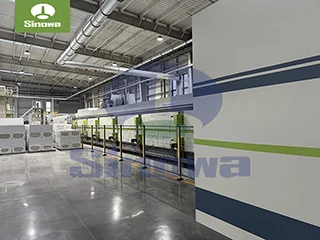
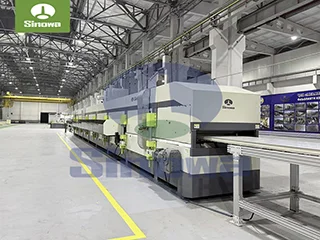
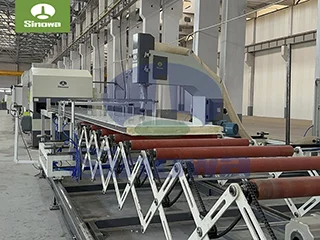
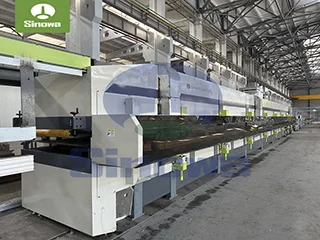
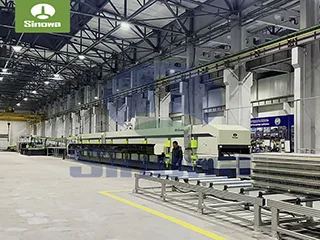
sandwich panel line
The structure of a composite insulation board production line is a systematic combination of functional modules, each undertaking specific production tasks and cooperating with each other to form a continuous and automated production flow. Generally, the basic structure includes raw material processing modules, mixing and stirring systems, molding units, compounding mechanisms, curing systems, cutting equipment, conveying devices, and control systems. The raw material processing module is responsible for preprocessing different raw materials, such as crushing, screening, and drying of inorganic insulation materials (like mineral wool, glass wool, and expanded perlite), and cutting of organic insulation cores (such as polystyrene foam, polyurethane foam, and extruded plastic boards) to ensure that the raw materials meet the particle size, moisture content, and shape requirements for subsequent processing. This module often includes specialized equipment such as crushers, sieves, and dryers, which can adjust processing parameters according to the characteristics of different raw materials to avoid the impact of impure or unqualified raw materials on product quality.
The mixing and stirring system is a key part of ensuring the uniformity and bonding performance of composite insulation boards. It usually consists of multiple agitators, batching devices, and feeding pipelines, which can accurately mix inorganic binders (such as cement, gypsum), insulation aggregates, additives (water-repellent agents, flame retardants, reinforcing fibers), and water in a preset ratio. Advanced mixing systems adopt dual-directional stirring or planetary stirring technology, which can fully disperse various raw materials, avoid agglomeration, and ensure that the mixture has stable viscosity and fluidity, laying a foundation for the formation of dense and uniform board structures. Some production lines are also equipped with automatic batching systems, which use sensors and controllers to realize precise measurement and automatic feeding of raw materials, reducing human error and improving the consistency of batch products.
The molding unit and compounding mechanism are responsible for shaping the mixed materials and realizing the composite bonding of different layers. The molding unit usually adopts methods such as pressing, extrusion, or casting, and the specific process is selected according to the type of composite insulation board. For example, for metal-faced sandwich boards, the molding unit uses roll forming technology to shape the upper and lower metal skins, and then combines them with the insulation core; for cement-based composite insulation boards, casting molding or pressing molding is adopted to form the base board, and then the surface layer is compounded. The compounding mechanism is equipped with pressing rollers, bonding stations, and positioning devices to ensure that the core layer, surface layer, and intermediate bonding layer are closely bonded without delamination or gaps. Some advanced production lines are designed with inclined conveyor belts and push rods to accurately align the insulation core with the surface layer during compounding, and use positioning plates to prevent displacement, further improving the compounding precision.
The curing system is used to promote the setting and hardening of the composite board, ensuring that it obtains sufficient strength and stability. Common curing methods include natural curing, steam curing, and thermal curing. Natural curing is suitable for small-scale production or products with low strength requirements, relying on natural temperature and humidity for curing, which has the advantage of low cost but long curing cycle. Steam curing uses a steam curing kettle to control temperature and humidity, which can accelerate the hydration reaction of binders such as cement, shorten the curing cycle from several days to several hours, and is suitable for large-scale continuous production. Thermal curing is mainly used for organic composite boards, using heating equipment to promote the foaming and curing of organic insulation materials, ensuring the formation of a uniform foam structure. The curing system is usually connected with the conveying device to realize continuous feeding and discharging, improving production efficiency.
The cutting equipment and conveying devices are responsible for the final shaping and transportation of products. The cutting equipment adopts precision cutting technology, such as circular saw cutting or CNC cutting, which can cut the cured composite boards into preset sizes according to production needs, with high cutting precision and smooth cutting surfaces, avoiding edge chipping or unevenness. Some production lines are equipped with intelligent cutting systems, which can automatically adjust cutting parameters according to product specifications, realizing multi-specification cutting and reducing labor input. Conveying devices include roller conveyors, belt conveyors, and lifting devices, which connect all production modules to form a continuous production line, reducing manual handling and avoiding damage to semi-finished or finished products during transportation. The control system is the "brain" of the entire production line, usually adopting PLC computer automatic control, which can realize the centralized control of all modules, set and adjust production parameters (such as mixing time, molding pressure, curing temperature, and cutting size), monitor the production process in real time, and alarm for faults such as material shortage, equipment failure, or parameter deviation, ensuring the stability and reliability of production.
The performance of composite sandwich panel line is reflected in multiple aspects such as automation level, production efficiency, product precision, and adaptability, which are important indicators to measure the quality and competitiveness of the production line. Automation level is one of the core performance indicators of modern production lines. High-automation production lines can realize automatic batching, automatic mixing, automatic molding, automatic compounding, automatic curing, and automatic cutting, reducing manual intervention, improving production efficiency, and ensuring the consistency of product quality. Some advanced production lines only need 6 operators to complete the entire production process, which greatly reduces labor costs and labor intensity. The automation system also supports parameter storage and call functions, which can quickly switch production parameters when producing different types of products, improving production flexibility.
Production efficiency is closely related to the structure design and equipment configuration of the composite sandwich panel production line. The production speed of continuous production lines can be adjusted according to market demand, with a daily output ranging from thousands to tens of thousands of boards, which can meet the needs of large-scale batch production. The improvement of production efficiency is also reflected in the optimization of the production cycle. For example, the use of steam curing can shorten the curing cycle, and the integration of molding and compounding processes can reduce the number of intermediate links. In addition, the production line is equipped with automatic template cleaning systems and automatic stacking and packaging devices, which can clean templates in time after product demolding to ensure the precision of subsequent products, and realize automatic stacking and packaging of finished products, further improving the overall production efficiency.
Product precision is another important performance indicator, which directly affects the installation effect and service life of composite insulation boards. High-precision composite sandwich panel production machine can control the thickness, size, flatness, and composite precision of boards within a small error range. For example, the thickness control press rollers of the molding unit adopt digital display control, which has high adjustment precision and can quickly adjust according to production requirements to ensure the consistency of board thickness. The precision cutting equipment can ensure that the length and width of the board meet the design requirements, and the cutting surface is smooth, which is convenient for on-site installation and splicing. The stability of product precision is also reflected in the uniform distribution of the internal structure of the board, without defects such as voids, agglomeration, or delamination, which ensures the thermal insulation, sound absorption, and structural strength of the board.
Adaptability refers to the ability of the composite sandwich panel machine to produce different types, specifications, and performance of composite insulation boards by adjusting parameters or replacing partial components. Good adaptability can expand the product scope of manufacturers and meet the diverse needs of different industries. For example, by replacing the mixing formula and adjusting the molding parameters, the same production line can produce cement-based composite insulation boards, metal-faced sandwich boards, and polymer composite insulation boards; by adjusting the cutting parameters and molding molds, it can produce boards of different thicknesses (ranging from 2mm to 40mm) and sizes. In addition, some production lines can be customized according to special needs, such as adding flame retardant processing modules or waterproof coating modules to produce boards with special performance requirements, enhancing the market adaptability of the production line.
The types of composite insulation board production lines are divided according to different classification standards, mainly including classification by product type, classification by production process, and classification by automation level. According to the type of products produced, the composite sandwich panel making machine can be divided into cement-based composite insulation board production lines, metal-faced sandwich board production lines, organic-inorganic composite insulation board production lines, and fire-resistant composite insulation board production lines. Cement-based composite insulation board production lines are mainly used to produce boards with cement as the base material and mixed with insulation aggregates (such as expanded perlite, vermiculite), which have the advantages of high strength, fire resistance, and durability, and are widely used in building exterior walls and roofs. Metal-faced sandwich board production lines use metal sheets (such as color steel plates, aluminum plates) as the upper and lower surfaces and insulation materials (such as polyurethane foam, rock wool) as the core layer, which are characterized by light weight, high strength, and quick installation, and are suitable for large-span buildings and prefabricated buildings.
Organic-inorganic composite insulation panel production line integrate the advantages of organic and inorganic insulation materials, using organic materials (such as polystyrene foam) to provide thermal insulation performance and inorganic materials (such as cement) to improve fire resistance and structural strength, avoiding the flammability of pure organic boards and the poor thermal insulation effect of pure inorganic boards. Fire-resistant composite insulation board production lines are specially designed to produce boards with high fire resistance levels, usually adding a large number of flame retardants in the mixing process, or using fire-resistant core materials (such as rock wool, glass wool), and equipped with special curing and processing processes to ensure that the boards can maintain stability in high-temperature environments and prevent fire spread. According to the production process, the production line can be divided into pressing type production lines, extrusion type production lines, casting type production lines, and foaming type production lines. Pressing type production lines use pressure to bond each layer of materials, which are suitable for producing dense composite boards with high strength; extrusion type production lines extrude the mixed materials through a die to form, which are suitable for producing boards with regular shapes and continuous production; casting type production lines pour the mixed materials into molds for curing and shaping, which are suitable for producing large-size or special-shaped composite boards; foaming type production lines mainly produce organic composite boards, using foaming agents to make the core material form a porous structure, which has excellent thermal insulation performance.
According to the automation level, the composite sandwich panel manufacturing line can be divided into fully automatic production lines, semi-automatic production lines, and manual production lines. Fully automatic production lines realize the full-process automation of production, with high production efficiency, stable product quality, and low labor intensity, which are suitable for large-scale manufacturers; semi-automatic production lines need manual assistance in some links (such as raw material feeding, finished product handling), with moderate investment and production efficiency, which are suitable for small and medium-sized manufacturers; manual production lines rely on manual operation for most processes, with low production efficiency, large product quality differences, and high labor intensity, which are gradually eliminated by the market, only used in small-scale small-batch production or special product processing.
The applications of composite insulation board production line are closely related to the application fields of composite insulation boards, covering construction, industry, refrigeration, transportation, and other fields, and playing an important role in energy conservation, environmental protection, and safety production. In the construction industry, which is the largest application field, composite insulation boards produced by the production line are widely used in building exterior wall insulation, interior wall partition, roof insulation, and floor insulation. In exterior wall insulation projects, composite insulation boards can effectively reduce building energy consumption, improve indoor thermal comfort, and reduce heating and air conditioning costs. For example, cement-based composite insulation boards and metal-faced sandwich boards are often used in exterior wall insulation systems of residential buildings, commercial buildings, and industrial plants, which not only have good thermal insulation performance but also can enhance the durability and weather resistance of the exterior wall. In interior wall partitions, light-weight composite insulation boards can reduce the self-weight of the building, increase the usable area, and have sound absorption and noise reduction effects, which are suitable for hospitals, schools, hotels, and other places with high requirements for noise control.
In the industrial field, composite insulation boards are used for insulation and heat preservation of industrial equipment, pipelines, and workshops, which can reduce energy loss, improve production efficiency, and ensure the safety of production processes. For example, in thermal power plants, chemical plants, and metallurgical plants, high-temperature pipelines and equipment need to be insulated with fire-resistant and high-temperature-resistant composite insulation boards to prevent heat loss and avoid scald accidents. In cold storage and refrigeration projects, composite insulation boards with excellent thermal insulation performance (such as polyurethane composite insulation boards) are used to build cold storage walls, roofs, and floors, which can maintain a stable low-temperature environment, reduce the energy consumption of refrigeration equipment, and extend the storage time of goods. The production line can adjust the insulation performance of the boards according to the temperature requirements of the cold storage (such as low-temperature cold storage, ultra-low temperature cold storage), meeting the diverse needs of the refrigeration industry.
In the transportation field, composite insulation boards are used in the production of thermal insulation compartments of refrigerated trucks, railway carriages, and ships, which can ensure the thermal insulation effect during the transportation of perishable goods (such as food, medicine), and maintain the quality of the goods. Light-weight composite insulation boards can also reduce the self-weight of transportation vehicles, improve transportation efficiency, and reduce fuel consumption. In addition, composite insulation boards are also used in special fields such as aerospace, national defense, and electronic equipment. For example, in aerospace, lightweight and high-strength composite insulation boards are used for thermal insulation of aircraft components; in electronic equipment, composite insulation boards with good insulation performance are used as insulation materials for equipment casings and internal components, ensuring the stable operation of electronic equipment.
With the continuous improvement of global energy conservation and environmental protection requirements, and the rapid development of the prefabricated building industry, the demand for composite insulation boards is increasing, and higher requirements are put forward for the performance and functionality of composite insulation sandwich panel machine. In the future, the production line will develop in the direction of higher automation, intelligence, and greenization. Intelligent production lines will integrate Internet of Things, big data, and artificial intelligence technologies to realize real-time monitoring, intelligent adjustment, and fault prediction of the production process, further improving production efficiency and product quality. Green production lines will pay more attention to energy conservation and environmental protection, adopt environmentally friendly raw materials and production processes, reduce energy consumption and pollutant emissions, and realize the recycling of waste materials (such as recycling and reusing dust generated during production). At the same time, the production line will be more flexible and modular, which can quickly adapt to the production of new types of composite insulation boards, meeting the changing market needs.
In conclusion, the composite insulation panel production line is a key equipment that supports the development of the composite insulation material industry. Its scientific structure design, excellent performance, and diverse types determine the quality and application scope of composite insulation boards. From the raw material processing to the finished product output, each module of the production line cooperates closely to realize the efficient and standardized production of composite insulation boards. With the continuous expansion of application fields and the continuous upgrading of technology, the composite insulation board production line will play a more important role in promoting energy conservation and environmental protection, and promoting the high-quality development of the construction and industrial industries. Manufacturers need to choose suitable sandwich panel line according to their own product positioning, production scale, and market demand, and continuously optimize production processes and improve equipment performance to gain an advantage in the fierce market competition.
https://www.cnsinowa.com/sandwich-panel-machines/composite-insulation-board-production-line.html