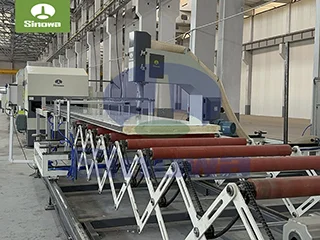
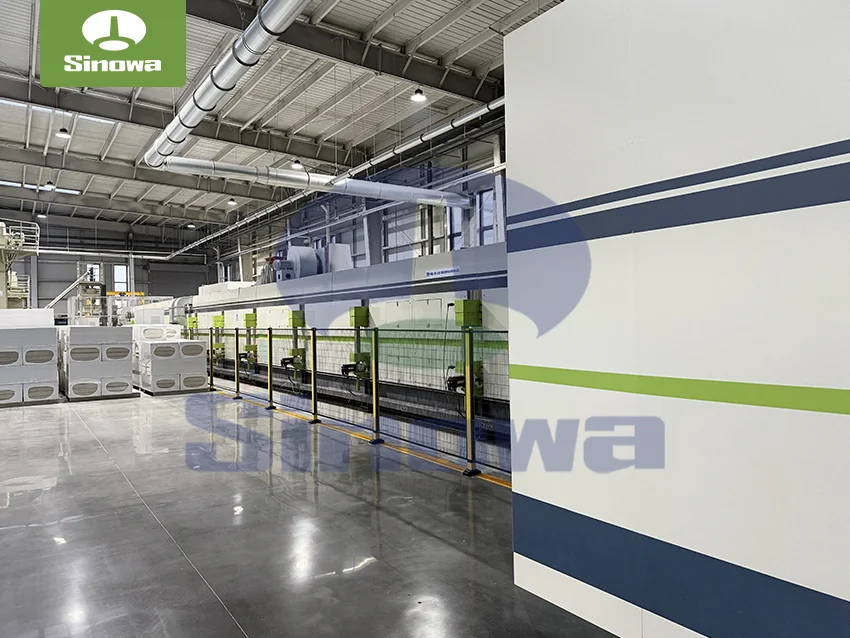
 sandwich panel line
The core energy-saving advantages of the energy saving PU foam production line are mainly reflected in its optimized thermal insulation and heat circulation structure design, which fundamentally reduces ineffective heat loss that plagues conventional production equipment. In the traditional PU foam production process, a large amount of heat generated by the exothermic foaming reaction is directly dissipated into the air, while external heating equipment needs to continuously operate to maintain the constant temperature required for curing, resulting in dual energy waste. The upgraded production line is equipped with fully insulated closed curing zones and raw material storage tanks, which adopt high-performance thermal insulation materials to wrap all heat-generating and temperature-control components. This structural design greatly weakens heat exchange between the production system and the external environment, maintaining stable internal temperature with minimal auxiliary heating energy. Meanwhile, the built-in waste heat recovery system collects residual heat from foaming and curing procedures, and converts and transmits the recycled heat to the raw material preheating link. Preheating polyol and isocyanate raw materials in advance reduces the heating load of subsequent processing equipment, forming a closed-loop heat utilization system that significantly cuts down overall thermal energy consumption throughout production.
Intelligent frequency conversion and automatic control systems are key functional modules that support the long-term energy-saving operation of the PU foam production line, realizing dynamic energy consumption adjustment according to actual production conditions. Traditional production lines usually operate at fixed power regardless of production load, leading to serious electric energy waste during equipment standby, low-speed operation, and intermittent production stages. The energy-saving model production line is fully equipped with variable frequency drive devices for all power components including conveying motors, stirring devices, and feeding pumps. These devices can automatically sense real-time production volume, material flow rate, and equipment operating status, and intelligently adjust motor operating speed and output power to avoid invalid power consumption under no-load or light-load conditions. Cooperating with the high-precision PLC intelligent control system, the whole production process realizes unmanned automatic operation of batching, feeding, mixing, and molding. The system precisely locks the optimal operating parameters for different foam formulas and product specifications, avoiding repeated debugging and equipment idling caused by manual operation errors, further improving electric energy utilization efficiency and reducing long-term production energy costs.
Precision raw material batching and mixing technology of the energy saving PU foam production line reduces resource waste and indirectly realizes energy conservation by improving raw material utilization rate. In conventional PU foam production, manual batching and ordinary mixing equipment often cause proportion deviation, uneven material mixing, and excessive feeding, which not only leads to unqualified foam product quality but also causes waste of chemical raw materials. The wasted raw materials will be discharged as industrial waste, requiring additional energy consumption for subsequent waste treatment. The energy-saving production line adopts high-precision metering and quantitative feeding devices, which can accurately control the proportion of various raw materials and additives according to product production requirements, ensuring zero deviation of material ratio for each batch of production. The optimized high-speed mixing structure enables rapid and uniform fusion of liquid raw materials, maximizing the chemical reaction efficiency of PU foaming. Sufficient and thorough foaming reaction eliminates unreacted residual materials, greatly improving raw material utilization, reducing material waste and subsequent waste disposal energy consumption, and forming an indirect energy-saving and consumption-reducing effect in the whole production cycle.
The optimized curing and molding process of the energy saving PU foam production line shortens production cycles and reduces cumulative energy consumption of unit products. The curing stage is the longest time-consuming link in PU foam production and also the main stage of continuous energy consumption of heating and heat preservation equipment. Traditional production lines have slow curing speed and long molding cycle due to unstable temperature control and unreasonable equipment structure, resulting in long-term continuous energy input for single product production. The energy-saving production line optimizes the internal structure of the curing tunnel and adopts uniform heat distribution technology to make the temperature inside the curing area more balanced. This enables PU foam to complete molecular stabilization and rapid molding in a shorter time without affecting product density, cell structure and mechanical properties. The shortened single-product production cycle allows the equipment to complete more production tasks within the same operating time, reducing the average energy consumption of each finished product. In addition, the automatic sensing device of the production line can judge the curing state of foam products in real time, automatically stop local heating and heat preservation work after product molding, and avoid long-term blind energy supply of equipment, further optimizing the energy consumption structure of the curing process.
The energy saving PU foam production line achieves green production and auxiliary energy conservation through environmentally friendly process configuration and low-loss equipment operation design. Modern industrial energy saving not only focuses on direct reduction of electricity and heat consumption, but also covers energy consumption optimization of environmental protection treatment and equipment operation maintenance. This production line adopts low-consumption and low-noise power components, which have lower operating power loss and longer service life compared with traditional motors and transmission parts, reducing energy waste caused by equipment aging and mechanical loss. Meanwhile, the production process applies low-carbon and efficient foaming auxiliary technologies, which optimize the foaming reaction environment to reduce harmful gas volatilization and industrial waste generation. The reduced waste discharge lowers the energy consumption required for flue gas purification, waste recovery and other environmental protection links. In addition, the whole line adopts modular and streamlined structural design, which reduces equipment operating resistance and mechanical friction loss during continuous operation. The smooth operation state of the equipment not only improves production stability but also effectively cuts down invalid mechanical energy consumption, realizing multi-dimensional energy-saving optimization in the whole production system.
In actual industrial application scenarios, the energy saving PU foam production line shows excellent adaptive energy-saving performance, adapting to flexible production demands and avoiding energy waste caused by production switching. Many PU foam manufacturing enterprises need to produce products of different specifications and types according to market demands, and traditional production lines require long-term equipment debugging, parameter resetting and equipment preheating during product switching, resulting in a large amount of invalid energy consumption. The energy-saving production line supports one-click switching of multiple production formulas and automatic parameter matching, which can quickly adjust equipment operating status, temperature parameters and feeding proportions without long-time shutdown and repeated preheating. Whether it is mass production of standard foam products or small-batch customized production of special specifications, the production line can maintain a low energy consumption state. Its flexible energy adjustment mode avoids the energy waste caused by frequent production switching and equipment repeated start-stop, greatly improving the energy-saving stability of multi-scenario production and bringing more flexible and efficient low-carbon production solutions for manufacturing enterprises.
With the continuous development of green manufacturing technology, the energy saving PU foam production line still has broad optimization space and development potential in energy-saving performance and production efficiency. The future upgrading direction of this equipment focuses on deeper intelligent energy management and collaborative optimization of multiple energy-saving technologies. By introducing more precise real-time energy consumption monitoring modules, the production line can realize real-time statistics, analysis and early warning of energy consumption data of each production link, automatically optimize operating parameters according to energy consumption changes, and achieve refined energy-saving control. At the same time, the integrated application of new thermal insulation materials and more efficient waste heat recovery technologies will further reduce the overall energy consumption level of the production line. While maintaining efficient and stable production, the continuous iteration of energy-saving technology will further improve the green production level of PU foam industry, help manufacturing enterprises reduce production costs, optimize production models, and promote the sustainable and high-quality development of the entire polyurethane foam manufacturing field.
https://www.cnsinowa.com/sandwich-panel-machines/energy-saving-pu-foam-production-line.html