Production Efficiency Of Phenolic Board Continuous Line
Sep 17, 2026
The continuous production line for phenolic boards has revolutionized traditional phenolic board manufacturing by eliminating intermittent operational gaps and manual inefficiencies.
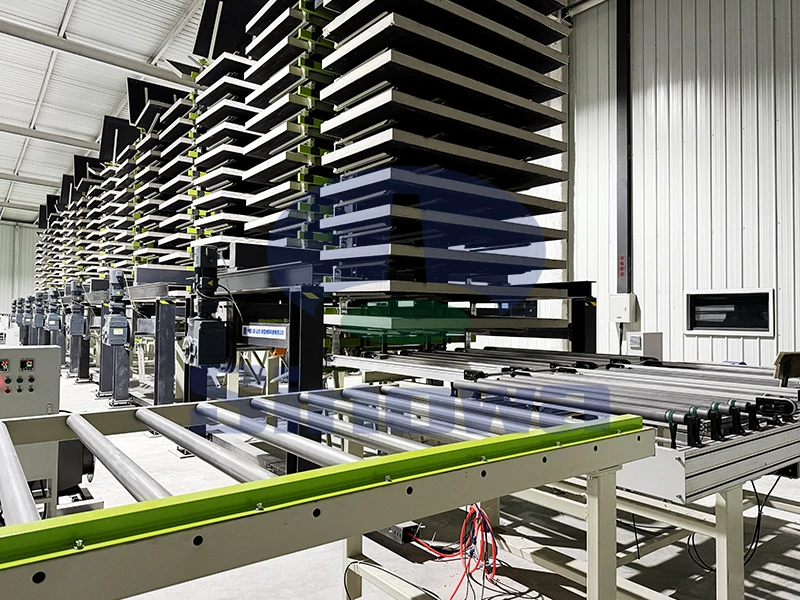
Traditional phenolic board manufacturing relies on intermittent batch production modes, which are plagued by frequent equipment startup and shutdown, repeated parameter debugging, and long waiting intervals between working procedures. These drawbacks severely restrict overall production throughput and cause unstable operational rhythms in daily manufacturing. In contrast, the continuous production line constructs a fully integrated and streamlined production loop that connects raw material feeding, foaming, compounding, curing, shaping, cutting and finished product output into one uninterrupted process. This integrated operation completely removes the invalid downtime inherent in batch production, forming a stable and cyclic production rhythm. Every functional module of the line operates in synchronous coordination, avoiding the production delays caused by mismatched speeds of individual equipment in traditional production systems. The consistent operational state also reduces mechanical wear and tear from frequent startup and shutdown, maintaining stable equipment operation for a long time and laying a solid foundation for sustained high-efficiency production. Moreover, the continuous working mode standardizes the conversion process of phenolic raw materials, making the physical and chemical reaction progress of each batch of products more uniform, which not only boosts production efficiency but also avoids repeated rework caused by inconsistent product performance.
Highly automated system configuration is the core driving force behind the efficient operation of phenolic board continuous production lines. Modern production lines adopt full-process automatic control, realizing unmanned operation in key links such as raw material proportioning, quantitative feeding, and constant-temperature foaming. The intelligent control system can precisely adjust core production parameters in real time according to production demands, including raw material dosage, reaction temperature, foaming speed and curing time. This precise automatic regulation eliminates parameter errors and operational deviations caused by manual operation, ensuring that each production link runs at the optimal efficiency state. Unlike manual operation which is easily affected by fatigue, experience and operational habits, the automated system maintains consistent operational accuracy and speed for long-term continuous production, effectively improving unit-time production output. In addition, the automatic linkage design between various equipment modules realizes synchronous start and stop and speed matching of the whole line. When adjusting product specifications, the system can complete overall parameter synchronization modification in a short time, avoiding the long debugging period required by traditional equipment, greatly shortening production switching time and improving flexible production efficiency. The automatic detection and early warning function also monitors equipment operating status and production process in real time, quickly identifying potential operational faults to reduce unplanned downtime.
Scientific process optimization and structural design of production lines further enhance the overall production efficiency of phenolic board manufacturing. Traditional production processes have redundant operational links and unreasonable process sequences, leading to low material utilization and long production cycles. The continuous production line optimizes and integrates the whole production flow, removing repetitive intermediate processing links and simplifying the material transmission and conversion path. The foaming and curing modules adopt an integrated structural design, realizing seamless connection between phenolic foam forming and solidification molding, which shortens the product molding cycle significantly. The optimized temperature control structure achieves uniform heat distribution in the curing area, enabling phenolic materials to complete chemical cross-linking and molding in a shorter time without sacrificing product quality. Meanwhile, the modular layout of the production line makes the spatial arrangement of equipment more reasonable, shortening the transmission distance of semi-finished products and reducing material conveying time and loss. The improved cutting and sorting system realizes fixed-length precise cutting and automatic arrangement of finished products at a high speed, matching the front-end high-speed production rhythm and avoiding product accumulation and line blockage. This systematic process optimization realizes the coordinated improvement of production speed, material utilization rate and product yield, comprehensively upgrading production efficiency.
Standardized operational management and regular equipment maintenance are essential guarantees for the long-term stable efficiency output of phenolic board continuous production lines. Continuous production equipment runs for a long time with high load, and standardized daily operation specifications can effectively avoid operational irregularities that affect production progress. Formulating unified operational procedures for startup, parameter adjustment, daily patrol and shutdown enables operators to standardize all operational behaviors, ensuring the production line always runs in a standardized and efficient state. Regular professional maintenance of key equipment modules such as feeding systems, foaming devices and control systems can eliminate potential equipment failures in advance, reduce the frequency of equipment failure shutdown and maintenance downtime. Timely cleaning of production equipment and production areas avoids material residue accumulation affecting equipment operation accuracy and product molding effect. In addition, establishing complete production operation records and efficiency monitoring mechanisms can track the operational data of the production line in real time, identify inefficient links and subtle equipment abnormalities in the production process, and carry out targeted optimization and adjustment. Scientific management mode avoids efficiency attenuation caused by irregular operation and equipment aging, ensuring that the production line maintains stable high-efficiency operation in long-term mass production.
Raw material adaptability and formula optimization play a vital role in improving the production efficiency of phenolic board continuous lines. The performance and matching degree of raw materials directly affect the smooth progress of foaming, curing and molding processes. Reasonable raw material proportioning and optimized formula design can accelerate the chemical reaction speed of phenolic materials, shorten the molding cycle of products, and thus improve unit-time production capacity. Optimized raw material formulas can enhance the stability of foaming reactions, avoid local excessive foaming or insufficient curing problems that cause product defects and rework, and effectively improve product yield. Higher yield means fewer invalid production operations, which indirectly improves the overall effective production efficiency of the line. In addition, the continuous production line with good raw material adaptability can flexibly match different types of qualified raw materials and adjusted formulas, realizing rapid switching of different product specifications without large-scale equipment debugging and process adjustment. This flexible adaptation ability reduces production preparation time, improves the utilization rate of production equipment, and enables the production line to maintain efficient operation under diversified production demands. Stable raw material reaction performance also reduces process fluctuation risks, ensuring continuous and orderly production progress.
With the continuous upgrading of industrial manufacturing technology, the production efficiency of phenolic board continuous lines still has huge room for improvement through intelligent upgrading and technological iteration. The introduction of intelligent data analysis technology can realize real-time monitoring, big data analysis and intelligent prediction of the whole production process, automatically optimizing production parameters according to real-time production conditions to achieve the most efficient production state. The upgraded intelligent sensing equipment can capture subtle changes in production temperature, pressure and material status, realizing ultra-precise process control and further improving production stability and efficiency. The integration of energy-saving and efficient production technologies can reduce ineffective energy consumption in the production process, while maintaining high production speed, realizing the coordinated improvement of production efficiency and energy utilization efficiency. In addition, the continuous optimization of production line modular structure and intelligent linkage system can further shorten the product switching cycle, improve the flexibility and continuity of production, and adapt to the increasingly diverse and large-scale market production demands. Future technological innovations will continue to break the efficiency bottlenecks of traditional continuous production lines, promote phenolic board manufacturing to develop towards higher efficiency, lower consumption and higher intelligence, and further enhance the overall production level of the industry.
https://www.cnsinowa.com/faqs/production-efficiency-of-phenolic-board-continuous-line.html
Main Products
-

Continuous PU Sandwich Panel Production Line
This continuous PU sandwich panel production line is an integrated automatic equipment. It covers uncoiling, forming, foaming, curing and cutting processes. With automatic raw material proportioning and precise temperature & pressure control, PIR sandwich panel production line continuously composites panels with double skins. Polyurethane sandwich panel production line stably produces steel and aluminum sandwich panels. Featuring high automation, the line makes fireproof and thermal-insulation panels for building enclosure and cold storage. -

Rock Wool Sandwich Panel Production Line
Continuous rockwool sandwich panel production line is an automatic integrated production equipment, consisting of uncoiling, forming, gluing and compounding, heating curing, fixed-length cutting, automatic stacking and other modules. The mineral wool sandwich panel production line continuously conveys color steel plates and rock wool core materials to automatically complete lamination and curing, which can produce fireproof and thermal insulation sandwich panels. Featuring high automation degree and stable operation, this production line is suitable for mass production of panels used for building walls, roofs and other scenarios. -

Phenolic Insulation Board Production Line
This integrated automatic production line continuously manufactures PU and phenolic insulation boards. The insulation board production line covers raw material proportioning, high-pressure foaming, laminating, curing and fixed-length cutting. Featuring high automation and stable molding, the insulation panel production line supports various surface materials. PU boards offer excellent thermal insulation, while phenolic boards have superior fire resistance. These products are widely used in construction, cold chain, ventilation ducts and other thermal insulation fields.