What Causes Uneven Foaming On Phenolic Insulation Board Production Line
Sep 22, 2026
Uneven foaming is a prevalent quality defect in phenolic insulation board production, causing inconsistent pore structure, uneven density and poor thermal performance. This issue stems from multiple interrelated factors covering raw material formulation, mixing procedures, temperature control, pressure stability, equipment operation and curing conditions throughout the continuous production process.
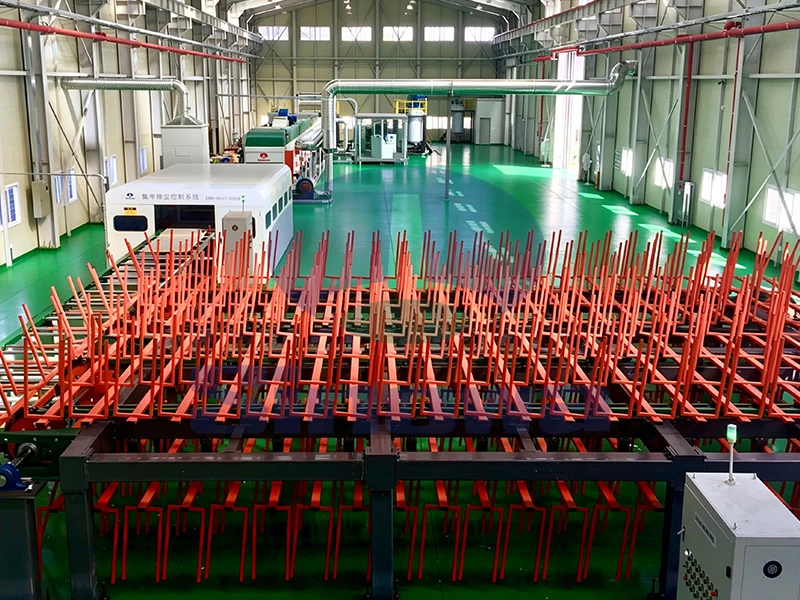
Improper raw material proportioning and inconsistent material properties are the primary triggers of uneven foaming in phenolic insulation board manufacturing. The production relies on a precise blend of phenolic resin, foaming agents, curing agents and auxiliary additives, and any deviation in component ratios will directly disrupt the foaming reaction balance. When the proportion of foaming agent is locally excessive, over-foaming occurs to form large, loose pores, while insufficient foaming agent leads to underdeveloped foam structures with dense, rigid areas. Similarly, uneven distribution of curing agents causes inconsistent reaction rates across the board surface; regions with more curing agent solidify rapidly to restrict foam expansion, whereas areas with less curing agent experience delayed curing and excessive bubble growth. In addition, fluctuations in the viscosity and activity of phenolic resin raw materials also affect foaming uniformity. Resin with unstable viscosity fails to mix evenly with additives, resulting in isolated material clusters that cannot undergo synchronous foaming. Minor variations in additive purity and particle fineness further exacerbate this problem, creating irregular foam textures and inconsistent board thickness in finished products.
Defective material mixing processes constitute another major cause of uneven foaming on the production line. Uniform mixing is the foundational step to ensure all functional components disperse evenly in the resin matrix, and unreasonable mixing parameters will completely undermine foaming consistency. Excessively high mixing speeds generate intense turbulence that traps tiny air bubbles in the high-viscosity resin mixture, and these encapsulated air pockets cannot escape during subsequent processing. The trapped air forms hidden voids and uneven pore clusters after curing, leading to patchy foaming defects. Conversely, overly low mixing speeds result in inadequate blending, leaving unmixed additive agglomerations and pure resin regions throughout the material. These heterogeneous areas exhibit entirely different foaming behaviors during heating and curing. Moreover, unreasonable mixing duration also causes problems; insufficient mixing fails to homogenize components, while prolonged mixing leads to premature partial foaming and pre-curing of local materials before formal molding. Many production lines also suffer from uneven material feeding during mixing, with intermittent or unstable raw material delivery causing inconsistent material ratios in different batches and different sections of the same board, ultimately producing uneven foaming effects across the product surface and interior.
Unstable temperature control throughout foaming and curing stages significantly induces uneven foaming defects. Temperature directly governs the reaction rate of phenolic resin cross-linking and the gas expansion efficiency of foaming agents, making it the most critical environmental parameter for stable foaming. Local overheating in the production equipment triggers premature micro-foaming and rapid surface curing of partial materials. The quickly formed solid surface skin locks internal gas, preventing uniform bubble expansion and creating dense surface layers with hollow internal structures. In contrast, partial low-temperature areas reduce the activity of foaming and curing agents, slowing down gas precipitation and resin solidification. Materials in low-temperature zones fail to expand fully within the standard production cycle, forming dense, under-foamed regions that contrast sharply with normally foamed areas. Continuous production lines often face uneven temperature distribution in molding and curing chambers, with temperature differences between edge and central areas of the board. Additionally, frequent temperature fluctuations during operation disrupt the synchronous progress of foaming and curing reactions. Short-term temperature surges cause abrupt gas expansion and bubble rupture, while sudden temperature drops stall foaming reactions, resulting in irregular pore sizes, inconsistent density and obvious foaming unevenness in finished boards.
Fluctuating working pressure in the molding chamber and material delivery system further aggravates uneven foaming phenomena. The continuous foaming process requires stable pressure environments to constrain the free expansion speed of foam materials and ensure consistent bubble formation and growth. Unstable internal pressure in the molding chamber leads to unbalanced foam expansion; instantaneous high pressure compresses newly formed bubbles to form dense structures, while instantaneous low pressure allows excessive bubble expansion and partial bubble collapse, creating alternating dense and loose foam areas. Pressure instability in the raw material metering and conveying system also delivers uneven material flow rates. Unsteady material output causes inconsistent material thickness and component ratios on the production substrate, so that different sections of the board receive different amounts of resin and additives, leading to asynchronous foaming degrees. Besides, uneven pressure applied by the upper and lower molding equipment results in inconsistent compression on different parts of the foaming material. Uneven mechanical pressure restricts foam expansion in pressed areas while allowing free expansion in loose areas, eventually forming boards with uneven thickness, irregular pore distribution and prominent foaming inconsistencies.
Mechanical operation deviations and equipment aging problems on the production line contribute greatly to long-term uneven foaming issues. Continuous production equipment relies on precise and stable mechanical movement to ensure uniform material spreading and synchronous foaming reaction. Misalignment of material spreading pendulums, unstable conveyor belt operating speeds and inconsistent equipment operation strokes will lead to uneven material paving thickness. Thick material layers retain more heat and undergo sufficient foaming, while thin layers dissipate heat quickly and fail to complete full foaming reactions, forming obvious foaming differences. Long-term equipment operation causes aging of mixing blades, mold plates and sealing components. Worn mixing blades cannot achieve uniform stirring, leaving residual material dead zones with unmixed components. Deformed mold plates and uneven conveyor belt surfaces create gaps and uneven stress during foaming and curing, disrupting uniform bubble growth. In addition, inaccurate equipment calibration of metering devices leads to cumulative errors in raw material proportioning over continuous production. These subtle mechanical deviations do not cause obvious defects in single-batch production but gradually form regular uneven foaming problems in mass continuous production, affecting overall product quality stability.
Asynchronous coordination between foaming reaction rate and curing reaction rate is an underlying cause of persistent uneven foaming in phenolic insulation board production. Qualified foam formation requires perfect synchronization of gas generation from foaming agents and resin cross-linking curing. When the foaming rate outpaces the curing rate, a large amount of gas precipitates rapidly before the resin forms a stable network structure. Excess free gas causes excessive bubble expansion, bubble merging and partial bubble rupture, forming large pores and hollow areas. On the contrary, if curing proceeds faster than foaming, the resin solidifies prematurely before full gas precipitation and bubble expansion, resulting in dense, under-foamed material areas with poor insulation performance. Many production scenarios have localized reaction rate mismatches due to uneven material dispersion and temperature differences. Partial areas show fast foaming and slow curing while others show slow foaming and fast curing, forming alternating defective regions on the same board. Moreover, delayed reaction feedback in continuous production makes it difficult to adjust parameters in real time for local reaction imbalances, leading to widespread uneven foaming defects that affect the overall yield and quality of phenolic insulation boards.
Main Products
-

Continuous PU Sandwich Panel Production Line
This continuous PU sandwich panel production line is an integrated automatic equipment. It covers uncoiling, forming, foaming, curing and cutting processes. With automatic raw material proportioning and precise temperature & pressure control, PIR sandwich panel production line continuously composites panels with double skins. Polyurethane sandwich panel production line stably produces steel and aluminum sandwich panels. Featuring high automation, the line makes fireproof and thermal-insulation panels for building enclosure and cold storage. -
Rock Wool Sandwich Panel Production Line
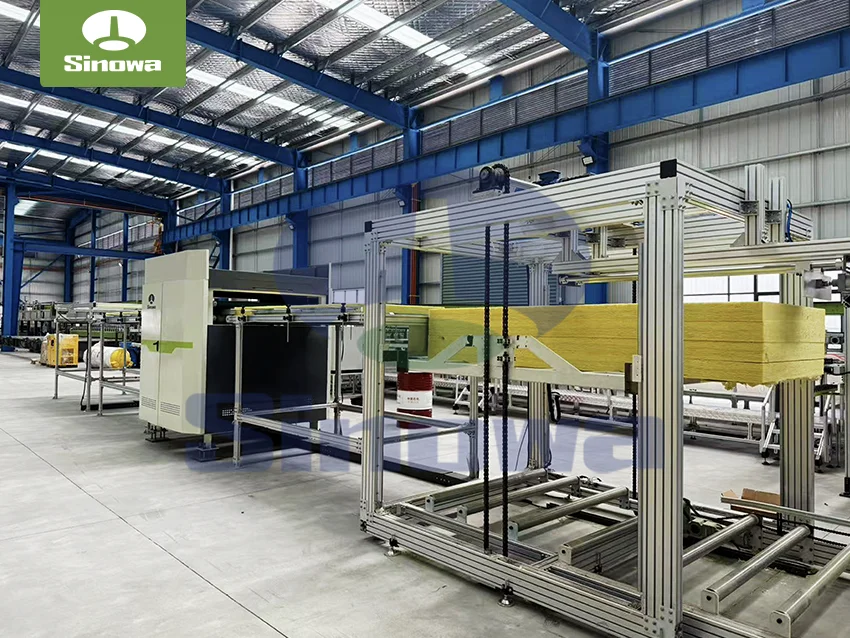
Continuous rockwool sandwich panel production line is an automatic integrated production equipment, consisting of uncoiling, forming, gluing and compounding, heating curing, fixed-length cutting, automatic stacking and other modules. The mineral wool sandwich panel production line continuously conveys color steel plates and rock wool core materials to automatically complete lamination and curing, which can produce fireproof and thermal insulation sandwich panels. Featuring high automation degree and stable operation, this production line is suitable for mass production of panels used for building walls, roofs and other scenarios. -
Phenolic Insulation Board Production Line
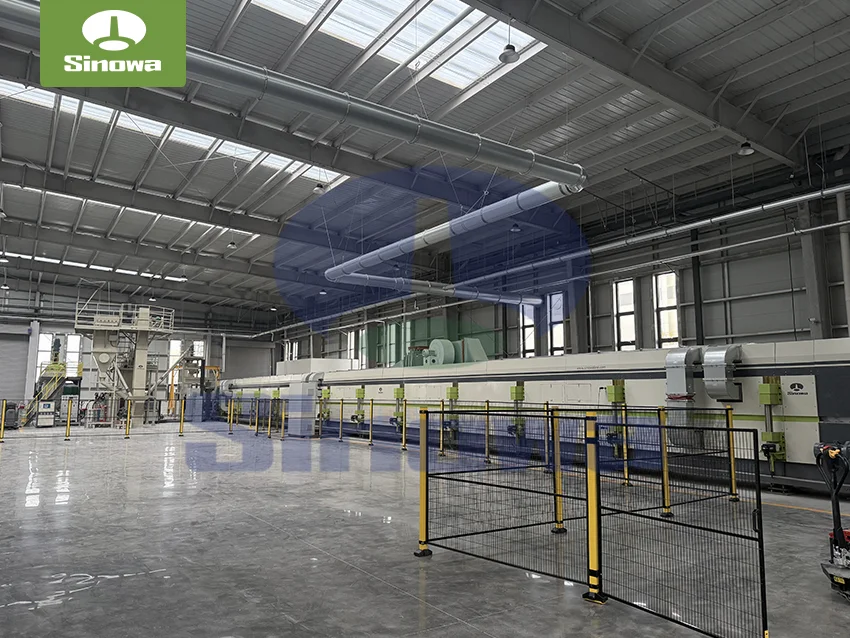
This integrated automatic production line continuously manufactures PU and phenolic insulation boards. The insulation board production line covers raw material proportioning, high-pressure foaming, laminating, curing and fixed-length cutting. Featuring high automation and stable molding, the insulation panel production line supports various surface materials. PU boards offer excellent thermal insulation, while phenolic boards have superior fire resistance. These products are widely used in construction, cold chain, ventilation ducts and other thermal insulation fields.