Frequent Shutdown Of Phenolic Board Continuous Production Line
Sep 17, 2026
Frequent unplanned shutdowns of phenolic board continuous production lines severely disrupt manufacturing stability, reduce production efficiency, and increase operational costs.
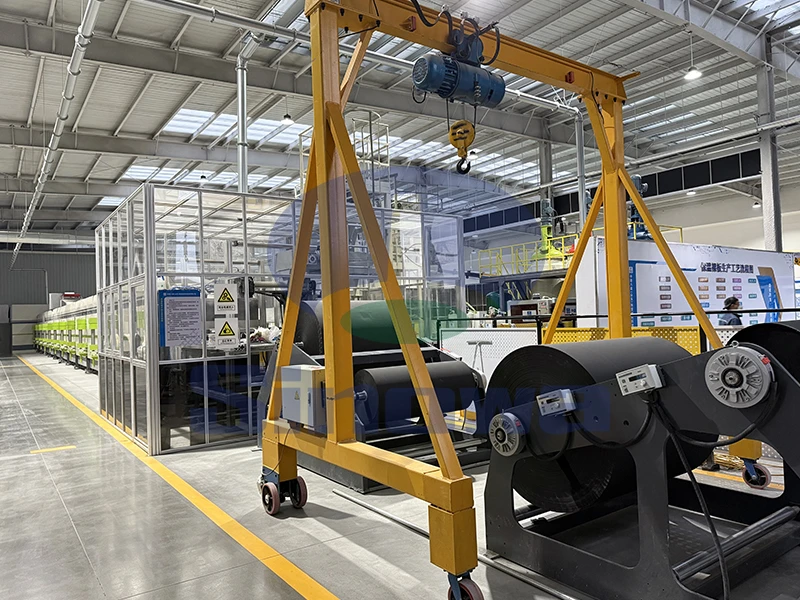
The frequent shutdown phenomenon of phenolic board continuous production lines is primarily triggered by cumulative mechanical equipment abnormalities, which constitute the most common cause of unplanned production halts in daily manufacturing. Phenolic board production involves continuous processes including raw material mixing, hot pressing, curing, cutting, and surface finishing, with each procedural link relying on coordinated operation of precision mechanical components and transmission systems. Long-term uninterrupted operation leads to gradual wear of core parts such as transmission bearings, conveyor belts, hot pressing rollers, and hydraulic system seals. Minor wear and gaps that are not detected and eliminated in daily inspections will gradually expand, causing abnormal vibration, unstable transmission speed, and insufficient pressure output during line operation. Once the operating parameters deviate from the normal range, the line’s automatic protection system will trigger an emergency shutdown to avoid equipment damage and product quality accidents. In addition, aging of electrical control components such as sensors, contactors, and frequency converters cannot be ignored. Long-term operation in high-temperature and dust-filled production environments easily causes sensor signal distortion, circuit poor contact, and component aging failure, leading to inaccurate system parameter judgment and forced shutdown of the entire production line. Most mechanical and electrical failures occur intermittently and randomly, resulting in irregular frequent shutdowns that greatly disrupt the continuous production rhythm and make it difficult for enterprises to maintain stable output efficiency.
Abnormal raw material quality and inconsistent feeding status are another key factor leading to frequent shutdowns of phenolic board continuous production lines. The production performance and processing adaptability of phenolic boards are highly dependent on the stability of raw material ratios and material properties, including phenolic resin, curing agent, filler, and reinforcing fiber materials. In the actual production process, uneven mixing of raw materials, excessive moisture content of fillers, and inconsistent viscosity of phenolic resin will cause abnormal material fluidity in the feeding and forming links. When agglomerated materials or unevenly proportioned materials enter the continuous production line, they are prone to blockage in feeding pipelines, forming molds and pressing gaps. The blocked materials will cause overload operation of feeding equipment and hot pressing equipment, and the overload protection device will automatically cut off the operation power to trigger shutdown. Meanwhile, unstable feeding speed and discontinuous material supply caused by faulty feeding equipment matching will lead to intermittent material breakage in the production process. The continuous production line is set with linkage protection for material supply continuity, and sudden material breakage will directly trigger program shutdown to prevent empty pressing and idle operation of equipment. These raw material and feeding abnormalities are often recurring due to incomplete pre-production detection, resulting in repeated shutdown problems that restrict continuous production progress.
Non-standard operational behaviors and imperfect daily management systems are important human factors inducing frequent shutdowns of phenolic board production lines. The continuous production line of phenolic boards has high requirements for operation standardization, and each post operator needs to strictly follow the process flow and parameter settings to complete production operations. In actual production scenarios, some operators lack systematic professional training, resulting in irregular operation behaviors such as random adjustment of process parameters, improper equipment start-stop operation, and untimely cleaning of production residues. Random adjustment of hot pressing temperature, pressure and operating speed will break the balanced operating state of the production line, cause mismatched operation of front and rear process links, and trigger system self-protection shutdown. In addition, untimely cleaning of residual phenolic materials and dust on the equipment surface will lead to long-term accumulation of sundries, which will affect the heat dissipation effect of hot pressing equipment and the sensitivity of sensor components, further inducing equipment failure and shutdown. Moreover, the enterprise’s daily equipment maintenance management mechanism is not perfect, with unscientific maintenance cycle, incomplete inspection items and unimplemented maintenance responsibilities. Potential equipment hazards cannot be eliminated in a timely manner, turning minor hidden dangers into faults that cause production shutdowns, forming a vicious cycle of frequent line halt and repeated maintenance.
Production site environmental changes and auxiliary system operation failures will also cause frequent shutdowns of phenolic board continuous production lines. Phenolic board production is carried out in a relatively closed workshop environment, and the stability of ambient temperature, humidity and dust concentration has a direct impact on the operation of production equipment and product forming quality. Excessively high workshop temperature will cause poor heat dissipation of electrical control equipment, leading to overheating and automatic shutdown of the control system; excessive humidity will cause damp aging of circuit lines and reduce the insulation performance of electrical components, easily triggering short-circuit protection and shutdown. A large amount of dust and fiber debris generated during production will adhere to the surface of precision equipment and electrical components if the ventilation and dust removal system operates abnormally, affecting equipment operation accuracy and inducing faults. In addition, the supporting auxiliary systems such as circulating water system, air pressure supply system and exhaust system are closely linked with the main production line. Once the circulating water flow is insufficient, air pressure supply is unstable or exhaust is not smooth, the hot pressing temperature and pressure of the main line cannot reach the set standard, and the system will automatically shut down to avoid unqualified product production and equipment damage. Most environmental and auxiliary system faults are accidental and difficult to predict, leading to sudden and frequent shutdowns of the production line.
Frequent shutdowns of phenolic board continuous production lines bring multiple negative impacts on enterprise production and operation, covering production efficiency, product quality and production cost. In terms of production efficiency, each unplanned shutdown and subsequent equipment restart, parameter debugging and line stabilization will consume a lot of production time, greatly reducing the effective operating time of the production line and leading to a significant decline in daily output. Frequent start-stop operations will also make the production line in an unstable operating state for a long time, resulting in low overall production rhythm and unable to meet continuous mass production needs. In terms of product quality, unstable equipment operation parameters caused by frequent shutdowns will lead to inconsistent curing degree, uneven surface flatness and unstable dimensional accuracy of phenolic board products, increasing the proportion of defective products and rework volume. In terms of cost consumption, repeated start-stop of equipment will increase power energy consumption, and frequent maintenance and replacement of worn parts will raise equipment maintenance costs. Meanwhile, the reduction of finished product yield and the increase of defective products further improve the comprehensive production cost of enterprises, restricting the economic benefit improvement of production and processing.
To solve the problem of frequent shutdowns of phenolic board continuous production lines, enterprises need to formulate comprehensive and targeted optimization improvement measures from equipment maintenance, raw material management, operational standardization and environmental control. First, establish a scientific equipment regular maintenance system, formulate detailed inspection and maintenance plans for mechanical transmission parts, electrical control components and auxiliary systems, regularly replace aging vulnerable parts, calibrate detection sensors, and eliminate potential equipment hazards in advance. Second, strengthen raw material quality inspection and pre-production treatment, strictly control raw material moisture, viscosity and mixing uniformity, optimize feeding equipment operation parameters, and avoid production blockage and shutdown caused by raw material abnormalities. Third, standardize staff operation management, carry out regular professional skill training and post assessment for operators, clarify operational specifications and post responsibilities, and reduce shutdown faults caused by human errors. Finally, optimize the production workshop environment, improve the ventilation, dust removal and constant temperature and humidity control system, ensure the stable operation of auxiliary supporting equipment, and fundamentally reduce the occurrence of unplanned shutdowns of phenolic board continuous production lines.
https://www.cnsinowa.com/faqs/frequent-shutdown-of-phenolic-board-continuous-production-line.html
Main Products
-

Continuous PU Sandwich Panel Production Line
This continuous PU sandwich panel production line is an integrated automatic equipment. It covers uncoiling, forming, foaming, curing and cutting processes. With automatic raw material proportioning and precise temperature & pressure control, PIR sandwich panel production line continuously composites panels with double skins. Polyurethane sandwich panel production line stably produces steel and aluminum sandwich panels. Featuring high automation, the line makes fireproof and thermal-insulation panels for building enclosure and cold storage. -

Rock Wool Sandwich Panel Production Line
Continuous rockwool sandwich panel production line is an automatic integrated production equipment, consisting of uncoiling, forming, gluing and compounding, heating curing, fixed-length cutting, automatic stacking and other modules. The mineral wool sandwich panel production line continuously conveys color steel plates and rock wool core materials to automatically complete lamination and curing, which can produce fireproof and thermal insulation sandwich panels. Featuring high automation degree and stable operation, this production line is suitable for mass production of panels used for building walls, roofs and other scenarios. -

Phenolic Insulation Board Production Line
This integrated automatic production line continuously manufactures PU and phenolic insulation boards. The insulation board production line covers raw material proportioning, high-pressure foaming, laminating, curing and fixed-length cutting. Featuring high automation and stable molding, the insulation panel production line supports various surface materials. PU boards offer excellent thermal insulation, while phenolic boards have superior fire resistance. These products are widely used in construction, cold chain, ventilation ducts and other thermal insulation fields.