What Causes Low Bonding Strength Of Panels From Rock Wool Sandwich Panel Production Line
Sep 29, 2026
Low bonding strength of finished panels from rock wool sandwich panel production line is a prevalent manufacturing defect affecting product durability and structural stability. This issue stems from multiple interconnected factors covering material quality, operational parameters, equipment status and environmental conditions in the production process, which collectively weaken the adhesive combination between rock wool core and metal surface layers.
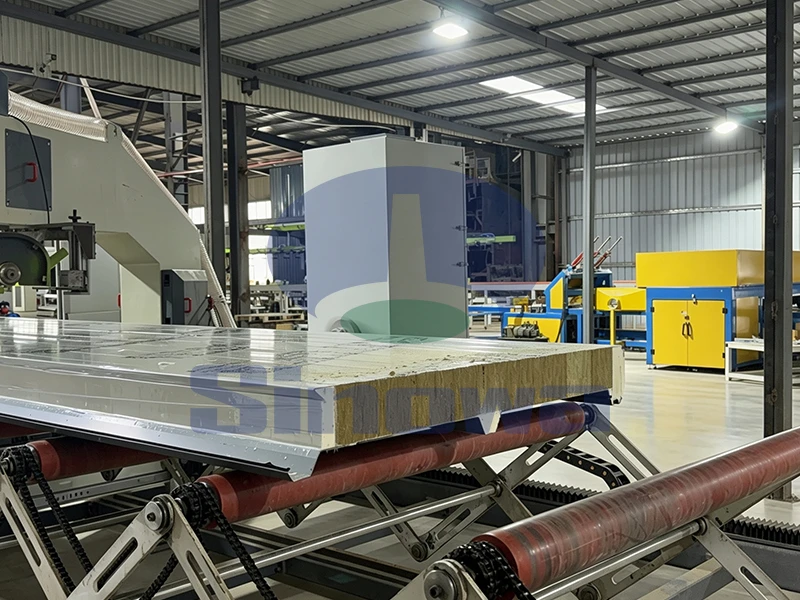
Improper adhesive selection and application stands as one of the most primary reasons for reduced bonding strength in products from rock wool sandwich panel production line. Adhesives serve as the critical medium connecting rock wool cores and metal facings, and any mismatch between adhesive properties and production requirements will directly undermine bonding performance. Many production failures occur when manufacturers adopt adhesives with poor wetting ability for rock wool fibers, which fail to penetrate the porous structure of rock wool thoroughly and only form superficial attachment on the material surface. In the continuous operation of rock wool sandwich panel production line, uneven adhesive coating further exacerbates this problem. Excessively thin coating creates dry spots with no effective bonding force, while overly thick coating leads to adhesive accumulation and incomplete curing inside the bonding layer. Additionally, expired or improperly stored adhesives will lose chemical activity, failing to produce stable adhesive polymerization reactions during production, resulting in fragile bonding interfaces that are prone to peeling and separation under minor external force.
Surface contamination of raw materials severely impairs the bonding effect and lowers the overall strength of panels processed by rock wool sandwich panel production line. Both metal surface sheets and rock wool core materials are susceptible to various contaminants during storage and pre-production handling, which form isolation layers on bonding surfaces and block effective adhesive integration. Metal coils often carry residual oil stains, dust particles and oxide layers generated during rolling and transportation, while rock wool cores easily absorb floating dust, fiber debris and fine particulate matter in the production workshop environment. These contaminants reduce the surface energy of bonding substrates, preventing the adhesive from fully spreading and adhering to the material surface. In the automated operation of rock wool sandwich panel production line, rapid feeding and assembly processes often omit fine surface cleaning procedures, making tiny contaminants difficult to remove thoroughly. Even microscopic residual pollutants can form countless weak bonding points across the panel interface, which gradually expand into large-area delamination and bonding failure during subsequent product storage and use.
Unstable production pressure and curing parameters in rock wool sandwich panel line are key operational factors leading to insufficient bonding strength. The bonding formation process relies on continuous and uniform mechanical pressure to ensure close fitting between the core material, adhesive and surface layer, as well as complete chemical curing of the adhesive. When the pressure system of rock wool sandwich panel production line operates abnormally, uneven pressure distribution appears on different parts of the panel. Insufficient pressure makes it impossible to eliminate gaps between bonding interfaces, leaving air bubbles that weaken bonding tightness, while excessive pressure squeezes out most of the adhesive and causes local adhesive deficiency. Meanwhile, unreasonable curing temperature and time parameters also hinder effective bonding formation. Low ambient or curing temperatures slow down the adhesive polymerization reaction, leading to incomplete curing and low adhesive toughness. Excessively short curing time cannot support full adhesive reaction, while overlong curing may cause adhesive aging and brittleness. These parameter deviations all result in unstable bonding structures and reduced overall panel bonding strength.
Poor quality and improper pretreatment of rock wool core materials directly restrict the bonding performance of panels manufactured via rock wool sandwich panel manufacturing line. The internal fiber structure and surface state of rock wool cores determine their adhesion compatibility with adhesives. Low-quality rock wool materials have loose and disordered fiber arrangements, with excessive internal gaps and low surface compactness, which cannot provide stable attachment points for adhesives. Such rock wool cores are prone to internal fiber separation before interfacial bonding failure, indirectly reducing the overall bonding strength of the panel. Moreover, rock wool materials with high moisture content will trigger chemical changes during the bonding process. Moisture volatilizes during heating and curing, generating tiny steam gaps at the bonding interface and destroying the integrated bonding structure. In the daily operation of rock wool sandwich panel production line, many manufacturers skip targeted core material pretreatment processes such as drying and fiber surface activation, resulting in poor matching between rock wool cores and adhesives, and fundamentally weakening panel bonding stability.
Equipment aging and irregular operational management in rock wool sandwich panel line gradually induce persistent low bonding strength problems. Long-term continuous operation will cause wear and deviation of key equipment components, including inconsistent running speed of conveyor belts, wear of pressing rollers, and inaccurate positioning of assembly modules. These equipment failures lead to dislocation and uneven fitting of surface layers and core materials during the automated production process, forming asymmetric stress distribution at bonding interfaces. Minor equipment errors that are ignored in daily production will accumulate and eventually form large-area bonding defects on finished panels. In addition, non-standard manual operation further amplifies equipment-induced problems. Unreasonable feeding speeds, irregular material positioning, and untimely equipment debugging disrupt the continuous and stable production rhythm of rock wool sandwich panel production line. Without regular equipment maintenance and parameter calibration, the production line cannot maintain optimal bonding conditions, resulting in fluctuating and generally low bonding strength of finished panels in batches.
Adverse workshop environmental conditions act as hidden factors that weaken the bonding strength of panels from rock wool sandwich panel production line. The temperature, humidity and cleanliness of the production workshop exert subtle but crucial influences on adhesive curing and bonding interface formation. High humidity environments make rock wool cores and metal surfaces absorb moisture continuously, while moisture interferes with the adhesive’s cross-linking reaction, reducing the adhesive’s cohesive force and interfacial adhesion. Excessively low workshop temperature not only slows down adhesive curing speed but also increases the viscosity of adhesives, making uniform coating and penetration difficult. Meanwhile, poor workshop cleanliness leads to suspended dust, fiber debris and oil mist floating in the air, which continuously settle on the uncured bonding surfaces during the operation of rock wool sandwich panel production line. These settled pollutants form isolated weak layers between materials, destroying the integrity of the bonding structure. Long-term operation in unregulated production environments will lead to widespread low bonding strength of finished panels and greatly reduce product service life.
Gallery
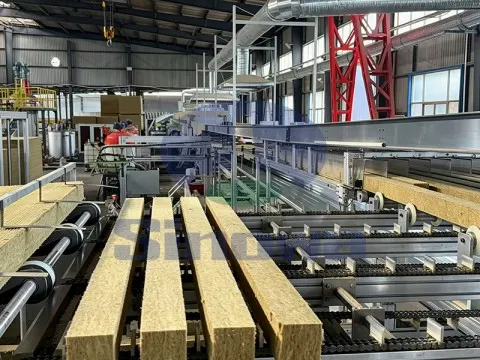
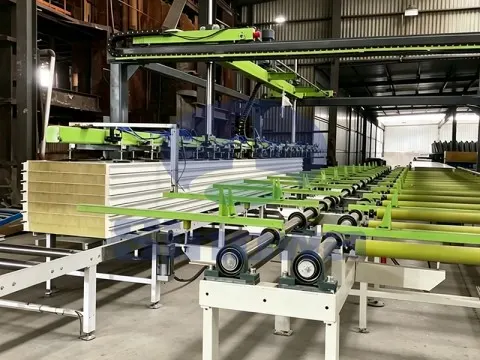
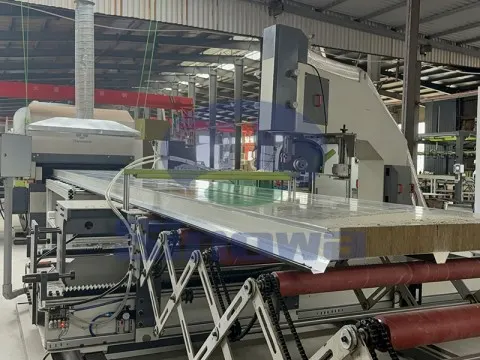
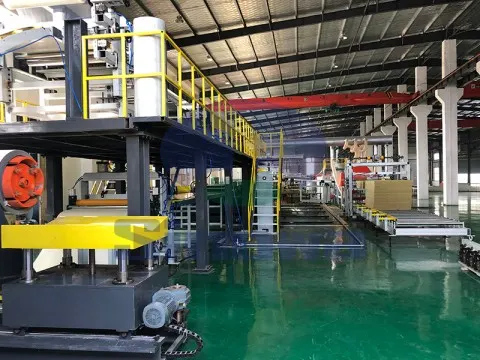
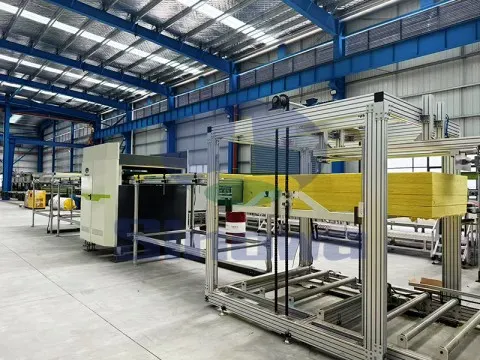
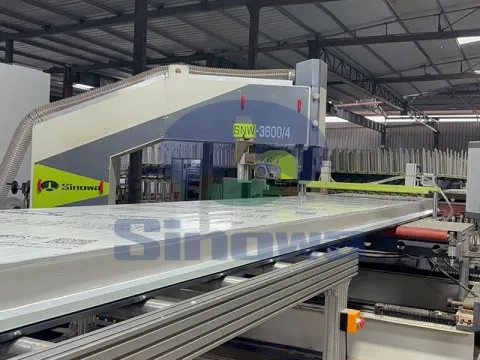
Sinowa is a professional manufacturer of sandwich panel machine in china, we provide diversified and high-performance sandwich panel production lines, including fully automatic continuous PU sandwich panel line and customized special lines to meet mass production and personalized order demands. These sandwich panel lines support processing multiple foam core materials, such as PU, PIR, mineral wool, rock wool and glass wool, covering different insulation and fireproof standards.
Featuring stable operation, high efficiency, energy saving and easy maintenance, our PU sandwich panel line deliver sandwich panels with excellent thermal insulation, fire resistance, sound insulation and lightweight durability. The finished panels are widely applied in industrial workshops, warehouse roofing and wall cladding, cold storage insulation, serving global construction and industrial insulation markets.
Main Products
-

Continuous PU Sandwich Panel Production Line
This continuous PU sandwich panel production line is an integrated automatic equipment. It covers uncoiling, forming, foaming, curing and cutting processes. With automatic raw material proportioning and precise temperature & pressure control, PIR sandwich panel production line continuously composites panels with double skins. Polyurethane sandwich panel production line stably produces steel and aluminum sandwich panels. Featuring high automation, the line makes fireproof and thermal-insulation panels for building enclosure and cold storage. -

Rock Wool Sandwich Panel Production Line
Continuous rockwool sandwich panel production line is an automatic integrated production equipment, consisting of uncoiling, forming, gluing and compounding, heating curing, fixed-length cutting, automatic stacking and other modules. The mineral wool sandwich panel production line continuously conveys color steel plates and rock wool core materials to automatically complete lamination and curing, which can produce fireproof and thermal insulation sandwich panels. Featuring high automation degree and stable operation, this production line is suitable for mass production of panels used for building walls, roofs and other scenarios. -

Phenolic Insulation Board Production Line
This integrated automatic production line continuously manufactures PU and phenolic insulation boards. The insulation board production line covers raw material proportioning, high-pressure foaming, laminating, curing and fixed-length cutting. Featuring high automation and stable molding, the insulation panel production line supports various surface materials. PU boards offer excellent thermal insulation, while phenolic boards have superior fire resistance. These products are widely used in construction, cold chain, ventilation ducts and other thermal insulation fields.
Other FAQs
- Energy Saving Measures For Rock Wool Sandwich Panel Production Line Operation
- High Temperature Resistance Performance Of Rockwool Sandwich Panel Production Equipment
- Panel Bonding Strength Improvement Methods In Rockwool Board Production Line
- How To Maintain The Rock Wool Sandwich Panel Production Line Daily
- Automation Program Upgrade Steps For Rock Wool Sandwich Panel Production Line
- Automatic Operation Debugging Steps For Rock Wool Sandwich Panel Production Line
- Why Is The Operating Speed Of Rock Wool Sandwich Panel Production Line Unstable
- Cold Start Operation Precautions Of Rock Wool Sandwich Panel Production Machine
- Production Speed Optimization Methods For Rock Wool Sandwich Panel Line
- How Does A Mineral Wool Sandwich Panel Production Line Operate In Full Automatic Mode
Related Articles
- Automatic Rock Wool Production Line
- Machinery For Rock Wool Production
- Rock Wool Foam Sandwich Panel Machine
- Rock Wool Sandwich Panel Machine
- Rockwool Sandwich Panel Machine
- Rock Wool Sandwich Panel Equipment
- Marine Composite Rock Wool Board Production Line
- Rockwool Sandwich Panel Production Machine for Cladding System
- Rock Wool Board Equipment
- Steel Edge Sealing Rock Wool Sandwich Panel Machine