Energy Saving Measures For Rock Wool Sandwich Panel Production Line Operation
Sep 17, 2026
Rock wool sandwich panel production consumes massive energy in heating, mechanical operation and ventilation. Adopting scientific and targeted energy-saving operational measures can effectively cut energy waste, reduce production costs, and improve the overall operational efficiency and sustainability of the production line.
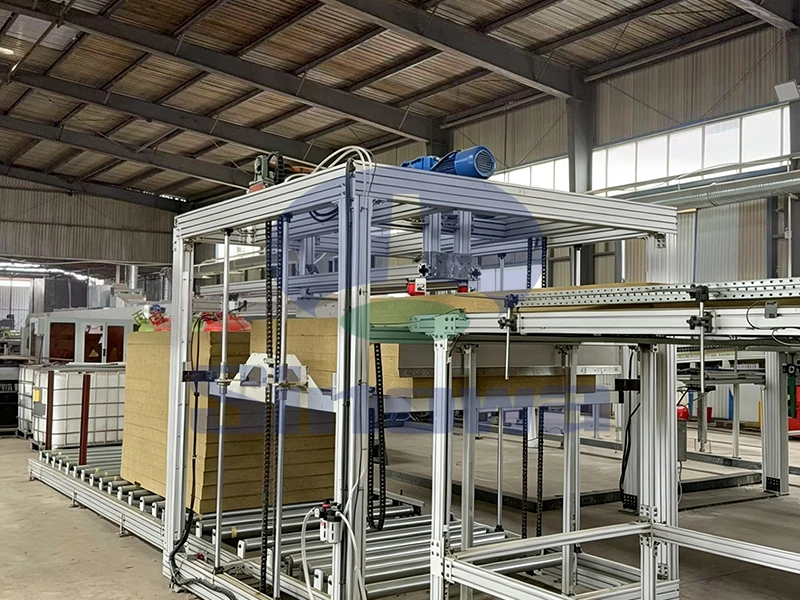
The core energy consumption link of rock wool sandwich panel production lies in the thermal processing stage, which includes rock wool melting, curing and bonding molding of composite panels, making optimized temperature control the primary energy-saving measure for daily operation. Most production lines suffer from energy waste caused by unreasonable temperature setting, frequent temperature fluctuation and long-term idle heating. Operators need to formulate graded temperature control schemes according to different production stages and product specifications, avoiding excessive heating temperature and unnecessary constant high-temperature operation. In the preheating stage of raw materials, gradual temperature rise should replace rapid high-temperature heating to reduce thermal energy loss caused by uneven material heating and heat dissipation. During the formal curing and molding process, the temperature of the heating system shall be stabilized within the optimal process range, and real-time temperature monitoring shall be implemented to avoid repeated heating due to temperature deviation. In addition, when the production line is in short-term standby or material replacement intervals, the heating equipment should be adjusted to the heat preservation state instead of full-load operation, and long-term idle heating without production tasks should be completely eliminated. This refined temperature management mode can effectively reduce invalid thermal energy consumption, stabilize the thermal efficiency of the heating system, and lay a foundation for long-term energy-saving operation of the production line without affecting product molding quality and structural performance.
Optimization of mechanical equipment operation mode is another key part of energy saving for rock wool sandwich panel production lines, as continuous high-load and unreasonable matching operation of mechanical equipment is a major source of electric energy waste. The production line involves multiple linked mechanical devices including feeding equipment, rolling machines, cutting machines and conveying systems, and mismatched operating speed and asynchronous start-stop of different equipment will cause idle power consumption and mechanical friction loss. Operators need to realize linkage speed regulation of the whole production line according to actual production capacity and processing rhythm, so that the operating speed of feeding, molding and conveying equipment can be coordinated and matched to avoid the phenomenon of front-end material accumulation and back-end equipment idle operation. For equipment that runs continuously for a long time, regular operational state inspection is required to eliminate abnormal energy consumption caused by mechanical jitter, stuck operation and excessive friction. Meanwhile, it is necessary to abandon the traditional full-time full-load operation mode and set up scientific start-stop and standby mechanisms. For auxiliary equipment that does not need continuous operation such as auxiliary conveying and sorting devices, they can be started in sections according to the production progress and shut down in time after completing the process link. Moreover, frequency conversion transformation and intelligent speed regulation can be applied to high-power mechanical equipment, which can automatically adjust operating power according to production load, effectively reducing invalid power consumption generated by constant-speed operation under low-load conditions and significantly improving the electric energy utilization rate of mechanical operation links.
Scientific maintenance of production line equipment plays an indispensable role in long-term energy-saving operation, as aging equipment, unmaintained parts and accumulated dirt will greatly reduce operational efficiency and increase energy consumption. In the heating system, long-term operation will lead to dust, scale and residual material accumulation on the surface of heating components and heat insulation layers, which will weaken heat conduction efficiency and increase heat loss. Regular cleaning of heating equipment, heat preservation channels and molding dies is required to keep the heat conduction surface smooth and ensure stable heat transfer efficiency. At the same time, the heat insulation structure of the heating system shall be inspected regularly, and aging, damaged and falling off heat insulation materials shall be replaced in a timely manner to reduce heat dissipation loss in the production workshop. For mechanical transmission parts such as bearings, gears and conveyor belts of the production line, regular lubrication and maintenance should be carried out to reduce mechanical friction resistance. Increased friction will not only cause equipment wear and tear but also require more electric energy to maintain normal operation, forming a vicious cycle of increased energy consumption and equipment loss. In addition, aging motors, lines and control components should be checked and updated regularly, as aging electrical equipment will cause power loss and unstable operation. A standardized daily, weekly and monthly maintenance system should be established to record equipment operation status and maintenance results, realize predictive maintenance, avoid energy waste caused by equipment failure and abnormal operation, and maintain the high-efficiency and low-energy-consumption operating state of the production line for a long time.
Optimization of raw material pretreatment and production process flow can effectively reduce indirect energy consumption in the production process of rock wool sandwich panels. Unprocessed raw materials often contain excess moisture, impurities and uneven particle size, which will increase the load of heating and molding processes, thus consuming more thermal and electric energy. Therefore, standardized pretreatment of rock wool raw materials and surface layer base materials should be carried out before formal production. The raw material drying process should be optimized to remove excess moisture in a graded manner, avoiding excessive water evaporation consuming a large amount of heat in the high-temperature molding stage. Impurity screening and particle size sorting of raw materials can ensure uniform heating and stable molding of materials, reduce defective rate and repeated processing caused by uneven raw material quality, and avoid secondary energy consumption generated by rework and reproduction. In terms of process flow, unreasonable process links and repeated handling operations should be optimized and simplified. For example, the multi-time positioning and correction operations in the molding process can be optimized through process adjustment to improve the one-time molding qualification rate of products. The material conveying and transfer links can be integrated to reduce the start-stop frequency of conveying equipment and the walking distance of materials, so as to reduce mechanical energy consumption in the transfer process. Optimizing the production process can fundamentally reduce invalid production links, lower the overall energy consumption level of the production line, and realize the dual improvement of production efficiency and energy-saving benefit.
The optimization of workshop ventilation and auxiliary system operation is easily overlooked but has a significant impact on the overall energy-saving effect of the production line. The production workshop needs to maintain a certain ventilation environment to discharge waste gas and heat generated in the production process, but unreasonable ventilation operation will cause a large amount of heat loss and electric energy waste. Many production workshops adopt continuous full-volume ventilation throughout the production process, which will take away a large amount of heat in the workshop during the heating production stage, forcing the heating system to increase power to maintain the process temperature, resulting in serious thermal energy waste. It is necessary to formulate segmented ventilation schemes according to production stages and workshop environmental conditions. In the high-temperature heating and curing stage, the ventilation volume should be appropriately reduced on the premise of ensuring safe production to avoid excessive heat loss; in the cooling and finished product processing stage, the ventilation system can be properly opened to accelerate cooling and improve processing efficiency. In addition, the ventilation equipment should be regularly maintained and debugged to ensure efficient operation, avoid increased power consumption caused by blocked ventilation pipes and low equipment efficiency. Meanwhile, the lighting, power supply and other auxiliary systems in the workshop should also implement energy-saving management, adopt intelligent control to turn on and off equipment according to working conditions, eliminate long-term no-load power consumption of auxiliary equipment, and further reduce the comprehensive energy consumption of the entire production link.
Personnel operation management and intelligent system application are important guarantees for the long-term implementation of energy-saving measures in rock wool sandwich panel production lines. All energy-saving equipment and optimized processes need standardized manual operation to exert maximum effects, so it is necessary to strengthen professional energy-saving training for front-line operators. The training content should cover standardized operation procedures of energy-saving equipment, identification methods of high-energy-consumption abnormal states, and correct operation methods of optimized processes, so that operators can form energy-saving operation awareness and avoid energy waste caused by irregular and inexperienced operation. Meanwhile, a sound energy-saving assessment and supervision mechanism should be established to monitor the energy consumption data of each production shift and each process link, timely discover and rectify excessive energy consumption problems, and mobilize the initiative of employees in energy-saving operation. In addition, introducing intelligent monitoring and control systems can further improve the precision of energy-saving management. The intelligent system can realize real-time collection, analysis and early warning of production energy consumption data, automatically adjust equipment operating parameters according to production load and environmental changes, and make up for the inaccuracy of manual operation. The combination of standardized manual management and intelligent equipment control can form a complete energy-saving operation system, continuously reduce the energy consumption of the rock wool sandwich panel production line, and promote the green and low-carbon development of production operation.
Main Products
-

Continuous PU Sandwich Panel Production Line
This continuous PU sandwich panel production line is an integrated automatic equipment. It covers uncoiling, forming, foaming, curing and cutting processes. With automatic raw material proportioning and precise temperature & pressure control, PIR sandwich panel production line continuously composites panels with double skins. Polyurethane sandwich panel production line stably produces steel and aluminum sandwich panels. Featuring high automation, the line makes fireproof and thermal-insulation panels for building enclosure and cold storage. -

Rock Wool Sandwich Panel Production Line
Continuous rockwool sandwich panel production line is an automatic integrated production equipment, consisting of uncoiling, forming, gluing and compounding, heating curing, fixed-length cutting, automatic stacking and other modules. The mineral wool sandwich panel production line continuously conveys color steel plates and rock wool core materials to automatically complete lamination and curing, which can produce fireproof and thermal insulation sandwich panels. Featuring high automation degree and stable operation, this production line is suitable for mass production of panels used for building walls, roofs and other scenarios. -

Phenolic Insulation Board Production Line
This integrated automatic production line continuously manufactures PU and phenolic insulation boards. The insulation board production line covers raw material proportioning, high-pressure foaming, laminating, curing and fixed-length cutting. Featuring high automation and stable molding, the insulation panel production line supports various surface materials. PU boards offer excellent thermal insulation, while phenolic boards have superior fire resistance. These products are widely used in construction, cold chain, ventilation ducts and other thermal insulation fields.