Cold Start Operation Precautions Of Rock Wool Sandwich Panel Production Machine
Sep 21, 2026
Cold start of rock wool sandwich panel production machines differs greatly from normal running operation and requires standardized pre-operation checks and gradual startup steps. Strict precaution implementation can effectively avoid mechanical wear, production faults and product defects, ensuring stable, safe and efficient initial operation of the whole production line.
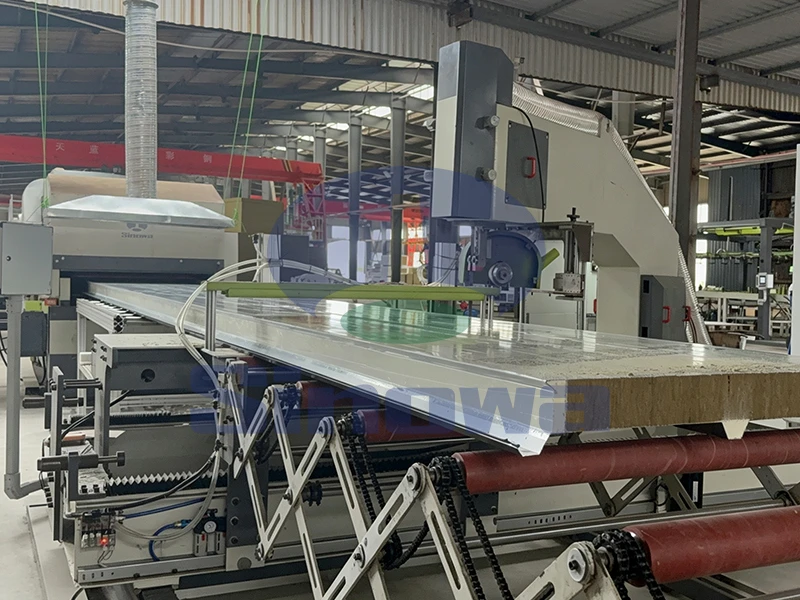
The primary precaution for the cold start of rock wool sandwich panel production machines lies in comprehensive pre-start mechanical inspection after long-term shutdown, as idle equipment is prone to component aging, dust accumulation and loose structural parts. Operators need to conduct a full visual and manual check of all mechanical components covering the feeding system, rolling forming device, bonding pressing mechanism and cutting assembly of the machine. It is essential to clear all accumulated dust, debris and residual rock wool materials attached to rollers, conveyor belts and bonding templates, since residual impurities will cause uneven panel surface, bonding gaps and even jamming during formal operation. Meanwhile, operators should check the tightness of all connecting bolts, fixed brackets and transmission parts, as long-term static placement may lead to slight loosening of fasteners, which will trigger abnormal vibration and component deviation during startup. The flexible transmission parts such as belts and chains also need careful inspection to confirm no aging, cracking, slack or dislocation, and appropriate tension adjustment should be done in advance to guarantee stable power transmission. Additionally, the sliding and rotating parts of the machine must be checked for lubrication status; insufficient lubrication after long shutdown will result in severe friction and wear, raising the risk of equipment failure in cold start process. Only after completing all-round mechanical inspection and troubleshooting can the subsequent startup preparation proceed steadily.
Electrical system inspection is an indispensable core link in cold start precautions, directly determining the operational safety and control stability of the rock wool sandwich panel production machine. Before powering on the equipment, operators must check the integrity and connection status of all electrical circuits, control switches, sensor components and power distribution boxes. It is necessary to remove dust and moisture inside the power distribution box to prevent short circuit, electric leakage and circuit burnout caused by humid environment and dust accumulation after long-term shutdown. All control buttons, emergency stop switches and indicator lights should be tested one by one to ensure flexible response and normal display, as insensitive control components will lead to delayed operation response and inability to stop equipment in case of emergencies. Various detection sensors responsible for monitoring feeding volume, pressing pressure and cutting size also need calibration inspection to avoid data deviation which may cause unqualified product specifications. After confirming the safety of the circuit system, the equipment can be powered on in stages instead of one-time full power startup. Low-power standby operation for ten to fifteen minutes is required first to preheat the electrical control system, activate dormant circuit components and eliminate potential hidden dangers of circuit instability. During the standby process, operators need to observe the real-time working state of the electrical system, check for abnormal noise, heating and sparking phenomena, and cut off the power immediately for maintenance if any abnormality occurs.
Reasonable preheating and gradual load adjustment are key precautions to prevent equipment damage during the cold start of rock wool sandwich panel production machines. The whole equipment is in a low-temperature static state before startup, and the metal components, transmission structures and bonding auxiliary devices have poor operation adaptability at low temperature. Direct high-speed and full-load startup will cause sharp friction and impact between components, easily leading to roller deformation, transmission part damage and unstable bonding temperature. Therefore, after electrical system standby is completed, the machine needs to run at no-load low speed for twenty to thirty minutes. The no-load operation can fully preheat all mechanical moving parts, make the lubricating oil circulate evenly inside the equipment, and restore the flexibility of each transmission and execution structure. During no-load operation, operators should continuously listen to the operating sound of the equipment, observe the operation stability of each component, and check whether there is jamming, stagnation and abnormal vibration. After the no-load preheating is stable, the production load and operating speed should be increased slowly in stages instead of reaching the standard production state at one time. Each speed and load adjustment needs to be maintained for a period of time to ensure all components adapt to the current operating state, which can effectively reduce mechanical fatigue and extend the service life of production equipment.
Raw material preparation and feeding system debugging are important auxiliary precautions to ensure smooth cold start and qualified product quality. Before formal production startup, operators need to inspect the quality and placement state of rock wool core materials, color steel plates and bonding adhesives used for production. The rock wool core materials should be kept flat and dry without moisture, deformation and breakage, as wet and deformed core materials will cause bonding failure and panel warping in cold start production. The surface of color steel plates needs to be clean and flat without scratches, rust and oil stains to ensure tight bonding with rock wool materials. In terms of adhesives, it is necessary to check the uniformity and activity of the adhesive, and stir the adhesive fully if it is placed statically for a long time to avoid uneven glue application affecting bonding firmness. Meanwhile, the automatic feeding system of the machine needs targeted debugging during cold start. Operators need to adjust the feeding speed and positioning accuracy of the rock wool core material and color steel plate feeding device to ensure stable and orderly feeding without deviation, stacking and material blockage. The glue application system also needs trial operation to check the uniformity and consistency of glue output, adjust the glue volume appropriately according to the low-temperature environment characteristics of cold start, and avoid insufficient or excessive glue application caused by low temperature affecting product quality. Standardized raw material inspection and feeding debugging can effectively reduce defective products in the initial stage of cold start and improve production yield.
Real-time operation monitoring and fault early warning handling are essential precautions to guarantee continuous and stable operation after cold start of the machine. In the initial stage of formal production after cold start, the equipment state is not completely stable, and various minor faults are prone to occur due to temperature adaptation and component running-in. Operators need to conduct full-time real-time monitoring of the whole production line operation state, focusing on checking the operating speed of each component, pressing pressure, bonding temperature and product forming effect. It is necessary to regularly observe the surface flatness, bonding tightness and overall specification of the initially produced rock wool sandwich panels, and adjust the equipment operation parameters timely if problems such as uneven pressing, incomplete bonding and dimensional deviation are found. At the same time, operators should pay close attention to the abnormal state of the equipment itself, including abnormal noise, excessive vibration, local overheating and unresponsive control. Once minor faults are found, targeted shutdown inspection and debugging should be carried out in time to avoid small faults evolving into large equipment failures that affect continuous production. In addition, a complete operation record should be made during the cold start process, recording the startup time, parameter adjustment data, equipment operation state and fault handling conditions, which can provide effective reference for subsequent equipment startup and daily maintenance.
Post-cold-start maintenance and standardized shutdown management are crucial supplementary precautions to maintain long-term stable performance of the production machine. After completing the cold start production task and the equipment runs stably for a certain period, operators need to conduct a comprehensive secondary inspection and maintenance of the equipment. First, clean the residual raw materials, adhesive residues and dust on the surface and inside of the machine to prevent long-term residue from corroding equipment components and affecting subsequent operation. Then, recheck the lubrication state of rotating and sliding parts, supplement lubricating oil for parts with insufficient lubrication, and check the wear degree of transmission parts such as belts and chains to replace severely worn components in a timely manner. Fastening inspection of all mechanical fixed parts should be done again to eliminate loose problems caused by startup vibration and operation friction. For the electrical system, it is necessary to sort out the circuit lines, clean the dust in electrical components, and check the aging degree of lines to ensure the safety of the electrical system for the next startup. When the equipment needs to be shut down after cold start production, it is forbidden to shut down the machine directly with full load. Instead, the production load and operating speed should be reduced gradually, and the equipment should run at no-load low speed for a period of time to cool down uniformly, avoiding sudden shutdown causing thermal expansion and contraction damage to metal components and internal structures. Standardized post-start maintenance and shutdown operation can effectively eliminate the potential hazards brought by cold start, optimize the equipment operation state, and lay a solid foundation for long-term stable and efficient operation of the rock wool sandwich panel production machine.
Main Products
-

Continuous PU Sandwich Panel Production Line
This continuous PU sandwich panel production line is an integrated automatic equipment. It covers uncoiling, forming, foaming, curing and cutting processes. With automatic raw material proportioning and precise temperature & pressure control, PIR sandwich panel production line continuously composites panels with double skins. Polyurethane sandwich panel production line stably produces steel and aluminum sandwich panels. Featuring high automation, the line makes fireproof and thermal-insulation panels for building enclosure and cold storage. -

Rock Wool Sandwich Panel Production Line
Continuous rockwool sandwich panel production line is an automatic integrated production equipment, consisting of uncoiling, forming, gluing and compounding, heating curing, fixed-length cutting, automatic stacking and other modules. The mineral wool sandwich panel production line continuously conveys color steel plates and rock wool core materials to automatically complete lamination and curing, which can produce fireproof and thermal insulation sandwich panels. Featuring high automation degree and stable operation, this production line is suitable for mass production of panels used for building walls, roofs and other scenarios. -

Phenolic Insulation Board Production Line
This integrated automatic production line continuously manufactures PU and phenolic insulation boards. The insulation board production line covers raw material proportioning, high-pressure foaming, laminating, curing and fixed-length cutting. Featuring high automation and stable molding, the insulation panel production line supports various surface materials. PU boards offer excellent thermal insulation, while phenolic boards have superior fire resistance. These products are widely used in construction, cold chain, ventilation ducts and other thermal insulation fields.
Other FAQs
- Low Power Consumption Operation Mode Of Rock Wool Sandwich Panel Line
- Daily Maintenance Methods For Rock Wool Sandwich Panel Production Line
- Energy Saving Measures For Rock Wool Sandwich Panel Production Line Operation
- High Temperature Resistance Performance Of Rockwool Sandwich Panel Production Equipment
- Panel Bonding Strength Improvement Methods In Rockwool Board Production Line