High Temperature Resistance Performance Of Rockwool Sandwich Panel Production Equipment
Sep 21, 2026
Rockwool sandwich panel production equipment features outstanding high temperature resistance, which underpins stable operation in extreme thermal processing environments. This performance safeguards continuous production, avoids thermal damage to core components, and ensures consistent quality of finished rockwool panels with reliable thermal stability and structural durability.
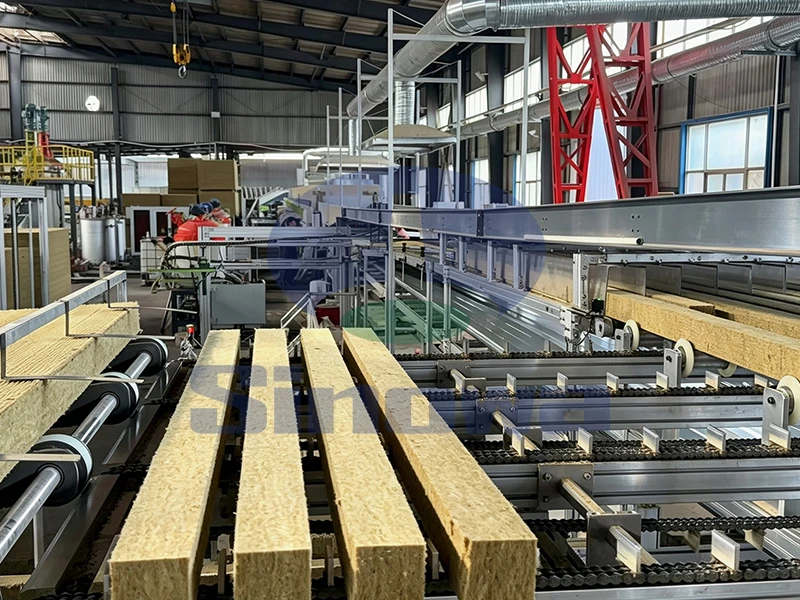
The high temperature resistance of rockwool sandwich panel production equipment is fundamentally defined by its core structural material selection and targeted thermal protection design, which enables the entire production line to withstand long-term high-temperature working conditions during rockwool raw material melting and panel forming processes. The core thermal processing units, including melting and fiberizing modules, are exposed to persistent ultra-high temperature environments during operation, where mineral raw materials are fully melted and restructured to form qualified rockwool fiber substrates. To adapt to such harsh working scenarios, key equipment components adopt high-temperature resistant inorganic alloy materials and special thermal insulation lining layers, which can effectively resist thermal erosion and avoid structural deformation under prolonged heat exposure. Unlike ordinary industrial processing equipment, this production line does not rely on simple surface heat insulation, but integrates internal heat dissipation structures and high-temperature anti-aging coatings, which balance thermal resistance and operational flexibility. This integrated design prevents local overheating of mechanical parts, reduces thermal fatigue caused by frequent temperature changes, and lays a solid foundation for long-term stable high-temperature operation of the equipment. Even in continuous high-load production cycles, the structural integrity and operational accuracy of the equipment can be well maintained, eliminating quality fluctuations caused by equipment thermal failure.
High temperature resistance performance directly determines the operational stability and service life of rockwool sandwich panel production equipment in continuous industrial production scenarios. In the whole production flow, the melting section maintains a long-term ultra-high temperature state, and the heat radiation and heat conduction generated will continuously affect the surrounding transmission and auxiliary components. Equipment with excellent high temperature resistance can effectively isolate excessive heat transfer, protecting precision transmission parts, electrical control components and connection structures from thermal damage. Without reliable high-temperature resistance, long-term high-heat operation will easily cause component aging, mechanical jitter and dimensional deviation, leading to unstable fiber forming effect and inconsistent thickness and density of finished panels. Advanced high-temperature resistant structural design also optimizes the equipment’s thermal expansion and contraction performance, avoiding equipment failure caused by thermal expansion of metal components and gap changes between parts. This stable thermal adaptability allows the production line to support uninterrupted batch production, greatly reducing equipment shutdown maintenance frequency caused by high-temperature damage, and improving the overall operational efficiency of the production system while lowering long-term operating costs.
The high temperature resistance characteristics of the equipment are closely linked to the quality performance of finished rockwool sandwich panels, forming a core linkage mechanism in the production process. Rockwool core materials gain their inherent high-temperature stability and non-combustible properties through strict ultra-high temperature melting and fiber forming processes, and only equipment with stable high-temperature resistance can provide a consistent thermal processing environment for raw material modification. When the production equipment maintains stable high-temperature operation, the internal molecular structure of mineral raw materials can be fully and uniformly reconstructed, forming dense and orderly rockwool fiber structures with excellent thermal insulation and fire resistance. If the equipment’s high-temperature resistance is insufficient, temperature fluctuations in the processing cavity will lead to incomplete raw material melting, uneven fiber fineness and inconsistent structural compactness of the rockwool core. These defects will directly reduce the high-temperature stability and structural strength of finished sandwich panels, resulting in poor thermal insulation performance and easy deformation under high-temperature conditions. Therefore, the equipment’s high-temperature resistance is not only a basic guarantee for its own safe operation, but also a key prerequisite for endowing rockwool sandwich panels with superior high-temperature resistance and thermal insulation functions.
Modern rockwool sandwich panel production equipment adopts multi-dimensional optimized high-temperature resistance technologies to adapt to diversified and high-intensity production demands. In addition to high-strength high-temperature resistant base materials for main structures, the equipment is equipped with layered thermal insulation structures and targeted heat dissipation systems for different functional areas. The high-temperature processing cavity adopts multi-layer composite thermal insulation lining, which can lock internal processing temperature and isolate external heat diffusion, while preventing external ambient temperature from affecting internal thermal processing accuracy. The transmission and power components far from the high-temperature cavity are equipped with independent heat insulation baffles and circulating heat dissipation channels, which avoid heat accumulation and ensure the sensitivity and stability of mechanical transmission and electrical control systems under long-term high-temperature working conditions. Moreover, the equipment’s connection joints and vulnerable parts are treated with high-temperature anti-oxidation and anti-corrosion processes, which effectively resist thermal oxidation and material aging in high-temperature environments. This multi-layer protection system enables the equipment to maintain stable high-temperature resistance in long-cycle and high-frequency production, and adapt to different production parameter adjustments without performance attenuation.
The high temperature resistance durability of production equipment is a key index to measure the comprehensive performance of rockwool sandwich panel production systems, reflecting the long-term operational reliability of the equipment. In actual industrial production, the equipment needs to bear repeated temperature rise and fall cycles, as well as continuous thermal impact during raw material feeding and processing. Excellent high-temperature resistance durability enables the equipment to avoid performance degradation and structural loosening after thousands of high-temperature operation cycles. The high-temperature resistant coatings and structural layers of the equipment have strong anti-fatigue performance, which can resist thermal stress changes caused by temperature differences and prevent peeling, cracking and deformation of protective layers. Long-term stable high-temperature resistance not only extends the overall service life of the production line, but also ensures the long-term consistency of product quality. In practical application, equipment with superior high-temperature durability can maintain stable processing accuracy and product qualification rate for a long time, avoiding frequent equipment debugging and parts replacement caused by high-temperature aging, which significantly improves the economic benefits and operational stability of industrial production.
With the continuous upgrading of industrial building material performance requirements, the high temperature resistance performance optimization of rockwool sandwich panel production equipment has become an important development direction in the industry. Current equipment optimization focuses on balancing ultra-high temperature resistance, energy conservation and operational efficiency, abandoning the traditional single heavy high-temperature resistant structure. New generation production equipment integrates lightweight high-temperature resistant composite materials and intelligent temperature adaptive adjustment structures, which not only maintains excellent thermal resistance in extreme processing environments, but also reduces equipment self-weight and heat energy loss. Meanwhile, the optimized structural design improves the equipment’s temperature field uniformity, further optimizing the raw material melting and fiber forming effect. Continuous innovation in high-temperature resistance technology will further enhance the automation level and production stability of rockwool sandwich panel production lines, help produce high-performance building insulation panels with more stable high-temperature resistance, and better meet the diverse application demands of modern industrial and architectural thermal insulation fields.
Main Products
-

Continuous PU Sandwich Panel Production Line
This continuous PU sandwich panel production line is an integrated automatic equipment. It covers uncoiling, forming, foaming, curing and cutting processes. With automatic raw material proportioning and precise temperature & pressure control, PIR sandwich panel production line continuously composites panels with double skins. Polyurethane sandwich panel production line stably produces steel and aluminum sandwich panels. Featuring high automation, the line makes fireproof and thermal-insulation panels for building enclosure and cold storage. -

Rock Wool Sandwich Panel Production Line
Continuous rockwool sandwich panel production line is an automatic integrated production equipment, consisting of uncoiling, forming, gluing and compounding, heating curing, fixed-length cutting, automatic stacking and other modules. The mineral wool sandwich panel production line continuously conveys color steel plates and rock wool core materials to automatically complete lamination and curing, which can produce fireproof and thermal insulation sandwich panels. Featuring high automation degree and stable operation, this production line is suitable for mass production of panels used for building walls, roofs and other scenarios. -

Phenolic Insulation Board Production Line
This integrated automatic production line continuously manufactures PU and phenolic insulation boards. The insulation board production line covers raw material proportioning, high-pressure foaming, laminating, curing and fixed-length cutting. Featuring high automation and stable molding, the insulation panel production line supports various surface materials. PU boards offer excellent thermal insulation, while phenolic boards have superior fire resistance. These products are widely used in construction, cold chain, ventilation ducts and other thermal insulation fields.
Other FAQs
- Automation Program Upgrade Steps For Rock Wool Sandwich Panel Production Line
- Automatic Operation Debugging Steps For Rock Wool Sandwich Panel Production Line
- Cold Start Operation Precautions Of Rock Wool Sandwich Panel Production Machine
- Production Speed Optimization Methods For Rock Wool Sandwich Panel Line
- Low Power Consumption Operation Mode Of Rock Wool Sandwich Panel Line