Conveyor System Maintenance For Rockwool Sandwich Panel Making Machine
Sep 22, 2026
The conveyor system serves as the core transport component of rockwool sandwich panel making machines, supporting continuous material feeding, forming and discharging processes. Regular and standardized maintenance eliminates operational faults, stabilizes production efficiency, extends equipment service life, and ensures consistent finished panel quality in long-term industrial operation.
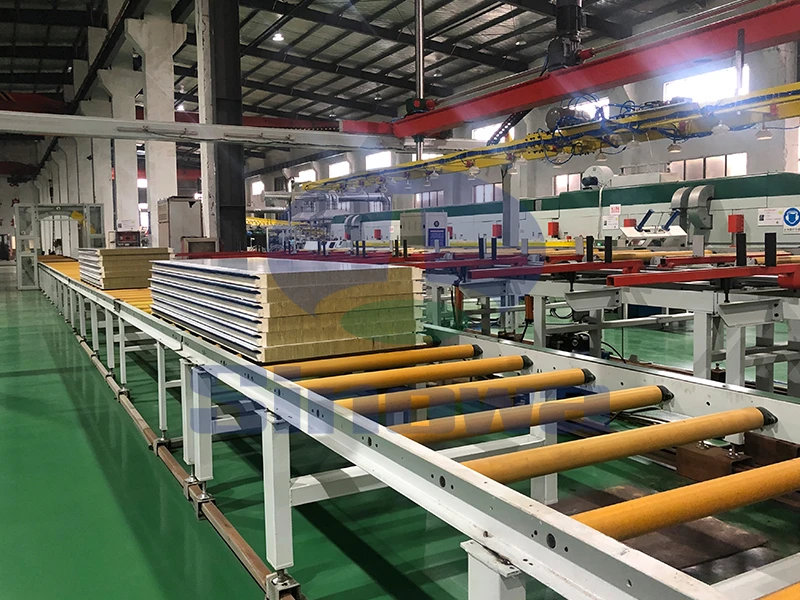
Daily routine maintenance is the foundation of stable conveyor system operation for rockwool sandwich panel production, focusing on real-time cleaning and basic operational inspection to avoid minor issues escalating into major faults. In the production process, rockwool fiber debris, residual adhesive, and tiny metal particles constantly accumulate on conveyor belts, rollers, and guide rails. These residues can cause belt slipping, material deviation, and uneven panel pressing if left unremoved, directly affecting the flatness and structural uniformity of finished rockwool panels. Operators need to conduct comprehensive surface cleaning of the entire conveyor system before and after daily production shifts, using professional cleaning tools to clear embedded fibers in belt gaps and wipe adhesive residues on transmission components. Meanwhile, visual inspections of conveyor operating status are essential, including checking for abnormal vibration, irregular noise, and jitter during belt operation, confirming the normal reset of emergency stop devices, and removing foreign obstacles in the material conveying path. This daily maintenance work takes a short time but effectively maintains the basic operating state of the conveyor system, avoids sudden production shutdowns caused by trivial blockages or abnormalities, and lays a solid foundation for continuous and stable daily production operations.
Weekly targeted maintenance mainly focuses on component adjustment and wearable part inspection of the conveyor system, solving potential hidden dangers that cannot be detected by daily superficial checks. The conveyor belt is the most frequently worn component in the system; long-term high-load operation often leads to loose tension, lateral deviation, edge wear, and local aging deformation. Every week, professional maintenance personnel need to detect the tension uniformity of the conveyor belt, adjust the tensioning device appropriately to ensure consistent tightness across the entire belt surface, and correct belt deviation to prevent unilateral friction and damage with guide rails. In addition, it is necessary to inspect all transmission rollers, support rollers and guide strip components, check for roller jamming, surface wear and fixed part loosening, and tighten loose bolts and fasteners in a timely manner. The sensor components matched with the conveyor system also require weekly calibration to ensure accurate induction of material position and conveying speed, avoiding dimensional errors of rockwool panels caused by inaccurate conveying positioning. Timely weekly adjustment and inspection can effectively reduce component wear rate, maintain the precise conveying state of the system, and ensure the dimensional accuracy of rockwool sandwich panels during continuous production.
Scientific and standardized lubrication maintenance is crucial to reducing friction loss and prolonging the service life of the conveyor system’s transmission components. The rockwool sandwich panel production environment features floating fine fibers and adhesive dust, which easily adhere to rotating and moving parts such as conveyor bearings, transmission gears, and universal couplings, leading to accelerated wear, poor rotation flexibility, and increased operating noise. Maintenance personnel need to formulate a reasonable lubrication cycle according to the actual operating frequency of the equipment. For components in continuous high-intensity operation, regular lubricant replenishment is required at fixed intervals, while intermittent operating parts can adopt a moderate cycle to avoid excessive lubrication. It is essential to select high-quality special lubricants suitable for industrial conveying equipment, avoid mixed use of different types of lubricants, and regularly clean residual deteriorated and contaminated old lubricants before replenishing new ones. Standardized lubrication can effectively reduce mechanical friction between moving parts, lower equipment operating energy consumption, prevent component heating and clamping stagnation faults, and keep the conveyor system running smoothly and efficiently for a long time.
Monthly in-depth component inspection and partial replacement maintenance aims to eliminate deep-seated hidden dangers of the conveyor system and ensure the long-term stability of core transmission structures. After long-term cumulative operation, some internal components of the conveyor system will produce invisible fatigue wear and structural aging, which cannot be found through daily and weekly inspections. Monthly maintenance needs to disassemble and inspect key core parts including drive motors, gearboxes, bearing sets and transmission chains. It is necessary to check the internal wear of gearbox gears, the flexibility of bearing rotation, and the tightness of chain meshing, and clean internal dust and fiber deposits that accumulate over time. For parts with obvious aging, severe wear, reduced elasticity or failed transmission performance, timely replacement is required instead of continuing to use them to prevent sudden equipment failure during peak production periods. At the same time, check the structural stability of the conveyor frame, welds and fixed supports, eliminate hidden dangers of loose structures and deformed supports, and ensure the overall structural rigidity of the conveyor system during high-speed and long-time conveying operations, providing stable structural support for rockwool material transportation and panel forming.
Electrical and control system maintenance is an indispensable part of conveyor system maintenance for rockwool sandwich panel machines, guaranteeing intelligent and stable operation of conveying procedures. The conveyor’s operating speed, start-stop rhythm and material matching linkage are all controlled by electrical components and control systems, and dust, moisture and long-term operation easily cause circuit aging and sensor failure. Regularly clean the dust and fiber accumulation on electrical control boxes, circuit boards and conveying sensors to prevent poor circuit contact and signal delay caused by dust coverage. Inspect circuit line aging, wire skin damage and interface loosening, replace aging lines in time, and fix loose wiring interfaces to avoid short circuits and signal interruption. Test the linkage coordination between the conveyor system and the host forming system regularly to ensure synchronous matching of conveying speed and pressing, cutting and forming procedures. Stable electrical control performance can avoid material stacking, conveying stagnation and panel forming defects caused by signal errors, effectively improve the overall yield of rockwool sandwich panels, and reduce production waste and rework costs.
Complete maintenance record management and standardized operational supervision are key to sustaining the long-term healthy operation of the conveyor system and optimizing maintenance strategies. All daily cleaning, regular inspection, lubrication adjustment, component replacement and fault maintenance work should be recorded in detail, including maintenance time, inspection items, existing problems, adjustment schemes and replacement part information. Systematic maintenance records can help maintenance personnel track the operation law and wear cycle of each component, accurately predict component failure risks, and formulate more scientific targeted maintenance plans instead of relying on blind regular maintenance. Meanwhile, standardize the daily operation behavior of staff, require operators to avoid overloading the conveyor system and irregular start-stop operations, and conduct regular professional training for maintenance personnel to improve their ability to judge and handle potential faults. Perfect maintenance management and standardized operation can effectively reduce equipment failure rate, prolong the overall service life of the conveyor system, ensure the long-term stable and high-efficiency operation of rockwool sandwich panel production lines, and create stable production benefits for industrial processing.
Main Products
-

Continuous PU Sandwich Panel Production Line
This continuous PU sandwich panel production line is an integrated automatic equipment. It covers uncoiling, forming, foaming, curing and cutting processes. With automatic raw material proportioning and precise temperature & pressure control, PIR sandwich panel production line continuously composites panels with double skins. Polyurethane sandwich panel production line stably produces steel and aluminum sandwich panels. Featuring high automation, the line makes fireproof and thermal-insulation panels for building enclosure and cold storage. -

Rock Wool Sandwich Panel Production Line
Continuous rockwool sandwich panel production line is an automatic integrated production equipment, consisting of uncoiling, forming, gluing and compounding, heating curing, fixed-length cutting, automatic stacking and other modules. The mineral wool sandwich panel production line continuously conveys color steel plates and rock wool core materials to automatically complete lamination and curing, which can produce fireproof and thermal insulation sandwich panels. Featuring high automation degree and stable operation, this production line is suitable for mass production of panels used for building walls, roofs and other scenarios. -

Phenolic Insulation Board Production Line
This integrated automatic production line continuously manufactures PU and phenolic insulation boards. The insulation board production line covers raw material proportioning, high-pressure foaming, laminating, curing and fixed-length cutting. Featuring high automation and stable molding, the insulation panel production line supports various surface materials. PU boards offer excellent thermal insulation, while phenolic boards have superior fire resistance. These products are widely used in construction, cold chain, ventilation ducts and other thermal insulation fields.
Other FAQs
- Daily Maintenance Methods For Rock Wool Sandwich Panel Production Line
- Energy Saving Measures For Rock Wool Sandwich Panel Production Line Operation
- High Temperature Resistance Performance Of Rockwool Sandwich Panel Production Equipment
- Panel Bonding Strength Improvement Methods In Rockwool Board Production Line
- Automation Program Upgrade Steps For Rock Wool Sandwich Panel Production Line