Automatic Operation Debugging Steps For Rock Wool Sandwich Panel Production Line
Sep 17, 2026
Automatic operation debugging of rock wool sandwich panel production lines is critical to stabilize product quality and reduce operational failures.
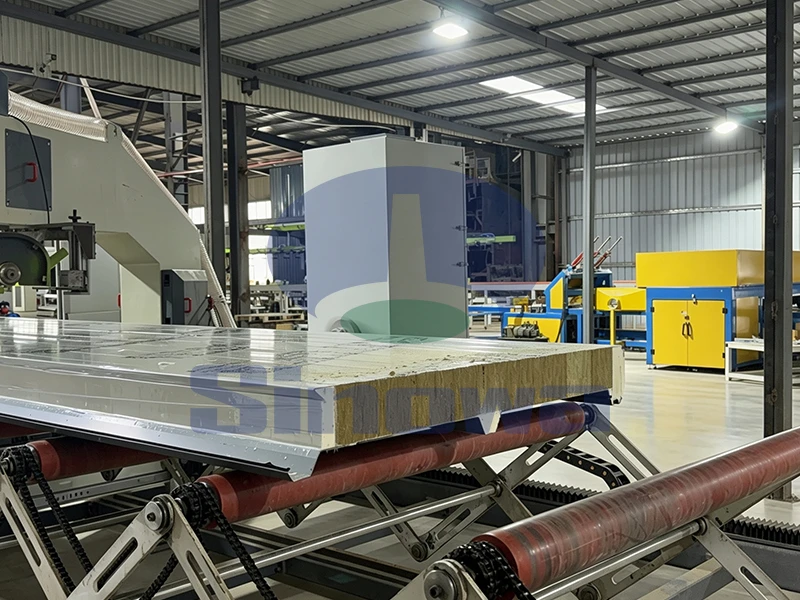
The first core step in automated debugging of rock wool sandwich panel production lines is comprehensive pre-operation static inspection, which lays a solid foundation for subsequent formal debugging and avoids potential safety and operational risks. Before activating any automated control system and mechanical equipment, operators need to conduct a full visual and manual inspection of all production components along the entire line. First, check the mechanical transmission parts, including conveyor rollers, pressing devices, cutting mechanisms and bonding assembly structures, to confirm there is no foreign matter accumulation, part wear, loose bolts or structural deviation. All movable components should be tested for flexible operation without jamming or abnormal resistance. Meanwhile, inspect the electrical control system, including circuit lines, connection terminals, sensor interfaces and control cabinet components, to ensure no line aging, poor contact or short-circuit hidden dangers. The pneumatic and hydraulic auxiliary systems also require detailed inspection, checking air pressure tightness, hydraulic oil volume and pipeline smoothness to guarantee stable power supply for automated actions. In addition, operators need to confirm the installation position and sensitivity of all automated detection sensors, such as position sensors, thickness detectors and speed sensors, as misplaced or insensitive sensors will directly cause automated program misoperation. This static inspection process requires meticulous item-by-item confirmation, eliminating all visible abnormal conditions before the equipment enters the power-on debugging state, which effectively reduces the failure rate of subsequent dynamic debugging and ensures the safety of the entire debugging process.
After completing the static inspection, the second step is system parameter initialization and precision calibration, which determines the dimensional accuracy and production consistency of finished rock wool sandwich panels. The automated production line relies on preset program parameters to realize continuous feeding, laminating, pressing and cutting, so accurate parameter setting is the core of stable automated operation. Operators first initialize the core operating parameters of the control system, including production line operating speed, rock wool core material feeding rate, upper and lower plate conveying synchronization speed, and hot pressing temperature and pressure parameters. All parameters need to be reset and calibrated according to the actual production specifications of sandwich panels, avoiding parameter mismatch caused by long-term equipment operation or previous production model switching. Then, conduct precision calibration of key processing links: calibrate the feeding positioning system to ensure the rock wool core material and metal panels are accurately aligned in the horizontal and vertical directions without offset; adjust the gap of the pressing mechanism to match the thickness standard of finished panels, ensuring uniform pressing force on the whole plate surface; calibrate the cutting system’s positioning and travel parameters to guarantee consistent cutting length and neat incision. During calibration, micro-adjustments should be made through multiple trial tests, and parameter data should be recorded in real time to form a stable parameter database. Reasonable parameter calibration can effectively avoid common quality problems such as panel offset, uneven pressing and irregular cutting in automated production, ensuring the uniformity of batch products.
The third debugging step is independent testing of single automated equipment and linkage verification of modular systems, which focuses on checking the coordination and stability of each functional module of the production line. The entire rock wool sandwich panel production line consists of multiple automated functional modules including feeding, gluing, laminating, hot pressing, cutting and discharging. First, conduct independent no-load debugging for each single equipment module to verify whether the single action of each device is accurate and in place. For the automatic feeding module, test the automatic conveying and intermittent stop functions of rock wool materials and metal panels to ensure stable feeding speed and accurate positioning; for the gluing module, check the automatic gluing volume and uniform spraying effect to avoid excessive or insufficient glue application; for the hot pressing and cutting modules, test the automatic lifting, pressing and cutting execution actions to ensure no action delay or position deviation. After the single-device debugging is qualified, carry out multi-module linkage debugging to simulate the actual production process and verify the sequential cooperation of each link. The key of linkage debugging is to check the signal transmission and action synchronization between modules, ensuring that the feeding, gluing, laminating and discharging actions are closely connected without program conflict or action lag. During the linkage test, observe the operation status of each component in real time, record abnormal vibration, noise or program pause phenomena, and adjust the program logic and action interval parameters in time to realize seamless linkage of the entire automated production line.
The fourth key debugging link is simulated load trial operation and real-time operation monitoring, which transforms no-load debugging effects into practical production adaptability. After the completion of mechanical and electrical linkage debugging, the production line needs to carry out low-speed, low-load simulated production with actual raw materials to comprehensively inspect the overall operating performance. Operators start the automated production program at a reduced operating speed and put in qualified rock wool core materials and metal panels for continuous simulated production. During the trial operation, focus on monitoring the operating stability of the entire line, including whether the material conveying is continuous and stable, whether the laminating and pressing process is uniform and firm, whether the automated cutting size is accurate, and whether the finished product discharging is smooth. At the same time, monitor the operating data of the electrical system, such as current, voltage and sensor feedback signals, to ensure all data are within the normal operating range. In addition, pay attention to the operating state of auxiliary systems such as pneumatic and hydraulic devices to maintain stable pressure and flow. In the process of simulated trial production, minor problems such as occasional material deviation and slight uneven gluing may occur. Operators need to track and adjust in real time, optimize the automated program response speed and equipment operating parameters according to the actual production state, and gradually increase the production speed and load to the standard production level after the trial operation is stable.
The fifth step is targeted fault diagnosis and optimization adjustment for hidden problems discovered during debugging and trial operation. Even if the production line completes smooth simulated production, some potential intermittent and hidden faults may still exist, which need to be accurately identified and optimized through professional diagnosis. Common hidden problems in automated operation include delayed sensor signal feedback, inconsistent speed of individual transmission rollers, unstable hot pressing pressure, and occasional program stalling. For signal feedback faults, operators need to clean sensor probes, adjust induction distance and optimize signal transmission programs to improve the sensitivity and stability of data collection. For mechanical operation inconsistencies, fine-tune the transmission tension of the conveyor belt, calibrate the horizontal level of the roller set, and lubricate the transmission bearings to eliminate abnormal resistance and speed deviation. For unstable pressure and temperature of the hot pressing system, check the heating and pressure regulating components, optimize the temperature control and pressure maintaining programs, and ensure constant working parameters during continuous production. In addition, sort out the minor faults occurring in the debugging process, summarize the corresponding adjustment schemes, and optimize the automated control program logic to improve the system’s fault tolerance and self-adaptation. This targeted optimization can eliminate hidden operational troubles in advance, reduce the failure rate of formal mass production, and extend the stable operation cycle of the production line.
The final step is overall acceptance verification and debugging result confirmation, which marks the completion of the entire automated operation debugging work and ensures the production line meets formal production conditions. After all debugging and optimization adjustments are completed, a comprehensive full-load continuous production test is carried out for a long time to verify the overall performance of the production line. The test adopts formal production parameters and standard raw materials to conduct uninterrupted automated batch production, and randomly inspects the dimensional accuracy, bonding firmness, surface flatness and overall quality of finished rock wool sandwich panels during the process. At the same time, comprehensively check the operating stability of mechanical equipment, the accuracy of electrical control programs, the sensitivity of automated detection systems and the coordination of various functional modules throughout the full-load operation process. No mechanical jamming, program error, material waste or unqualified product batch phenomenon is allowed during the verification process. After passing the continuous operation test and product quality inspection, sort out all debugging records, parameter calibration data and fault optimization files to form a complete debugging report. Finally, lock the optimized production parameters and program settings, complete the handover of debugging work, and confirm that the automated production line can achieve stable, efficient and standardized formal production operation.
Main Products
-

Continuous PU Sandwich Panel Production Line
This continuous PU sandwich panel production line is an integrated automatic equipment. It covers uncoiling, forming, foaming, curing and cutting processes. With automatic raw material proportioning and precise temperature & pressure control, PIR sandwich panel production line continuously composites panels with double skins. Polyurethane sandwich panel production line stably produces steel and aluminum sandwich panels. Featuring high automation, the line makes fireproof and thermal-insulation panels for building enclosure and cold storage. -

Rock Wool Sandwich Panel Production Line
Continuous rockwool sandwich panel production line is an automatic integrated production equipment, consisting of uncoiling, forming, gluing and compounding, heating curing, fixed-length cutting, automatic stacking and other modules. The mineral wool sandwich panel production line continuously conveys color steel plates and rock wool core materials to automatically complete lamination and curing, which can produce fireproof and thermal insulation sandwich panels. Featuring high automation degree and stable operation, this production line is suitable for mass production of panels used for building walls, roofs and other scenarios. -

Phenolic Insulation Board Production Line
This integrated automatic production line continuously manufactures PU and phenolic insulation boards. The insulation board production line covers raw material proportioning, high-pressure foaming, laminating, curing and fixed-length cutting. Featuring high automation and stable molding, the insulation panel production line supports various surface materials. PU boards offer excellent thermal insulation, while phenolic boards have superior fire resistance. These products are widely used in construction, cold chain, ventilation ducts and other thermal insulation fields.