Why Is The Operating Speed Of Rock Wool Sandwich Panel Production Line Unstable
Sep 29, 2026
The unstable operating speed of rock wool sandwich panel production line is a common industrial production issue that hinders consistent output and product quality. This problem stems from mechanical wear, electrical control deviations, material supply fluctuations, and improper operation, affecting the line's continuous and efficient running state.
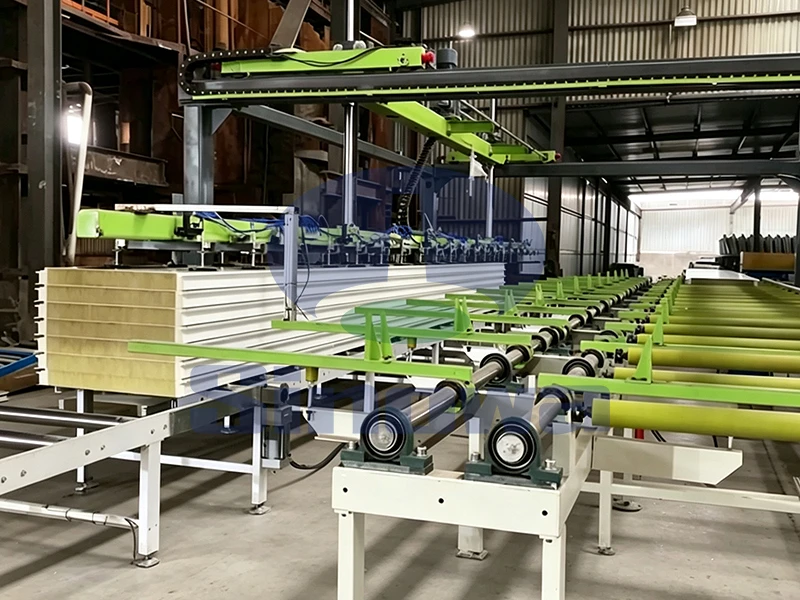
Mechanical transmission system failures are the most primary cause of unstable speed for rock wool sandwich panel production line. Long-term continuous operation will inevitably cause gradual wear and aging of core transmission components, including drive bearings, conveyor rollers, transmission belts and coupling parts. Worn bearings will generate continuous mechanical vibration during operation, which disrupts the uniform rotation of the transmission shaft and leads to periodic speed jitter of the entire production line. Loose or aging transmission belts cannot maintain stable tension, resulting in frequent slipping between the belt and driving rollers; this intermittent power loss directly causes sudden acceleration and deceleration of the conveying and forming mechanisms. In addition, misalignment of transmission shafts and deformed roller gaps will break the synchronous operation of each processing unit of the rock wool sandwich panel production line. Different functional sections such as feeding, pressing and trimming operate at inconsistent speeds, forming overall speed fluctuation. Without regular inspection and replacement of worn parts, minor mechanical defects will accumulate and evolve into severe speed instability, greatly reducing production continuity and increasing the risk of sudden shutdowns.
Electrical control system inaccuracies serve as another key factor triggering speed instability of rockwool sandwich panel production line. The automatic operation of the production line relies on precise frequency converters, servo motors and programmable control systems to maintain fixed operating speeds. In actual production environments, dust accumulation, humidity changes and long-term electrical component aging will affect the signal transmission accuracy of control devices. Frequency converters may experience output power fluctuations due to internal circuit aging, failing to provide stable power support for servo motors, which causes the motor rotation speed to deviate from the set value randomly. Meanwhile, delayed or distorted sensor signal feedback will make the control system unable to adjust operating parameters in real time. When the production line bears variable processing loads, the control system cannot complete timely speed compensation, leading to obvious speed fluctuations. Moreover, unstable factory power voltage and frequent current fluctuations will interfere with the normal operation of electrical components, further amplifying the speed instability problem of the rock wool sandwich panel production line and making it difficult to maintain constant-speed production.
Unstable raw material supply and abnormal material characteristics greatly interfere with the constant-speed operation of rock wool sandwich panel line. The normal running speed of the production line is matched with fixed material feeding specifications and conveying resistance. When the bulk density, fiber uniformity and humidity of rock wool raw materials change unregularly, the processing resistance of the forming and bonding sections will fluctuate significantly. Excessively humid rock wool materials will increase adhesion between fibers and equipment parts, raising conveying and processing resistance and forcing the production line to slow down involuntarily. In contrast, overly loose rock wool fibers will cause uneven material filling, leading to intermittent idle load operation of the equipment and sudden speed surge. In addition, inconsistent feeding speed of the automatic feeding mechanism and material blockage in the conveying channel will cause discontinuous material supply. The rock wool sandwich panel production line will repeatedly switch between loaded and no-load operation states, resulting in frequent speed changes. Long-term unstandardized material pretreatment and mixed use of unqualified raw materials will make this speed instability problem more persistent and difficult to eliminate quickly.
Improper daily operation and inadequate maintenance management exacerbate the speed fluctuation problems of rock wool sandwich panel production line. Many production failures originate from non-standard manual operation and neglected routine maintenance. Operators often adjust production parameters arbitrarily according to temporary output needs, frequently modifying the operating speed and load parameters of the production line without professional debugging. Frequent parameter changes will disrupt the stable operation logic of the control system, making the equipment unable to form a fixed and stable operating cycle. In terms of maintenance, insufficient lubrication of moving parts is a common problem; deteriorated or insufficient lubricating oil increases friction resistance of mechanical components, causing unsmooth operation and speed jitter. Besides, long-term accumulation of production waste such as rock wool debris and metal dust inside the equipment will block transmission gaps and interfere with the normal operation of rollers and gears. Irregular equipment calibration and lack of regular system debugging will make minor operational deviations accumulate continuously, gradually evolving into obvious speed instability faults that affect the overall production efficiency of the rock wool sandwich panel production line.
Environmental condition changes in the production workshop also have an unignorable impact on the operating speed stability of rock wool sandwich panel manufacturing line. Industrial production workshops often have variable temperature and humidity conditions, which affect the mechanical and electrical performance of production equipment in multiple ways. In low-temperature environments, mechanical lubricants will thicken sharply, reducing lubrication efficiency and increasing the operating resistance of transmission components, leading to slow and unstable equipment operation. Excessively high workshop temperature will cause overheating of electrical control components, reducing the operation accuracy of frequency converters and servo motors and triggering speed fluctuations. Meanwhile, high humidity will easily cause slight dampness and oxidation of internal circuits and metal parts of the equipment, affecting signal transmission and mechanical operation accuracy. In addition, strong workshop vibration generated by surrounding mechanical equipment will interfere with the synchronous operation of the rock wool sandwich panel production line, disrupting the stable operating state of each functional unit and resulting in irregular speed changes during continuous production.
Reasonable equipment debugging and standardized daily management can effectively solve the speed instability problem of rock wool sandwich panel production line. Enterprises can establish a regular equipment inspection mechanism to regularly check and replace worn transmission parts, calibrate the parallelism and gap of conveying rollers, and ensure stable mechanical power transmission. It is necessary to regularly clean electrical components, test the operating accuracy of control systems, and eliminate signal delay and power fluctuation faults. Standardizing raw material pretreatment and feeding management to ensure consistent material characteristics and continuous feeding can reduce load fluctuations during equipment operation. Meanwhile, strengthening operator professional training, formulating standardized parameter adjustment specifications and perfecting daily lubrication and environmental maintenance systems can fundamentally maintain the stable and efficient operation of the rock wool sandwich panel production line.
Gallery
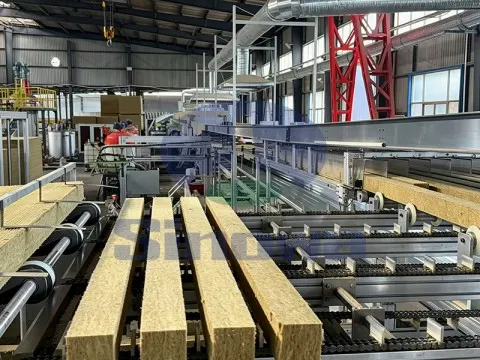
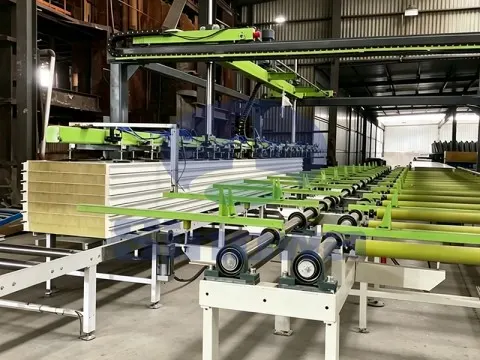
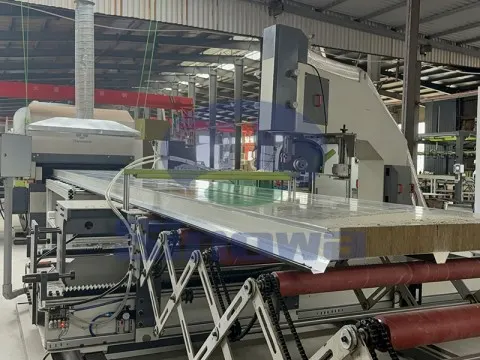
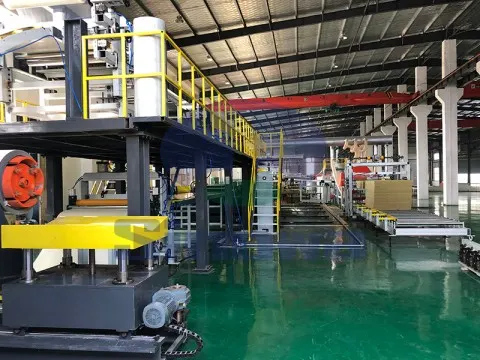
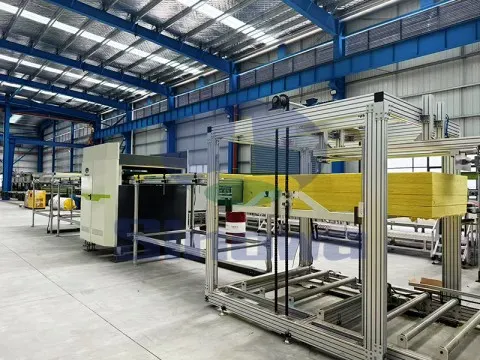
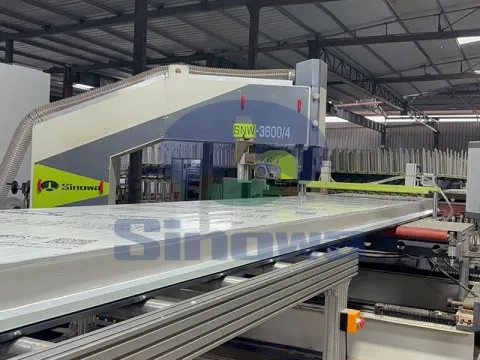
Sinowa is a professional manufacturer of sandwich panel machine in china, we provide diversified and high-performance sandwich panel production lines, including fully automatic continuous PU sandwich panel line and customized special lines to meet mass production and personalized order demands. These sandwich panel lines support processing multiple foam core materials, such as PU, PIR, mineral wool, rock wool and glass wool, covering different insulation and fireproof standards.
Featuring stable operation, high efficiency, energy saving and easy maintenance, our PU sandwich panel line deliver sandwich panels with excellent thermal insulation, fire resistance, sound insulation and lightweight durability. The finished panels are widely applied in industrial workshops, warehouse roofing and wall cladding, cold storage insulation, serving global construction and industrial insulation markets.
Main Products
-

Continuous PU Sandwich Panel Production Line
This continuous PU sandwich panel production line is an integrated automatic equipment. It covers uncoiling, forming, foaming, curing and cutting processes. With automatic raw material proportioning and precise temperature & pressure control, PIR sandwich panel production line continuously composites panels with double skins. Polyurethane sandwich panel production line stably produces steel and aluminum sandwich panels. Featuring high automation, the line makes fireproof and thermal-insulation panels for building enclosure and cold storage. -

Rock Wool Sandwich Panel Production Line
Continuous rockwool sandwich panel production line is an automatic integrated production equipment, consisting of uncoiling, forming, gluing and compounding, heating curing, fixed-length cutting, automatic stacking and other modules. The mineral wool sandwich panel production line continuously conveys color steel plates and rock wool core materials to automatically complete lamination and curing, which can produce fireproof and thermal insulation sandwich panels. Featuring high automation degree and stable operation, this production line is suitable for mass production of panels used for building walls, roofs and other scenarios. -

Phenolic Insulation Board Production Line
This integrated automatic production line continuously manufactures PU and phenolic insulation boards. The insulation board production line covers raw material proportioning, high-pressure foaming, laminating, curing and fixed-length cutting. Featuring high automation and stable molding, the insulation panel production line supports various surface materials. PU boards offer excellent thermal insulation, while phenolic boards have superior fire resistance. These products are widely used in construction, cold chain, ventilation ducts and other thermal insulation fields.
Other FAQs
- Energy Saving Measures For Rock Wool Sandwich Panel Production Line Operation
- What Causes Low Bonding Strength Of Panels From Rock Wool Sandwich Panel Production Line
- High Temperature Resistance Performance Of Rockwool Sandwich Panel Production Equipment
- Panel Bonding Strength Improvement Methods In Rockwool Board Production Line
- How To Maintain The Rock Wool Sandwich Panel Production Line Daily
- Automation Program Upgrade Steps For Rock Wool Sandwich Panel Production Line
- Automatic Operation Debugging Steps For Rock Wool Sandwich Panel Production Line
- Cold Start Operation Precautions Of Rock Wool Sandwich Panel Production Machine
- Production Speed Optimization Methods For Rock Wool Sandwich Panel Line
- How Does A Mineral Wool Sandwich Panel Production Line Operate In Full Automatic Mode
Related Articles
- Rock Wool Foam Sandwich Panel Production Line
- Continuous Mineral Wool Sandwich Panel Production Line
- Edge Sealing Rock Wool Board Production Line
- Rock Wool Sandwich Panel Production Line with Low Maintenance Cost
- Color Steel Rock Wool Composite Production Line
- Rockwool Sandwich Panel Line
- Composite Rock Wool Board Production Line
- Rock Wool Sandwich Panel Production Line with Automatic Width Adjustment
- Rockwool Sandwich Panel Machine with Double Belt Press System
- Partition Wall Composite Rock Wool Sandwich Panel Line