Production Speed Optimization Methods For Rock Wool Sandwich Panel Line
Sep 17, 2026
Rock wool sandwich panel production lines often face speed bottlenecks affecting overall output and operational efficiency.
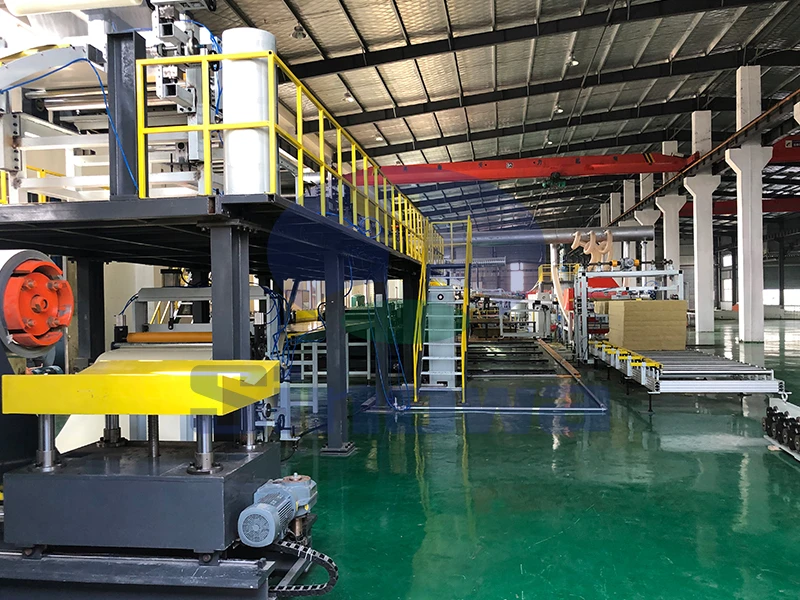
The core foundation of improving rock wool sandwich panel production speed lies in optimizing the coordination and operational stability of core production equipment. Most production speed bottlenecks in traditional lines stem from mismatched operating frequencies between upstream and downstream equipment, as well as frequent minor equipment shutdowns caused by parameter mismatches. In the raw material feeding stage, automatic feeding devices for rock wool cores and metal sheets often have inconsistent conveying speeds, leading to material accumulation or temporary material shortages in the subsequent bonding and pressing processes. By fine-tuning the servo motor parameters of each conveying unit and realizing synchronous linkage of all front-end feeding equipment, the intermittent pause phenomenon caused by material supply discontinuity can be effectively eliminated. Meanwhile, regular dynamic calibration of pressing equipment is essential. Long-term operation will lead to slight deviations in pressing pressure and roller gap, which not only reduce production speed by requiring repeated pressing adjustments but also cause unqualified products that need rework. Timely calibration of pressure parameters and gap spacing ensures one-time forming of panels, greatly improving the continuous operation efficiency of the production line. In addition, daily equipment maintenance and fault pre-inspection can avoid unexpected shutdowns caused by component wear, circuit aging or mechanical jams, maintaining a stable and continuous production rhythm that is the prerequisite for sustained speed improvement.
Process flow simplification and standardized refinement are key measures to significantly elevate the production speed of rock wool sandwich panel lines. Many production lines retain redundant manual operation links and repetitive process steps in long-term operation, which consume a large amount of production time and reduce overall line efficiency. The traditional production process includes multiple manual inspection and auxiliary positioning steps in the laminating, gluing and cutting stages, which rely on manual experience and have unstable operation speed and accuracy. Replacing manual auxiliary positioning with automatic positioning and sensing devices can realize precise positioning of rock wool cores and metal plates in real time, eliminating the time loss of manual adjustment and repeated alignment. Moreover, optimizing the gluing process is crucial for both production speed and product quality. Uneven gluing and excessive glue curing time are important factors restricting the pace of subsequent processes. By adjusting the gluing thickness control system and adopting uniform and rapid curing gluing operation modes, the waiting time for glue curing can be shortened without affecting bonding firmness, enabling the production line to enter the pressing and forming process more quickly. Removing redundant intermediate inspection steps and establishing a real-time online quality monitoring mechanism also avoids frequent production pauses caused by offline sampling inspection, realizing seamless connection of each production link and greatly improving the overall operational speed of the production line.
Scientific material handling and storage management can effectively avoid production delays caused by material problems and stabilize the high-speed operation of the production line. Rock wool core materials and metal surface materials have special storage and handling requirements, and improper management is a common hidden cause of low production efficiency. Unordered material stacking often leads to time-consuming material searching and handling during production, while damp and deformed rock wool cores will cause jamming and forming failures in the production process, forcing the line to slow down or shut down temporarily. Standardizing material storage areas to achieve classified and fixed-position storage of different specifications of raw materials can shorten the material handling and feeding preparation time before production. At the same time, establishing a standardized material pre-treatment process is essential. Pre-drying and shaping rock wool cores before they enter the production line can eliminate product defects and equipment jams caused by material moisture and deformation, ensuring smooth feeding and processing. In addition, optimizing the material conveying rhythm to match the operating speed of processing equipment avoids material backlog at individual process nodes. Excessive material accumulation will increase the operating load of local equipment, reduce processing efficiency, and even trigger equipment overload protection and shutdown. Reasonable material scheduling ensures that each process maintains a moderate material reserve, realizing balanced and efficient operation of the entire production line.
Improving operational proficiency and standardizing staff operation management play an indispensable role in optimizing production speed. Even with advanced equipment and optimized processes, irregular manual operations will restrict the full release of production capacity. Different operators have different operating habits and proficiency levels, leading to inconsistent operation speeds and frequent operational errors in key links such as equipment start-stop, parameter adjustment and finished product collection. Unified standardized operation procedures should be formulated for all production posts, clarifying the standardized operation steps, parameter adjustment ranges and rapid fault disposal methods for each process. Regular professional skill training for front-line operators can improve their proficiency in equipment operation and process control, enabling them to complete various operational actions more quickly and accurately. Meanwhile, strengthening post responsibility management and real-time production rhythm supervision can avoid operational delays caused by human factors such as casual operation and post leaving. In addition, training operators on rapid response to common minor faults enables them to quickly eliminate small equipment jams and parameter deviations in the production process, avoiding prolonged production pause caused by waiting for professional maintenance personnel, and effectively improving the continuous operating speed of the production line.
Intelligent transformation and local automation upgrading of production lines are effective means to achieve long-term and stable speed improvement. Most traditional rock wool sandwich panel production lines adopt semi-automatic operation modes, with many links relying on manual intervention, resulting in limited production speed and unstable production rhythm. Carrying out intelligent upgrading of key production links can greatly reduce manual intervention and improve operational efficiency. Installing intelligent sensing and automatic adjustment systems for gluing, pressing and cutting equipment can realize real-time monitoring and automatic optimization of process parameters, automatically adjusting equipment operating speed according to production conditions to maintain the optimal production state. Adopting automatic finished product sorting and stacking equipment replaces manual collection and arrangement of finished panels, greatly improving the efficiency of the final production link and avoiding finished product accumulation that restricts the operation of upstream processes. Moreover, building a production line data monitoring system can record the operating speed, fault records and process parameter changes of each link in real time, helping technical personnel accurately locate speed bottlenecks and targeted optimize weak links in production. The gradual intelligent and automatic upgrading of the production line can realize unmanned and efficient operation of most links, fundamentally breaking through the speed limit of traditional production modes.
Daily production operation optimization and dynamic bottleneck troubleshooting ensure the sustained and stable high-speed operation of rock wool sandwich panel production lines. Production line operation conditions are affected by equipment aging, material batch differences and environmental changes, and fixed optimization schemes cannot adapt to long-term production needs. It is necessary to establish a daily production data statistics and analysis mechanism, regularly counting the operating speed, downtime, fault types and output efficiency of each production link, timely discovering new production bottlenecks formed in the production process. For local links with reduced operating efficiency, targeted process adjustment and equipment maintenance should be carried out in a timely manner to eliminate efficiency constraints. At the same time, optimizing the daily production scheduling plan, reasonably arranging equipment startup, maintenance and production tasks, avoiding frequent equipment startup and shutdown caused by unreasonable scheduling, and maintaining a stable continuous production state. In addition, optimizing the production workshop environment, controlling temperature and humidity within the suitable range for production processing, avoiding the impact of adverse environmental conditions on material processing and equipment operation stability, can effectively reduce production failures and speed fluctuations, and maintain the long-term efficient and high-speed operation of the entire rock wool sandwich panel production line.
Main Products
-

Continuous PU Sandwich Panel Production Line
This continuous PU sandwich panel production line is an integrated automatic equipment. It covers uncoiling, forming, foaming, curing and cutting processes. With automatic raw material proportioning and precise temperature & pressure control, PIR sandwich panel production line continuously composites panels with double skins. Polyurethane sandwich panel production line stably produces steel and aluminum sandwich panels. Featuring high automation, the line makes fireproof and thermal-insulation panels for building enclosure and cold storage. -

Rock Wool Sandwich Panel Production Line
Continuous rockwool sandwich panel production line is an automatic integrated production equipment, consisting of uncoiling, forming, gluing and compounding, heating curing, fixed-length cutting, automatic stacking and other modules. The mineral wool sandwich panel production line continuously conveys color steel plates and rock wool core materials to automatically complete lamination and curing, which can produce fireproof and thermal insulation sandwich panels. Featuring high automation degree and stable operation, this production line is suitable for mass production of panels used for building walls, roofs and other scenarios. -

Phenolic Insulation Board Production Line
This integrated automatic production line continuously manufactures PU and phenolic insulation boards. The insulation board production line covers raw material proportioning, high-pressure foaming, laminating, curing and fixed-length cutting. Featuring high automation and stable molding, the insulation panel production line supports various surface materials. PU boards offer excellent thermal insulation, while phenolic boards have superior fire resistance. These products are widely used in construction, cold chain, ventilation ducts and other thermal insulation fields.
Other FAQs
- Daily Maintenance Methods For Rock Wool Sandwich Panel Production Line
- Energy Saving Measures For Rock Wool Sandwich Panel Production Line Operation
- Panel Bonding Strength Improvement Methods In Rockwool Board Production Line
- Automatic Operation Debugging Steps For Rock Wool Sandwich Panel Production Line