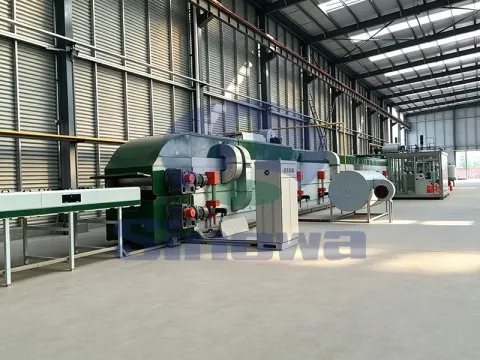
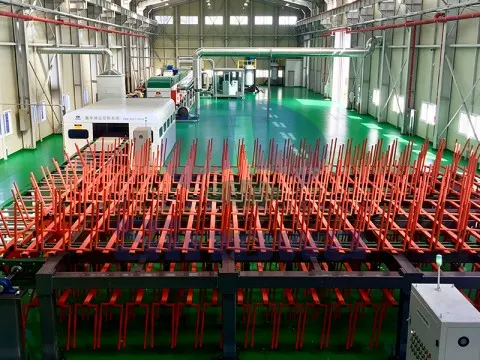
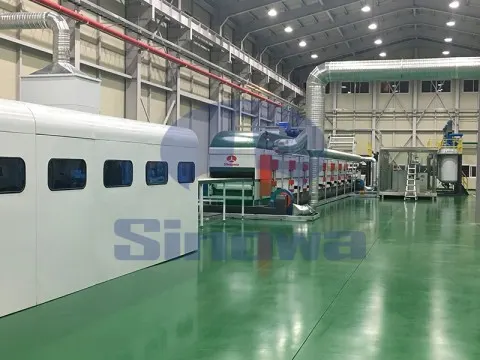
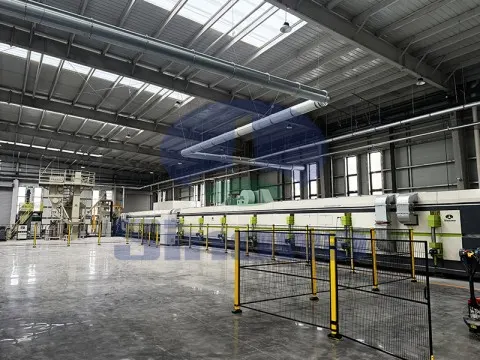
sandwich panel line
Raw material preparation and precise batching constitute the foundational process of the entire mineral wool insulation panel manufacturing line, which directly determines the basic performance and quality stability of finished products. The main raw materials applied in the production include natural hard rocks such as basalt and dolomite, as well as auxiliary recycled mineral materials and industrial by-product slags, all of which are screened and purified in advance to remove impurities and unqualified bulk materials that may affect fiber forming quality. The production line is equipped with a fully enclosed automatic batching system, which can accurately weigh and mix different raw materials according to set proportions through intelligent sensing and metering devices. This precise batching mode avoids the component deviation caused by manual operation, ensures the uniformity of raw material composition in each production batch, and lays a solid foundation for consistent product density and mechanical properties. In addition, the enclosed storage and conveying structure of the raw material system effectively prevents material moisture absorption and external dust pollution, maintains the dryness and purity of raw materials, and further optimizes the subsequent high-temperature melting and fiber forming effects, reducing defective product rates in the production process.
High-temperature melting treatment is the core thermal processing link of mineral wool panel production, undertaking the key task of converting solid mineral raw materials into molten liquid for fiber processing. The production line adopts an energy-efficient enclosed melting furnace with a scientific temperature gradient control system, which can heat the mixed mineral raw materials to a sufficient molten state through staged temperature rise. The integrated thermal insulation structure of the furnace body reduces heat loss during operation, improving overall energy utilization efficiency while ensuring stable and uniform heating of internal materials. After reaching the preset molten state, the liquid mineral mixture maintains stable fluidity and uniformity, without local overheating or insufficient melting problems that easily occur in traditional equipment. The sealed operating environment of the melting system also effectively avoids the overflow of high-temperature flue gas and dust, realizing cleaner production operation. Moreover, the intelligent temperature adjustment module can dynamically fine-tune the melting temperature according to raw material characteristics and production specifications, ensuring that the molten materials always meet the optimal fiber forming conditions and providing reliable molten raw materials for the subsequent centrifugal fiber forming process.
Centrifugal fiber forming and binder spraying are crucial processes that shape the microscopic structure and service performance of mineral wool insulation panels. The high-temperature molten mineral liquid is stably transported to the high-speed centrifugal spinning unit, which uses high-speed rotating equipment to stretch and disperse the liquid material into fine and uniform mineral fibers. The fiber diameter formed by this process is fine and moderate, with a crisscross three-dimensional distribution structure, which is the key to the excellent thermal insulation and sound absorption performance of finished panels. During the fiber forming process, the production line is equipped with an automatic atomization spraying system, which uniformly sprays environmentally friendly adhesive binders and hydrophobic auxiliary agents on the surface of scattered mineral fibers. The precise spraying dosage and uniform coverage ensure stable bonding force between fibers, while endowing the finished products with good water repellency and structural stability. The whole fiber forming and spraying process operates in a closed negative pressure environment, which effectively collects floating fine fibers, avoids material waste and environmental pollution, and ensures the continuity and stability of fiber output for subsequent mat forming processing.
Fiber mat layering and preliminary shaping determine the flatness, thickness uniformity and structural compactness of semi-finished mineral wool panels. After fiber forming and binder spraying, the loose mineral fibers are evenly laid on the circulating conveying mesh belt through a uniform distribution system, initially forming a fluffy fiber mat structure. The production line adopts a multi-layer cross-laying technology, which makes the fibers overlap and interweave in multiple directions, effectively improving the overall tensile strength and structural uniformity of the fiber mat and avoiding the quality problems of local looseness and uneven density caused by single-direction fiber laying. The intelligent thickness detection device installed in the layering link can monitor the real-time thickness of the fiber mat and automatically adjust the fiber feeding volume and conveying speed to ensure that the thickness of the fiber mat is always within the preset range. After layered laying, the fiber mat passes through the preliminary pressing device, which carries out gentle compression shaping on the fluffy fiber mat to discharge excess air inside, preliminarily fix the overall structure of the fiber mat, and prepare for the subsequent high-temperature curing and final shaping process.
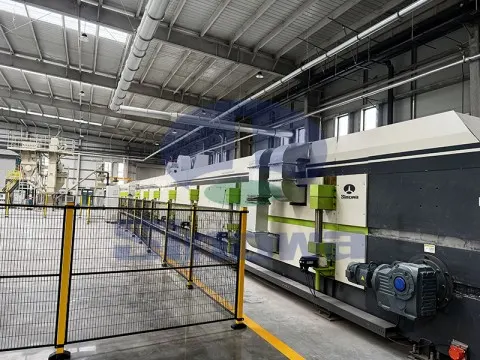
High-temperature curing and structural stabilization are key steps to finalize the physical structure and comprehensive performance of mineral wool insulation panels. The preliminarily shaped fiber mat is continuously sent to the constant-temperature curing oven through the conveying system, and undergoes thermal curing treatment under stable high-temperature hot air penetration conditions. The uniform hot air circulation system inside the curing oven ensures that each part of the fiber mat is heated evenly, which can fully activate the sprayed binder, realize firm bonding between fibers, and form a stable and integrated porous structure. The intelligent temperature and wind speed control system can adjust the curing parameters according to the panel thickness and density specifications, ensuring thorough curing without causing fiber damage or binder aging failure due to excessive temperature. After curing, the loose fiber mat is solidified into a rigid and stable plate structure with fixed thickness and density, possessing good compression resistance and structural stability. Meanwhile, the high-temperature curing process can volatilize trace moisture and residual substances inside the panel, further improving the thermal stability and anti-aging performance of the finished product, and ensuring long-term reliable service in complex application environments.
Cooling, precision trimming and size shaping optimize the dimensional accuracy and surface quality of finished mineral wool insulation panels. After exiting the curing oven, the high-temperature cured panels are firstly transported to the automatic cooling area, where natural air cooling and auxiliary air cooling are combined to realize uniform and rapid cooling of the panels. The gradual cooling mode effectively avoids panel deformation, cracking and structural loosening caused by rapid temperature change, and maintains the flatness and structural stability of the plates. After cooling, the panels enter the precision trimming and cutting unit, which is equipped with high-precision longitudinal and transverse cutting saws. The longitudinal cutting mechanism trims the irregular edges on both sides of the panel to ensure consistent width, while the transverse cutting mechanism cuts the continuous long plate into standard length specifications according to production requirements. All cutting processes are automatically controlled by the system, with high cutting precision and smooth incision, without burrs or edge damage. This fine processing link eliminates dimensional errors and surface defects generated in the previous production processes, making the appearance and dimensional accuracy of finished products fully meet the requirements of various engineering applications.
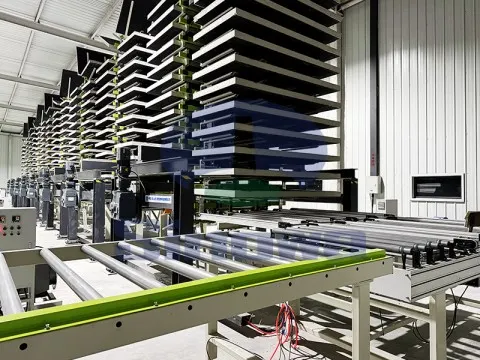
Final inspection, stacking and automatic packaging complete the whole production process of mineral wool insulation panels and realize standardized finished product output. After precision trimming, all finished panels will pass through the online full inspection system, which automatically detects key indicators including panel thickness, density, flatness and structural integrity, and screens out unqualified products in real time to ensure that all delivered products have stable and qualified performance. Qualified finished panels are automatically stacked by the mechanical stacking device in neat and standard layers, with accurate stacking quantity and stable placement, which is convenient for subsequent storage and transportation. The fully automatic packaging system carries out sealed packaging for stacked panels, which can effectively isolate external moisture, dust and mechanical collision damage during storage and transportation, maintain the excellent performance of mineral wool panels for a long time. The whole post-processing process realizes unmanned automatic operation, which not only improves production efficiency and packaging consistency, but also reduces manual operation errors. The complete set of automated processes from production to packaging ensures the high quality and market adaptability of mineral wool insulation panels, supporting large-scale and standardized industrial production.
Sinowa is a professional manufacturer of sandwich panel machine in china, we provide diversified and high-performance sandwich panel production lines, including fully automatic continuous PU sandwich panel line and customized special lines to meet mass production and personalized order demands. These sandwich panel lines support processing multiple foam core materials, such as PU, PIR, mineral wool, rock wool and glass wool, covering different insulation and fireproof standards.
Featuring stable operation, high efficiency, energy saving and easy maintenance, our PU sandwich panel line deliver sandwich panels with excellent thermal insulation, fire resistance, sound insulation and lightweight durability. The finished panels are widely applied in industrial workshops, warehouse roofing and wall cladding, cold storage insulation, serving global construction and industrial insulation markets.
https://www.cnsinowa.com/sandwich-panel-machines/mineral-wool-insulation-panel-manufacturing-line.html