 sandwich panel line
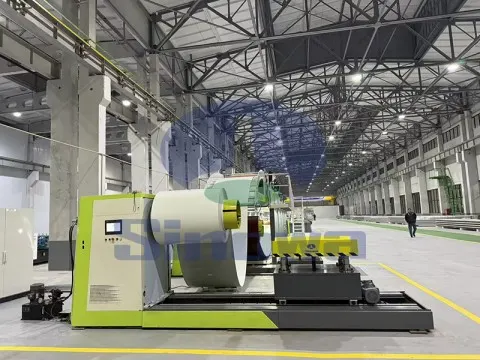
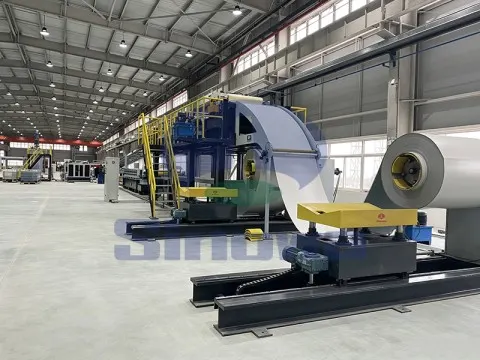
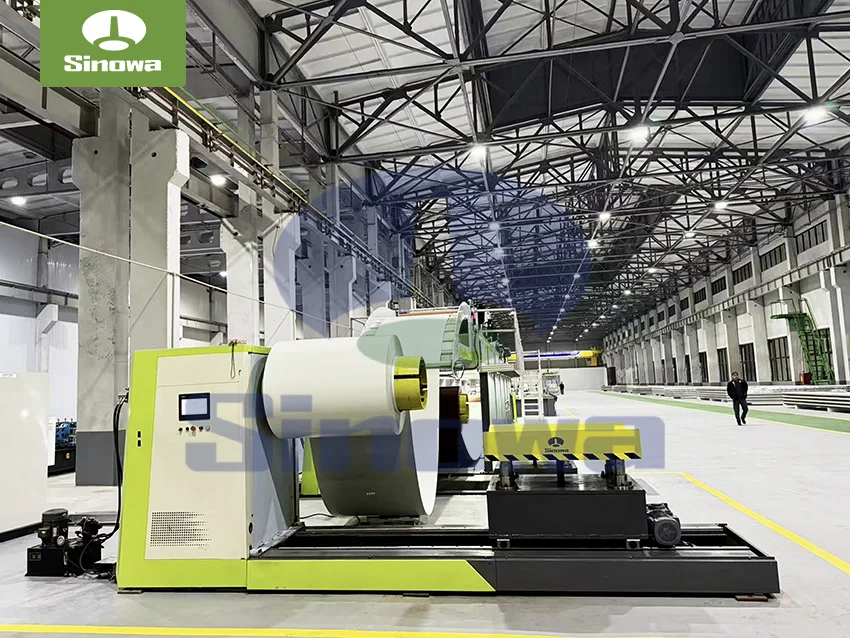
The operational foundation of the entire PIR sandwich panel line lies in standardized raw material preparation and precise feeding pretreatment, which directly determines the bonding quality and overall performance of finished panels. The production line supports multiple types of surface facing materials, including coated metal sheets and anti-corrosion alloy sheets, all of which undergo strict pretreatment before formal composite processing. The sheet unwinding system operates at a stable and adjustable speed, ensuring flat and tension-free material feeding to prevent wrinkles or deformation in subsequent molding procedures. Meanwhile, professional surface treatment devices conduct micro-cleaning and surface activation on the facing materials, removing surface dust, oil stains and oxide layers to enhance the adhesion between metal surfaces and PIR foam core materials. In terms of core material raw materials, the two-component chemical raw materials for PIR foaming are stored in independent sealed storage tanks, with constant temperature and pressure maintenance devices to stabilize material activity. The intelligent metering system accurately controls the proportion of each chemical component, eliminating formula deviations that may affect foam compactness and structural uniformity. All feeding links are linked by synchronous control systems to realize matching supply speed of surface materials and core materials, laying a solid foundation for stable continuous production.
Precision chemical mixing and uniform material pouring constitute the core pre-process of PIR foam forming in the manufacturing line. After precise metering, the PIR chemical raw materials are transported to a high-efficiency dynamic mixing unit, where high-speed stirring and turbulent mixing are carried out to achieve full fusion of different components. The mixing system adopts closed-loop parameter regulation to adjust mixing speed, time and pressure in real time according to production speed and material characteristics, ensuring the mixed liquid material has uniform molecular distribution and stable reaction activity. Avoiding incomplete mixing or local component imbalance, this precise processing mode effectively prevents the occurrence of hollow holes, loose structures and uneven density in the subsequent foam core layer. The well-mixed liquid mixture is then evenly poured onto the flat lower facing material through a multi-point uniform pouring device. The pouring range and flow rate are intelligently adjusted according to the preset panel thickness specifications, realizing full coverage of the material surface without overflow or missing areas. The whole mixing and pouring process is completed in a fully enclosed environment, which not only ensures production safety but also avoids external environmental interference on the chemical reaction process, guaranteeing the consistency of each batch of raw material reaction state.
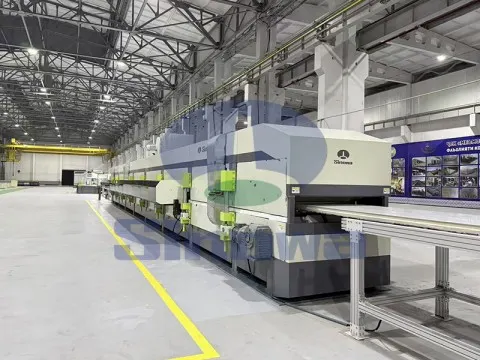
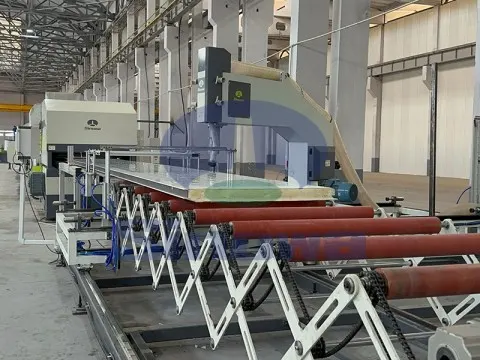
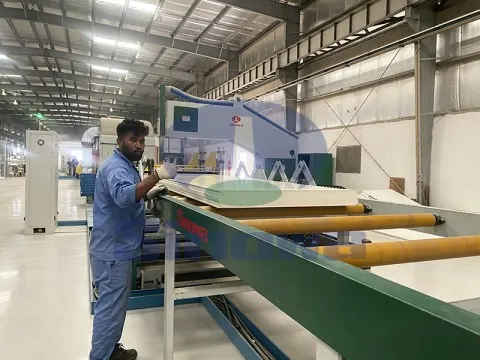
Continuous foaming, curing and composite molding are the key stages that shape the structural performance of PIR sandwich panels, serving as the core functional section of the entire production line. After the liquid mixed material is poured on the lower facing material, it immediately initiates a continuous chemical reaction including foaming, polymerization and curing inside the sealed molding channel. The production line is equipped with a constant temperature curing system that maintains a stable reaction temperature environment, effectively controlling the foaming speed and curing cycle of PIR materials. As the foam expands evenly and solidifies gradually, it forms a dense and uniform thermal insulation core layer, and closely bonds with the upper and lower facing materials under the pressure of the double-layer conveyor system. The dual-track conveyor device maintains a fixed spacing between the upper and lower sheets throughout the molding process, ensuring accurate control of panel thickness and flatness. Lateral forming devices on both sides of the production line shape the panel edges synchronously during the molding process, realizing one-time forming of neat and standardized edge structures. The integrated molding process enables the foam core and surface materials to form an integral composite structure, greatly improving the overall structural strength, delamination resistance and service durability of the panel compared with manually bonded products.
Intelligent parameter control and synchronous operation optimization are important advantages of modern industrial PIR sandwich panel manufacturing lines, supporting stable and high-efficiency mass production. The entire production process is centrally controlled by an intelligent operating system, which uniformly regulates the operating parameters of all functional units including feeding, mixing, pouring, molding and cutting. The system integrates real-time monitoring modules for temperature, pressure, speed and material flow, automatically adjusting operational parameters according to production specifications and real-time operating conditions to maintain the stability of the production process. All equipment units realize synchronous linkage operation, avoiding production stagnation or product quality problems caused by mismatched speed of front and rear processes. For example, the feeding speed of facing materials is automatically matched with the foaming reaction speed and molding traction speed, ensuring uninterrupted continuous production. In addition, the system supports parameter memory and one-key switching of different panel specifications, enabling rapid adjustment of production lines to meet diverse production demands for panels of different thicknesses and sizes. The real-time data monitoring and fault self-diagnosis functions also reduce equipment failure rates, improve production continuity and effectively reduce manual intervention costs.
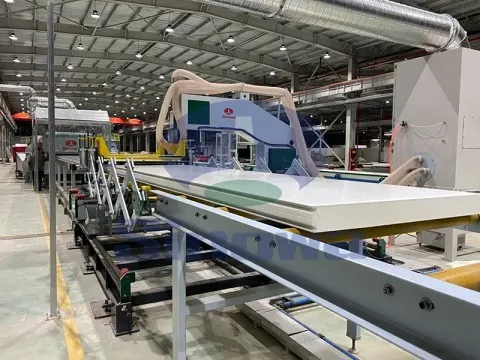
Fixed-length cutting, edge trimming and precision post-processing procedures ensure the dimensional accuracy and finished product quality of PIR sandwich panels. After continuous curing and molding, the integrated panel semi-finished products are transported to the cutting section at a stable speed. The production line adopts a flying saw cutting system that realizes dynamic fixed-length cutting in the continuous moving state of panels, avoiding production pause and improving overall production efficiency. The cutting device features high-precision positioning and stable cutting performance, ensuring flat and smooth cutting sections without burrs, cracks or material deformation. After cutting, the panels enter the edge trimming and finishing process, where professional trimming equipment calibrates the panel edges to eliminate tiny dimensional deviations generated in the molding process and ensure consistent overall dimensions of finished products. Meanwhile, the post-processing section is equipped with surface inspection devices to conduct real-time detection of panel surface flatness, bonding integrity and core layer compactness, screening out unqualified products in time. The independent closed cutting workshop effectively reduces noise and dust pollution generated during cutting, realizing environmentally friendly production while protecting the precision of processing equipment.
Finished product cooling, automatic stacking and intelligent packaging are the final links of the PIR sandwich panel production line, completing the whole closed-loop production process. After post-processing, the freshly produced panels retain a certain curing temperature and need to pass through an intelligent cooling conveying system for gradual constant-temperature cooling. The layered cooling design ensures uniform heat dissipation of the panels, avoiding structural deformation or performance changes caused by rapid temperature difference, and further stabilizing the bonding strength and internal structure of the composite panels. The cooled qualified panels are automatically transported to the stacking station, where the mechanical stacking device carries out orderly layered stacking according to fixed specifications, realizing neat and standardized placement of finished products and saving storage space. Subsequently, the automatic packaging system completes overall wrapping and edge protection of the stacked panels, effectively preventing surface scratches, edge damage and dust contamination during transportation and storage. The whole finishing process is fully automated without manual participation, which not only improves packaging efficiency and uniformity but also ensures the intact appearance and performance of finished panels, facilitating subsequent transportation and on-site construction.
The industrial PIR sandwich panel production line achieves high-efficiency, high-quality and low-consumption production through integrated process design and intelligent equipment configuration, bringing significant application value to the composite building material industry. The continuous production mode completely breaks the limitations of traditional batch production, greatly improving production output while maintaining stable and reliable product quality for each batch. The precise formula control and integrated molding process endow PIR sandwich panels with excellent and consistent thermal insulation, fire resistance and structural stability, enabling the products to adapt to various complex building application scenarios. In addition, the highly automated production mode reduces manual operation errors and labor costs, and the closed and environmentally friendly production design meets the development requirements of green industrial manufacturing. With flexible production adaptability, the line can meet the customized production needs of panels with different specifications, providing efficient and reliable production solutions for large-scale and standardized construction projects, and continuously promoting the upgrading and intelligent development of the sandwich panel manufacturing industry.
Sinowa is a professional manufacturer of sandwich panel machine in china, we provide diversified and high-performance sandwich panel production lines, including fully automatic continuous PU sandwich panel line and customized special lines to meet mass production and personalized order demands. These sandwich panel lines support processing multiple foam core materials, such as PU, PIR, mineral wool, rock wool and glass wool, covering different insulation and fireproof standards.
Featuring stable operation, high efficiency, energy saving and easy maintenance, our PU sandwich panel line deliver sandwich panels with excellent thermal insulation, fire resistance, sound insulation and lightweight durability. The finished panels are widely applied in industrial workshops, warehouse roofing and wall cladding, cold storage insulation, serving global construction and industrial insulation markets.
https://www.cnsinowa.com/sandwich-panel-machines/industrial-pir-sandwich-panel-manufacturing-line.html