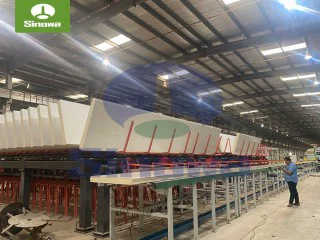
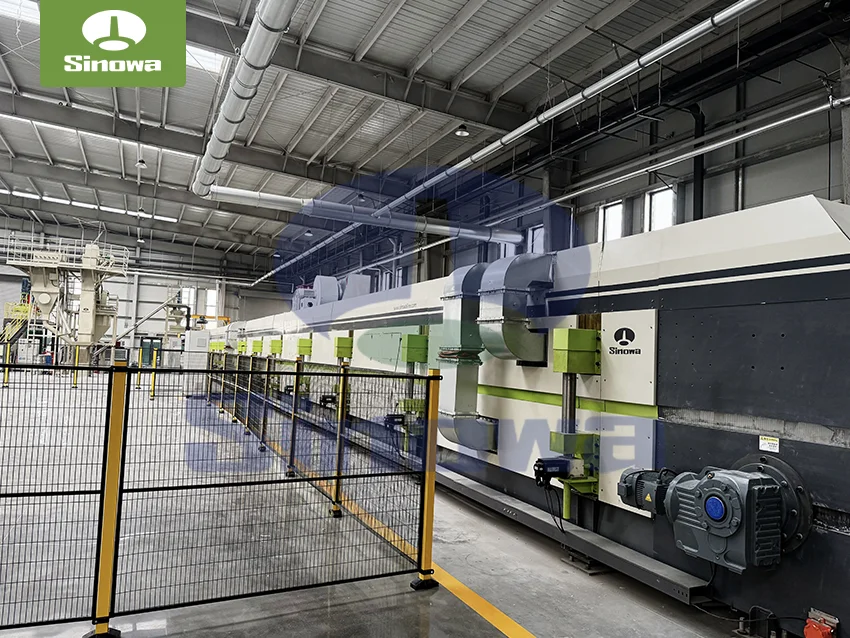
 sandwich panel line
The operational logic of the continuous PUR PIR sandwich panel production line is built on systematic modular coordination, with every functional module operating in synchronous linkage to ensure seamless production progression. The entire production process starts with the surface material feeding and pretreatment module, where coiled metal or decorative surface materials are automatically uncoiled, leveled and trimmed to eliminate surface wrinkles, edge burrs and dimensional deviations. This pretreatment step is critical to guaranteeing the flatness and assembly accuracy of subsequent composite panels. Following surface material preparation, the core material batching and mixing system takes charge of precise proportioning of polyurethane raw materials. Equipped with high-precision metering and mixing devices, the system accurately adjusts the ratio of raw materials according to preset production parameters, realizing seamless switching between PUR flexible foam formula and PIR rigid foam formula. The well-mixed liquid raw materials are evenly injected between the upper and lower surface layers through a high-pressure pouring system, ensuring full coverage of the composite cavity without voids or uneven accumulation. Each link in this stage features adjustable operating parameters, adapting to different panel thicknesses, core material densities and surface material types, laying the groundwork for diversified product production.
Foaming expansion and double-belt lamination constitute the core molding stage of the entire production line, determining the structural integrity and bonding performance of finished sandwich panels. After liquid PUR or PIR raw materials are injected between the two surface layers, the semi-finished product immediately enters the double-belt pressing system, which is the key functional area for panel shaping and preliminary bonding. The upper and lower parallel heat-conveying belts maintain a fixed and adjustable spacing, precisely controlling the final thickness of the sandwich panel, while applying uniform and stable pressure across the entire panel width and length. This balanced pressure environment enables the liquid foam to expand freely and evenly in the closed cavity, fully filling the gap between surface layers and forming a tight integrated bonding structure. During the foaming process, the self-adjusting speed of the double-belt conveyor synchronizes with the foam curing rhythm, effectively avoiding layer dislocation, core material deviation and local thinning defects caused by speed mismatch. The overall lamination process operates continuously without pause, eliminating the batch-to-batch performance differences existing in intermittent production and significantly improving the structural consistency of panel products.
Constant-temperature curing treatment is an indispensable post-molding process that stabilizes the internal structure and enhances the comprehensive mechanical properties of PUR and PIR sandwich panels. The production line is equipped with an extended closed curing tunnel, which is divided into multiple independent temperature control zones with gradient temperature settings to adapt to the polymerization characteristics of different polyurethane materials. PUR foam requires mild and stable temperature conditions to complete molecular curing, ensuring good flexibility and bonding toughness, while PIR foam needs relatively higher curing temperatures to promote full cross-linking reactions, thereby improving its structural rigidity and dimensional stability. Each temperature control zone is fitted with high-sensitivity temperature sensing elements and automatic heating adjustment components, which monitor and correct internal temperature in real time to maintain a constant and uniform curing environment. Through staged and targeted curing treatment, the foam core completes thorough polymerization and shaping, eliminating residual internal stress generated during foaming and lamination. This process effectively improves the compression resistance, bending resistance and overall structural stability of the panel, preventing subsequent deformation, cracking or delamination during long-term use.
The finished product cutting and post-processing module realizes precise sizing and standardized finishing of continuous molded sandwich panels, completing the final link of automated production. After full curing and structural stabilization, the continuous long panel is transported to the flying saw cutting station, which adopts high-speed synchronous cutting technology that moves synchronously with the panel conveying speed. This synchronous cutting mode avoids dimensional errors and section burrs caused by relative speed differences, ensuring neat and flat panel sections and accurate finished product dimensions. The cutting system supports flexible setting of arbitrary panel lengths according to production demands, realizing personalized sizing production for different engineering and application needs. After cutting, the panels enter the automatic sorting and conveying mechanism, which automatically sorts qualified products and removes defective products screened by real-time quality detection. The subsequent edge trimming and surface finishing processes further optimize the overall appearance and assembly performance of the panels, removing residual foam scraps and edge irregularities. The entire post-processing stage achieves unmanned continuous operation, greatly improving production efficiency while ensuring the uniformity of finished product appearance and dimensional accuracy.
One of the most prominent advantages of the continuous PUR PIR sandwich panel production line is its strong production flexibility and product adaptability, which can meet the diversified manufacturing demands of modern composite panel markets. By simply adjusting the system parameters of the batching system, pressing spacing and curing temperature zones, the equipment can rapidly switch between producing PUR and PIR core panels, realizing dual-purpose production of one set of equipment. PUR core panels produced by the line feature excellent toughness, adhesion and thermal insulation performance, suitable for lightweight enclosure structures and low-temperature insulation scenarios, while PIR core panels boast superior structural rigidity and high-temperature resistance, catering to high-standard building envelope and industrial insulation needs. In addition to core material switching, the production line also adapts to various surface materials and different panel thickness specifications. The adjustable structural design of each functional module enables it to match surface layers with different hardness and textures, and stably produce panels of multiple thicknesses. This flexible production capacity effectively reduces equipment investment costs for manufacturers and improves the market response speed of product upgrading and iteration.
Highly automated intelligent control system configuration endows the continuous PUR PIR sandwich panel production line with stable operation performance and low maintenance cost advantages. The entire production process is centrally controlled by an integrated intelligent operating platform, which realizes one-click parameter setting, automatic equipment startup and shutdown, and real-time monitoring of full-process operating status. The system can automatically identify abnormal operating parameters such as raw material proportion deviation, temperature fluctuation and conveyor speed mismatch, and trigger automatic adjustment and early warning prompts to avoid batch defective products caused by equipment abnormalities. The modular equipment structure simplifies daily maintenance and fault repair work, with each functional unit independently detachable and adjustable, reducing downtime loss caused by equipment maintenance. Meanwhile, the automated production mode greatly reduces manual operation links, lowers labor intensity and human error rates, and realizes standardized and repeatable production processes. Long-term stable operation of the equipment ensures continuous and consistent product quality, effectively reducing production comprehensive costs and improving enterprise production benefits.
The continuous PUR PIR sandwich panel production line drives the upgrading and sustainable development of the green building material industry with its efficient, stable and low-consumption production characteristics. Compared with traditional discrete production modes, the continuous production process greatly shortens the production cycle of single panels, improves unit time output, and effectively reduces energy consumption and material waste in the production process. The precisely controlled foaming and curing process ensures that the produced PUR and PIR sandwich panels have uniform thermal insulation performance, stable structural performance and excellent durability, which can meet the long-term service requirements of various building and industrial insulation scenarios. As the market demand for energy-saving, environmentally friendly and high-performance building enclosure materials continues to grow, this continuous production equipment provides reliable technical and equipment support for large-scale promotion and application of polyurethane composite panels. It promotes the standardized development of the sandwich panel manufacturing industry, and plays an important role in accelerating the transformation and upgrading of the construction industry towards energy conservation, environmental protection and high efficiency.
https://www.cnsinowa.com/sandwich-panel-machines/continuous-pur-pir-sandwich-panel-production-line.html