How To Troubleshoot Automatic Packing Misalignment Of PIR Sandwich Panel Production Line
Oct 26, 2026
Automatic packing misalignment is a common malfunction in PIR sandwich panel production lines, which disrupts continuous production, causes panel surface scratches and packaging waste. This article sorts out practical troubleshooting ideas, starting from inspection of conveying components, positioning structures and sensing parts, to help operators quickly locate root causes and restore stable packing accuracy.
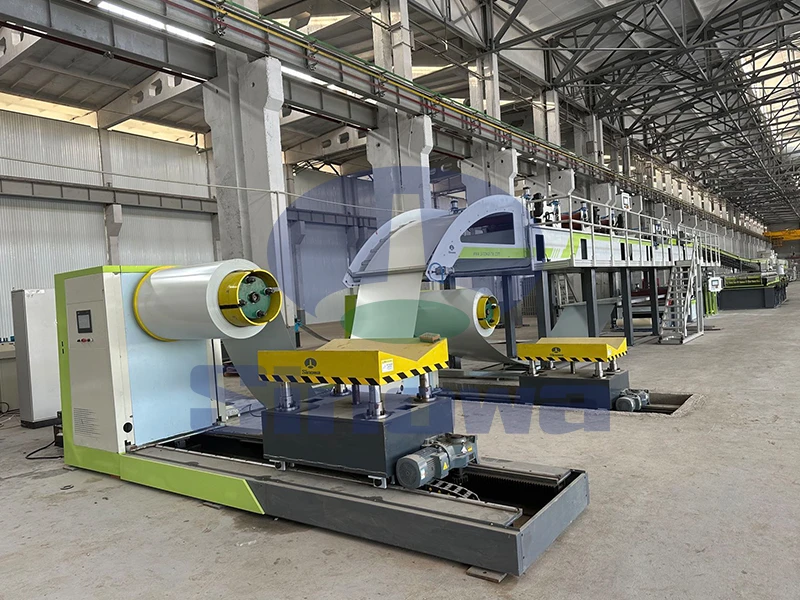
The first step of troubleshooting is to carry out a comprehensive visual inspection of the conveying system that transports PIR sandwich panels to the packing station. Many misalignment issues originate from abnormal running states of the conveyor rollers and belts. Operators need to observe whether individual rollers are stuck, worn unevenly or loose in installation, because inconsistent rotation speed of rollers will generate lateral thrust on the panel and push it away from the preset travel track. Belt deviation and aging also bring similar risks; cracked belt edges or uneven tension on both sides can make the panel slide sideways during movement. It is also necessary to check for accumulated debris, leftover foam fragments and adhesive residues on the roller surface, which change the friction coefficient between the panel and conveying parts. These tiny attachments often lead to inconsistent sliding resistance on the left and right sides of the panel. During inspection, the production line should be set to low-speed jog mode to avoid safety accidents, and temporary marks can be drawn on the side of the panel to record its offset direction and distance when passing through the conveying section, so as to judge whether the deviation occurs in this link. If abnormal rollers are found, they should be cleaned, adjusted or replaced in time, and the tension of the conveyor belt should be calibrated to keep the running speed of the whole conveying surface synchronized.
After confirming that the conveying system works normally, focus should be shifted to the mechanical positioning baffles and guide mechanisms near the packing station. These structures are responsible for limiting the horizontal position of PIR sandwich panels before packing, and slight deformation or clearance change will directly trigger misalignment. Long-term repeated collision with panels may bend the guide plates, loosen the fixed bolts or generate excessive gaps between the baffle and the panel edge. When the gap is too large, the panel can shake freely in the horizontal direction; when the baffle is distorted, it will squeeze the panel to one side forcibly. Operators need to check the straightness of each guide piece along the feeding direction, and test whether the baffle can reset smoothly after each positioning action. Some guide structures use spring reset components, and fatigue failure of springs will cause the baffle to fail to reach the standard positioning position. It is also important to check the parallelism between the left and right groups of guides. If the front and rear spacing of the two baffles is inconsistent, a funnel-shaped channel will be formed, and the panel will be forced to deviate while moving forward. Adjustment work should follow the principle of fine tuning, slightly tightening the fixing bolts and correcting the bent parts, then run single test panels repeatedly to observe whether the offset trend disappears, and avoid excessive adjustment that causes the panel to jam.
Sensor and signal detection faults are another major source of packing misalignment, as the automatic packing action relies entirely on position feedback signals to trigger corresponding actions. Photoelectric sensors and proximity switches are widely used to detect the arrival and edge position of PIR sandwich panels. Dust, foam powder and adhesive mist floating in the production environment are easy to cover the sensor lens or induction surface, weakening the signal intensity or causing signal delay. In this case, the control system cannot capture the panel position at the correct time, and the packing actuator starts to work in advance or lag behind, resulting in offset packaging. Operators should wipe the sensing surface gently with soft cleaning materials, and check whether the installation bracket of the sensor is loose. Vibration generated during long-term line operation may shift the sensor installation angle, changing its induction area. It is also necessary to verify the signal response stability through the control terminal, observe whether there are intermittent signal loss or false triggering records. If the sensor aging leads to unstable induction, replace it with a matching component and recalibrate the induction position. After calibration, multiple panels of different lengths and widths should be sent for testing, to ensure that the sensor can accurately identify the panel edge under normal production conditions.
The synchronization coordination between the packing actuator and the feeding system cannot be ignored in the troubleshooting process. The automatic packing unit includes film feeding rollers, pressing mechanisms and wrapping execution parts, all of which need to keep strict action synchronization with the panel feeding speed. When the synchronization parameter drifts, the packing film is fed faster or slower than the panel moving speed, pulling the panel sideways or making the film wrap at an inclined angle. The drive chain and timing belt connecting different execution parts may stretch after long-time operation, changing the transmission ratio and destroying the original synchronization relationship. Operators can check the tightness of the transmission parts and check whether there are slipping phenomena during operation. In addition, the internal parameters of the control program may be changed accidentally by misoperation, or the data stored in the controller drifts after power fluctuation. It is advisable to compare the current action timing parameters with the original stable setting values, adjust the delay time of packing triggering and the operating speed of each action axis, and carry out continuous trial run after modification. Do not adjust multiple parameters at the same time; only modify one parameter in each test, so that the influence of each adjustment on the alignment effect can be judged clearly.
The flatness and dimensional consistency of PIR sandwich panels themselves will also induce packing misalignment, which is easy to be ignored by on-site maintenance personnel. Panels with warped edges, uneven thickness or diagonal size errors will not fit closely with the guide and positioning mechanism during feeding. Even if all mechanical and electrical parts of the production line are in good condition, a warped panel will tilt when passing through the positioning station, and the packaging film will follow the inclined panel to form misalignment. In the inspection process, several panels that show obvious packing offset should be selected and placed on a flat reference platform to check their straightness and edge state. If the panel itself has forming defects from the previous foaming and cutting section, the problem cannot be solved only by adjusting the packing equipment. At this time, it is necessary to feed back the situation to the upstream forming and cutting process, check the working state of the cutting saw and shaping fixture, and control the forming precision of the panel. Operators can separate the defective panels in advance before they enter the packing section, so as to prevent continuous misalignment and avoid wasting packaging materials and polluting the packing station.
Abnormal tension control of the packaging film is a hidden factor leading to packing misalignment. When the tension of the film roll is unstable, the film will shrink or stretch unevenly during wrapping. Excessive tension will pull the edge of the PIR sandwich panel and drag the panel out of the correct position; insufficient tension will make the film loose and slide on the panel surface, and the wrapping position will shift randomly. The film tension is controlled by the brake assembly of the film unwinding shaft and the tension roller set. The friction disc of the unwinding brake may wear and cause unstable braking force, and the bearing of the unwinding shaft may be stuck, making the film release not smooth. Operators need to check whether the rotation of the film roll is smooth, adjust the damping force of the brake device gradually, and observe the tightness state of the film during wrapping. The tension roller should keep parallel to the panel edge; if the roller tilts, the film will bear uneven lateral force and run to one side. After adjustment, run the equipment with a new film roll, and track the alignment condition of the wrapping seam continuously until the tension remains stable in the whole unwinding process.
Vibration interference of the frame and base of the packing station will gradually destroy the positioning accuracy during long-term continuous production. The automatic packing unit is fixed on the base frame, and the anchor bolts may loosen under the continuous vibration generated by the whole production line. When the support frame shakes during operation, the relative position between the guide mechanism, sensor and packing execution head changes dynamically, and the alignment state which is calibrated at static state cannot be maintained in running state. Operators can check the fastening condition of all anchor bolts and connecting bolts on the packing frame, and tighten the loose bolts in sequence. It is also necessary to check whether the shock absorption pads under the base are aging and hardened. Failed shock absorption pads cannot buffer vibration, and the vibration amplitude of the frame will increase obviously. Replacing aging shock absorption parts can reduce high-frequency shaking. After fastening and shock absorption treatment, carry out continuous production test for a certain period of time, and record whether the misalignment phenomenon recurs after the equipment runs for a long time, to distinguish the deviation caused by static calibration error and dynamic vibration.
Daily maintenance loopholes are the root cause of repeated packing misalignment failures. Many alignment problems do not appear suddenly, but accumulate gradually due to insufficient routine inspection and lubrication. Sliding pairs, linear bearings and rotating shafts of the positioning and guiding mechanism lack lubricating oil, which increases movement resistance, makes the positioning action sluggish and incomplete. Wear will accelerate without lubrication, and the clearance of moving parts becomes larger and larger over time. Enterprises need to form a regular inspection checklist for the packing section, including cleaning of sensing elements, lubrication of moving pairs, fastening of connecting pieces and inspection of wearing parts. The inspection frequency should be matched with the daily running time of the production line. When replacing wearing parts, parts with consistent dimensional tolerance should be selected to avoid changing the original assembly clearance. Operators should record each misalignment fault, mark the offset direction, processing measures and improvement effect, so as to summarize the fault law. Through standardized preventive maintenance, the probability of sudden misalignment failure can be greatly reduced, and the automatic packing section can maintain long-term stable operation.
After finishing all troubleshooting and adjustment work, systematic verification and effect confirmation are essential to ensure that the misalignment problem is completely solved instead of being temporarily relieved. It is not enough to test only one or two panels. Operators should launch the production line to run continuously for a period of time under normal production speed, and alternately send panels of different specifications that are often produced on the line. During the verification, observe the wrapping position of each panel continuously, check the overlap position of the packaging film, and confirm that no offset, inclination and wrinkling appear. If individual panels still have slight deviation, fine-tune the corresponding mechanism according to the offset direction found in the verification process. After the alignment effect meets the production requirement, lock all adjusted bolts and save the modified control parameters. Meanwhile, inform all on-site operators of the fault cause and adjustment points, so that they can quickly identify similar signs in subsequent production, take early intervention measures, minimize the downtime caused by automatic packing misalignment, and improve the overall operating efficiency of the PIR sandwich panel production line.
Gallery
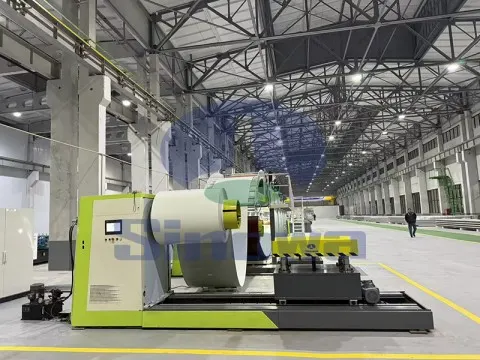
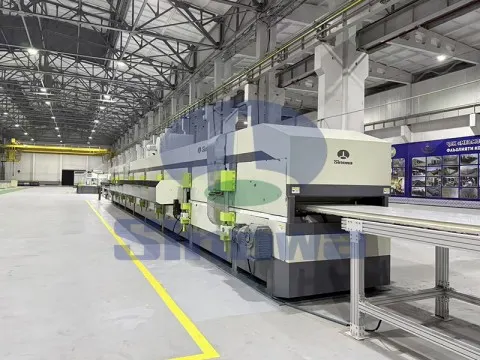
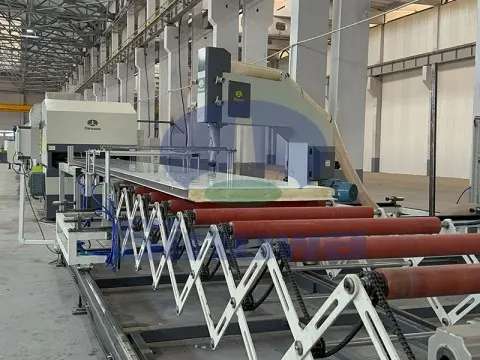
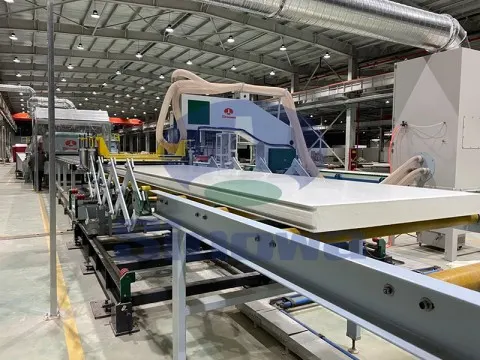
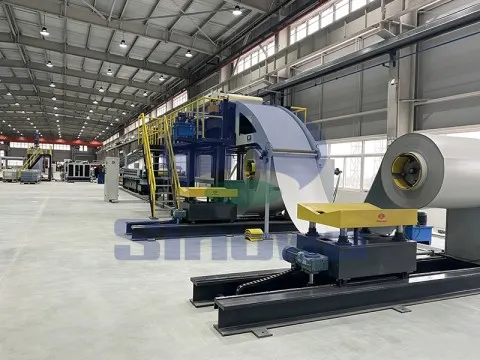
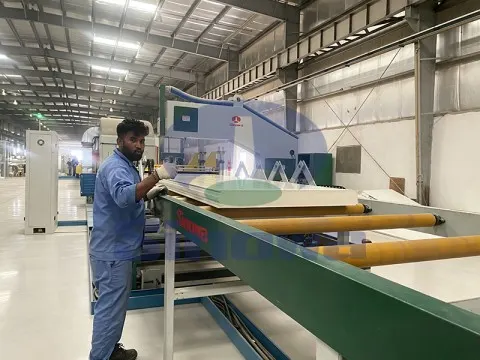
Sinowa is a professional manufacturer of sandwich panel machine in china, we provide diversified and high-performance sandwich panel production lines, including fully automatic continuous PU sandwich panel line and customized special lines to meet mass production and personalized order demands. These sandwich panel lines support processing multiple foam core materials, such as PU, PIR, mineral wool, rock wool and glass wool, covering different insulation and fireproof standards.
Featuring stable operation, high efficiency, energy saving and easy maintenance, our PU sandwich panel line deliver sandwich panels with excellent thermal insulation, fire resistance, sound insulation and lightweight durability. The finished panels are widely applied in industrial workshops, warehouse roofing and wall cladding, cold storage insulation, serving global construction and industrial insulation markets.
Main Products
-

Continuous PU Sandwich Panel Production Line
This continuous PU sandwich panel production line is an integrated automatic equipment. It covers uncoiling, forming, foaming, curing and cutting processes. With automatic raw material proportioning and precise temperature & pressure control, PIR sandwich panel production line continuously composites panels with double skins. Polyurethane sandwich panel production line stably produces steel and aluminum sandwich panels. Featuring high automation, the line makes fireproof and thermal-insulation panels for building enclosure and cold storage. -
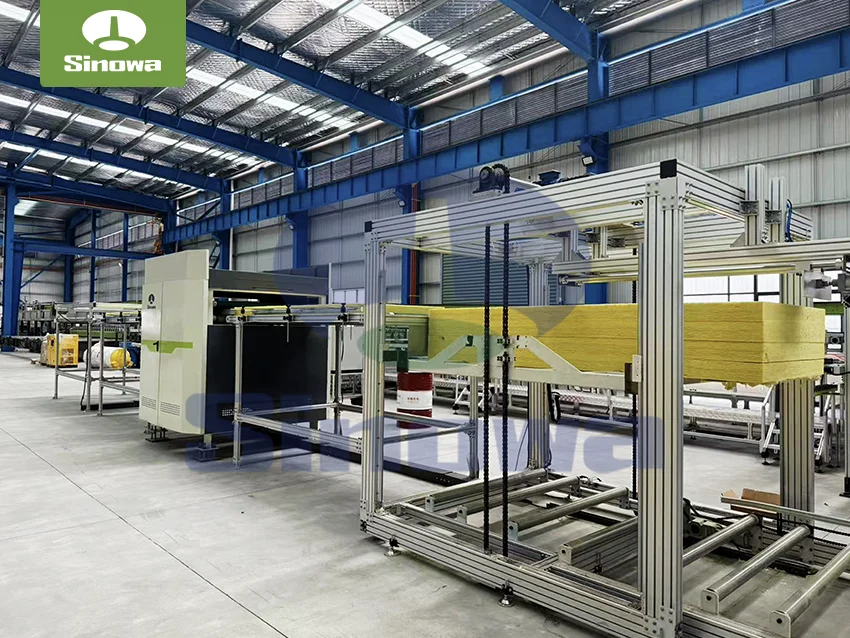
Rock Wool Sandwich Panel Production Line
Continuous rockwool sandwich panel production line is an automatic integrated production equipment, consisting of uncoiling, forming, gluing and compounding, heating curing, fixed-length cutting, automatic stacking and other modules. The mineral wool sandwich panel production line continuously conveys color steel plates and rock wool core materials to automatically complete lamination and curing, which can produce fireproof and thermal insulation sandwich panels. Featuring high automation degree and stable operation, this production line is suitable for mass production of panels used for building walls, roofs and other scenarios. -
Phenolic Insulation Board Production Line
This integrated automatic production line continuously manufactures PU and phenolic insulation boards. The insulation board production line covers raw material proportioning, high-pressure foaming, laminating, curing and fixed-length cutting. Featuring high automation and stable molding, the insulation panel production line supports various surface materials. PU boards offer excellent thermal insulation, while phenolic boards have superior fire resistance. These products are widely used in construction, cold chain, ventilation ducts and other thermal insulation fields.
Other FAQs
- Equipment Foundation Construction Standard For PU Sandwich Panel Line
- Anti-corrosion Treatment Standard For PU Sandwich Panel Equipment
- Difference Between Continuous And Discontinuous PU Sandwich Panel Production Lines
- Daily Maintenance Items Of Polyurethane Sandwich Panel Production Line
- What Temperature Range Is Suitable For Continuous PU Sandwich Panel Production Line Operation
- What Cooling System Is Required For A Continuous PU Sandwich Panel Line
- Can A Polyurethane Sandwich Panel Production Line Produce Pir Sandwich Panels
- What Are The Common Faults Of A Polyurethane Sandwich Panel Machine
- How To Optimize Cutting Sequence Of PIR Sandwich Panel Production Line Batch Panels
- How To Adjust The Feeding Speed Of Insulation Panel Production Line For Stable Output
Related Articles
- PUR Sandwich Panel Machine
- Composite Insulation Board Production Line
- Exterior Wall Insulation Board Production Line
- Foam PU Sandwich Panel Line
- High-tech PU Sandwich Panel Line Manufacturer
- PIR Sandwich Panel Production Line For Sale With Installation Service
- PIR Sandwich Panel Line For Roof and Wall
- PU Sandwich Panel Manufacturing Machine For Glass Wool Composite Panels
- Principle of Color Steel PU Sandwich Panel Machine
- PU Sandwich Panel Manufacturing Line For Fire-Resistant Wall