sandwich panel line
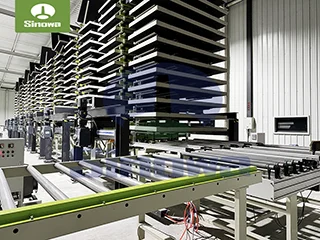
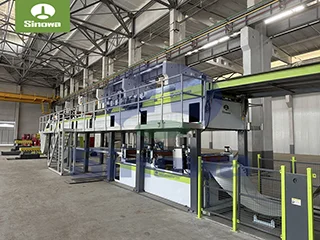
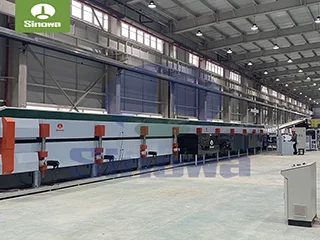
The core structural design of the adjustable-thickness PU sandwich panel line focuses on modularized adjustable mechanisms that realize precise and stable thickness modification without disrupting continuous production. The key adjustable components include upper and lower roller sets, spacing calibration systems, and synchronous lifting units installed in the lamination and molding sections of the production line. All adjustable modules are linked to an intelligent control system that supports real-time parameter input and automatic spacing adjustment, allowing operators to set target panel thickness through a simple operating interface. Unlike traditional production lines that rely on manual mechanical calibration with low accuracy and poor stability, this automated adjustment structure ensures uniform spacing across the entire production width, avoiding uneven panel thickness or surface warping caused by inconsistent local gaps. Each adjustable mechanical unit is equipped with precision positioning and locking devices, which firmly fix the adjusted structural spacing during high-speed continuous operation to prevent parameter deviation caused by mechanical vibration or material impact. The modular design also makes daily maintenance and parameter debugging more convenient, ensuring long-term stable operation of the thickness adjustment function while adapting to different production batch requirements.
The working principle of thickness adjustment is closely combined with the continuous PU foaming and composite molding process, forming a coordinated and efficient production logic. Polyurethane sandwich panels are composed of upper and lower surface protective materials and a closed-cell PU foam core layer, and the overall panel thickness is determined by the gap between the upper and lower composite rollers and the foaming expansion rate of the PU raw materials. The adjustable production line realizes linkage control between mechanical spacing and chemical foaming parameters. When adjusting to thinner panel specifications, the system automatically reduces the gap between the molding rollers and synchronously fine-tunes the raw material mixing ratio, feeding volume, and foaming pressure to ensure the PU foam forms a uniform and dense cellular structure within a narrow space. For thicker panel production, the equipment increases the roller spacing in real time and optimizes the foaming curing time and temperature parameters to guarantee full expansion and complete curing of the PU core without hollowing or uneven density. This synchronous adjustment of mechanical structure and process parameters ensures that panels of all thickness specifications maintain excellent structural integrity and consistent physical performance, avoiding product quality defects caused by mismatched process parameters.
The adjustable thickness function greatly expands the application adaptability of PU sandwich panels produced by the line, covering multiple downstream industry scenarios with differentiated thickness requirements. In architectural enclosure engineering, thin-specification panels are suitable for interior wall decoration and lightweight partition structures, providing basic thermal insulation and sound insulation effects while reducing building load. Medium-thickness panels are widely used for exterior wall insulation, roof enclosure, and factory building partition walls, balancing structural strength and energy-saving performance for conventional industrial and civil buildings. Thick adjustable panels are dedicated to special scenarios with high thermal insulation and load-bearing requirements, including cold storage insulation walls, constant-temperature workshop enclosures, and special environmental protection facilities. Beyond construction fields, the adjustable production line also meets the thickness demands of insulation panels for refrigeration equipment, mobile integrated buildings, and new energy equipment protection structures. The ability to switch thickness specifications freely on a single production line enables manufacturers to respond quickly to diverse market orders, avoiding the limitations of single-specification equipment and realizing one-stop production of multi-scenario PU sandwich panels.
Intelligent automatic control technology is the core support for the stable and accurate thickness adjustment of the production line. The entire equipment is equipped with a centralized intelligent control system that integrates parameter storage, one-key switching, real-time monitoring, and error correction functions. The system pre-stores optimal process parameters corresponding to different panel thicknesses, enabling operators to complete specification switching with one key without repeated debugging and parameter testing. During the production process, high-precision sensing devices installed at key positions of the production line continuously detect the running spacing of molding components, panel flatness, and core layer thickness data, and feed the information back to the control system in real time. Once minor thickness deviation is detected, the system automatically triggers fine calibration to keep product specifications within the preset tolerance range. In addition, the control system has a self-protection function for parameter adjustment, which automatically locks the production state and sends an early warning when abnormal spacing or parameter mismatch occurs, effectively preventing defective products and equipment failure risks. The intelligent control mode not only improves the accuracy and stability of thickness adjustment but also greatly reduces the technical requirements for operators.
Compared with traditional fixed-thickness PU sandwich panel production lines, the adjustable-thickness model has significant advantages in production efficiency and cost control. Traditional equipment needs to stop production, disassemble and replace molds, and manually calibrate mechanical spacing when switching panel thicknesses, which consumes a large amount of production preparation time and reduces effective production hours. The adjustable production line realizes non-stop dynamic switching of thickness specifications, completing parameter adjustment in a short time during continuous production, greatly improving the overall production efficiency of multi-batch and multi-specification orders. In terms of cost investment, a single adjustable production line can replace multiple fixed-specification production devices, effectively reducing equipment procurement costs and factory space occupancy. Meanwhile, the precise linkage adjustment of process parameters optimizes the usage of PU raw materials and surface materials, reducing material waste caused by parameter mismatch during specification switching. The unified production process and parameter standardization also lower the rate of defective products, reducing subsequent reprocessing and material loss costs, bringing more stable economic benefits to manufacturing enterprises.
The production line ensures excellent and consistent comprehensive performance of finished panels across all adjustable thickness ranges through optimized process matching and structural design. The closed-cell PU foam core produced by synchronous foaming and thickness adjustment has uniform cell structure and stable density, endowing the panels with low thermal conductivity, excellent thermal insulation, and energy-saving performance. Panels of different thicknesses maintain high structural bonding strength between the surface layer and the foam core, avoiding delamination, cracking, or core shedding in long-term use. Thin panels retain lightweight and flexible installation characteristics, suitable for narrow-space and decorative engineering scenarios, while thick panels have enhanced compressive strength and structural stability, adapting to complex environmental conditions and long-term load-bearing use. In terms of appearance quality, the precision adjustable roller structure ensures smooth and flat panel surfaces with uniform overall dimensions, meeting the fine processing requirements of high-end engineering projects. All finished products maintain stable corrosion resistance, sound insulation performance, and weather resistance, fully meeting the long-term use requirements of different application scenarios.
With the continuous upgrading of composite material manufacturing industry and the increasingly diversified market demand for insulation and enclosure panels, the adjustable-thickness PU sandwich panel production line has become an important development trend in the industry. Its flexible production mode breaks through the single-specification limitation of traditional production equipment, enabling manufacturing enterprises to cope with personalized and differentiated market orders more flexibly. The integration of intelligent adjustment technology and continuous production technology not only improves the automation and precision level of panel manufacturing but also promotes the standardized and refined development of the PU sandwich panel industry. In the future, with the further optimization of mechanical adjustment structure and intelligent control algorithms, the production line will realize wider thickness adjustment ranges, higher adjustment accuracy, and more efficient specification switching, further expanding its application scope in emerging fields such as green energy-saving buildings, intelligent mobile facilities, and special industrial insulation engineering, and providing more reliable technical and equipment support for the innovation and upgrading of composite insulation materials.
https://www.cnsinowa.com/sandwich-panel-machines/pu-sandwich-panel-line-with-adjustable-panel-thickness.html