Can A Continuous PU Sandwich Panel Line Produce Curved Sandwich Panels
Oct 26, 2026
Many manufacturers wonder whether a continuous PU sandwich panel production line can deliver curved panels instead of only flat finished products. This article explores the working limits of continuous lines, explains core technical barriers, introduces feasible modification approaches, and distinguishes production logic between continuous and batch processes for curved PU sandwich panels.
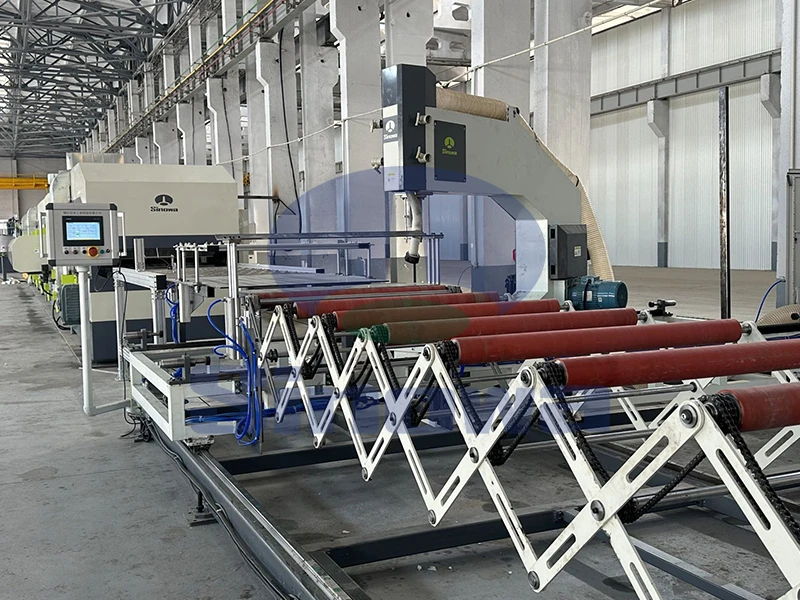
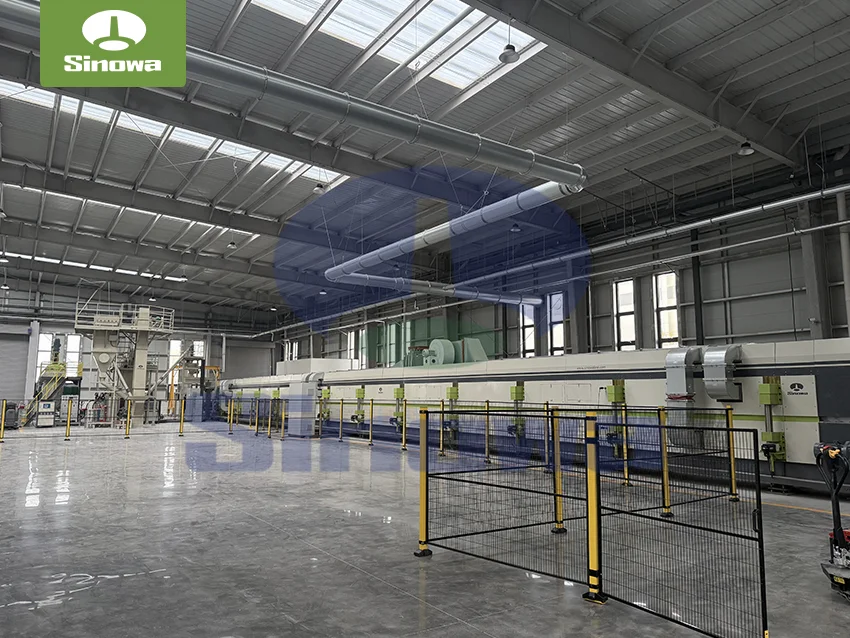
A standard continuous PU sandwich panel line is engineered around a linear, uninterrupted forming workflow. Raw facing materials, including metal sheets or composite facings, are unwound and fed forward at a fixed speed, while liquid PU foam components are metered, mixed and poured evenly between the two facings. The material stack then travels through a long double-belt conveyor system that maintains consistent pressure and fixed gap height to control panel thickness. Throughout this journey, the upper and lower belts keep the entire composite constrained in a flat plane until the PU foam completes curing. Every structural component of the line, from guiding rollers to the continuous curing tunnel, is aligned to hold straight geometry. Once the foam starts its exothermic curing reaction inside the confined space, internal foam expansion and bonding forces lock the facings and foam core together rapidly. Any attempt to bend the material composite while it moves through the continuous belt section will disrupt uniform pressure distribution, break the stable foam cell structure, and create uneven bonding between the core and facings. This inherent linear design makes the standard continuous setup naturally suited for flat panels, and it cannot directly produce curved profiles without targeted adjustments to multiple core stations.
The key challenge lies in the timing of PU foam curing and shaping. PU foam used for sandwich panels has a narrow reactive window after mixing. In continuous production, the foam must fill the cavity between facings, rise steadily and harden while held under controlled pressure. If shaping takes place too early, before the foam develops sufficient green strength, the soft foam core will collapse or deform unevenly under its own weight and the tension of the outer facings. Localized thin spots, voids and delamination will appear on the finished curved surface. If shaping is delayed until the foam is nearly fully cured, the rigid composite will resist bending, and the facings may crack or separate from the foam core. Unlike thermoplastic materials that can be reheated and reshaped easily, cured PU foam has limited flexibility. The continuous line moves material at a steady, preset pace, so operators have very little room to pause the production flow to adjust shaping timing. Matching the bending operation precisely to the foam’s strength development curve becomes extremely difficult on a non-modified continuous line, which is why most standard lines avoid curved forming entirely.
Some industry practitioners consider adding bending rollers at the outlet section of a continuous line to create curved panels after the panel exits the curing tunnel. This post-cure bending method seems simple at first glance, yet it carries obvious quality risks. After full curing, the PU core and facings form a rigid composite structure. Applying mechanical bending force creates tensile stress on the outer arc side and compressive stress on the inner arc side of the panel. The brittle foam core tends to develop invisible microcracks under compression, which weaken thermal insulation performance and reduce the panel’s impact resistance over time. Metal facings may also experience permanent stress concentration at the bending zone, increasing the chance of corrosion initiation at these locations. The bonding interface between foam and facings is vulnerable to shear stress generated during forced bending, and hidden delamination can expand gradually once the panel is installed and exposed to temperature cycles. Even if the panel holds its curved shape temporarily after bending, long-term dimensional stability cannot be guaranteed. This post-cure approach is therefore only acceptable for very gentle radii and non-critical applications, and it is not a reliable general solution for high-quality curved PU sandwich panels.
Modification of the continuous line to integrate in-line forming is a more technically sophisticated route for curved panel production. This solution requires replacing part of the fixed flat double-belt section with adjustable forming modules that can generate a consistent curved profile while the PU foam is still in the semi-cured state. The guiding rollers and supporting jigs must be customized to match the target bending radius, and their positions need synchronized adjustment with the line running speed. The foam pouring distribution also needs re-calibration, because foam flow behavior changes in a curved cavity; more material may accumulate on the inner arc if the pouring pattern remains the same as for flat panels. Operators must fine-tune the chemical formula of the PU system to extend the cream time and adjust the rate of strength build-up, so the composite can hold the curved shape once it leaves the forming section. Line speed control becomes far more sensitive, as minor fluctuations alter how long the material stays within the curved forming zone. These modifications raise the complexity of equipment operation and narrow the production flexibility, since a set of forming tools usually corresponds to one specific bending radius. Switching between different curve specifications takes considerable setup time and material for trial runs.
Compared with modified continuous lines, discontinuous batch pressing equipment is widely regarded as a more mature choice for curved PU sandwich panels. In batch processes, facings are pre-shaped to the required curved contour and placed inside matched curved moulds. PU foam is injected into the closed mould cavity, and the system stays static while the foam expands and cures fully within the pre-defined curved boundary. Since shaping happens before foam injection and curing takes place in a stationary mould, there is no conflict between linear conveying movement and curved geometry. The mould can maintain uniform pressure across the whole curved surface, producing consistent foam density and reliable adhesion. Batch moulds can achieve tight bending radii and complex curved shapes that continuous lines struggle to replicate. However, batch production has clear drawbacks: cycle times are much longer, labour input for loading and unloading moulds is higher, and overall output volume cannot compete with the high throughput of a continuous line running flat panels. Manufacturers often select batch lines when they have small-batch orders with diverse curved profiles, while continuous lines focus on large-volume flat panel orders.
Hybrid workflows have emerged as a practical compromise for factories that own continuous PU sandwich panel lines and occasionally need curved products. In this arrangement, the continuous line runs normally to produce flat PU sandwich panels that meet base quality requirements, and these flat panels are sent to a separate, offline shaping workshop. The offline station uses controlled heating together with matched curved dies to soften the composite moderately before applying forming pressure. Heating parameters must be strictly controlled to avoid thermal degradation of the PU foam and coating damage on the facings. This hybrid method avoids major reconstruction of the continuous production line, protecting the high efficiency of its main flat panel production. It also allows the factory to handle sporadic curved panel orders without investing in a full set of batch moulding equipment. Even so, the hybrid workflow still has limitations. The achievable bending radius remains restricted, and product inspection needs extra steps to check for internal core cracking and interface separation. Waste rates tend to be higher than those seen in dedicated curved batch moulding, so this method works best for low-demand curved projects rather than mass curved panel manufacturing.
Many factors determine whether a modified continuous line can successfully make acceptable curved panels, and bending radius stands out as the most decisive parameter. Panels with a very large radius, where the curvature is subtle, are far easier to produce than sharply curved ones. When the radius is large, the difference in length between the outer and inner facing arcs is minimal, stress on the foam core and bonding layers stays low, and in-line forming modules can shape the material smoothly while the foam gains strength. As the target radius reduces and the curve becomes tighter, stress gradients inside the panel rise rapidly. The foam core struggles to accommodate the geometric difference between the two facings, and defects such as core crushing, facings wrinkling and open delamination become much more common. Panel thickness also interacts with bending performance. Thicker PU sandwich panels have a larger distance between the two facings, amplifying the length difference between the inner and outer arcs during bending. Thin panels can tolerate tighter curves under the same process setup, while thick panels usually demand larger minimum radii and more conservative process settings.
Material selection for facings and PU foam formulation also sets boundaries for curved panel production on a continuous line. Different facing materials respond differently to in-line forming. More ductile facings can stretch and conform to curved contours without cracking, while brittle facings will develop surface fractures under even mild forming force. The PU foam system needs customized reactivity and elastic properties. Foam with higher green strength at an earlier stage can hold curved shape better after forming, but it must not cure too fast before the shaping action completes. Formulators may adjust catalyst levels and foam crosslink density to balance shape retention and ductility. Too rigid a foam mix fractures during forming, while overly soft foam cannot maintain dimensional stability after leaving the forming station. Surface coating on facings is another consideration; some coating layers lose adhesion or develop crazing when subjected to bending strain, requiring compatible coating systems suitable for curved forming. All these material adjustments add development work and testing before stable curved production can begin on a modified continuous line.
In summary, a standard continuous PU sandwich panel line cannot directly produce curved sandwich panels due to its linear forming mechanism and the fixed curing environment for PU foam. Curved panels are achievable only after substantial equipment modification, precise PU formulation tuning and strict control over forming timing, and such modified lines are limited to relatively gentle curvatures. Post-cure bending and hybrid offline shaping methods offer simpler alternatives but come with notable quality trade-offs. For high-quality curved panels with tight radii, batch moulding processes remain the preferred option. Factories should evaluate order volume, required bending radius, acceptable defect tolerance and production flexibility before deciding whether to modify an existing continuous line, adopt a hybrid workflow or add separate batch moulding capacity for curved PU sandwich panel supply.
Gallery
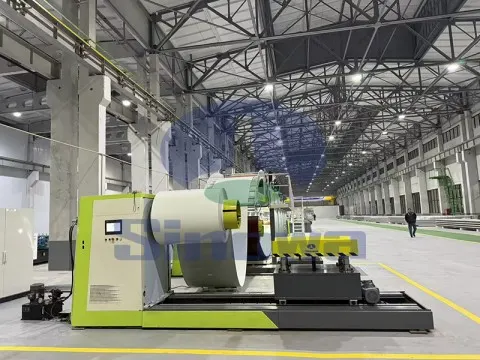
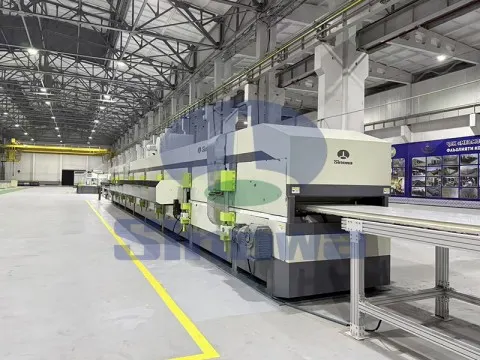
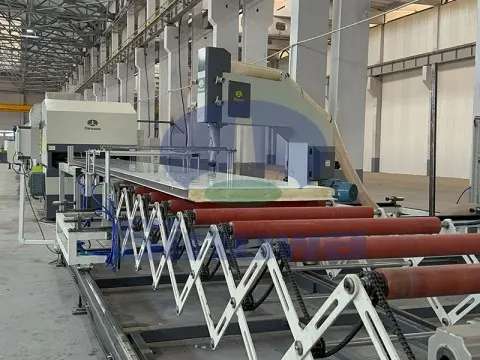
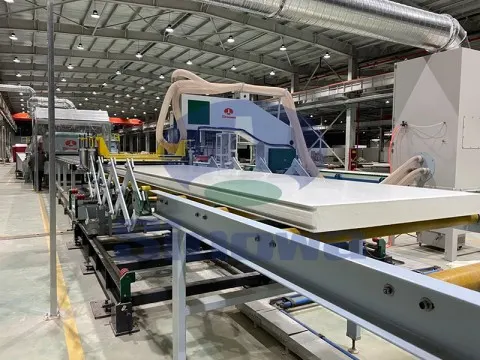
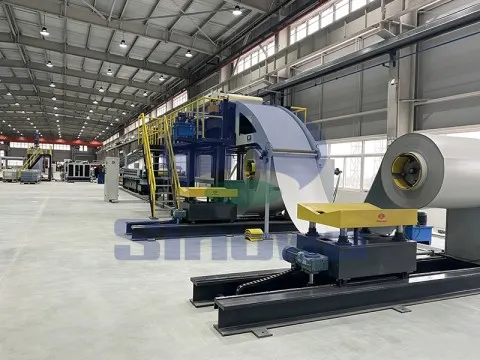
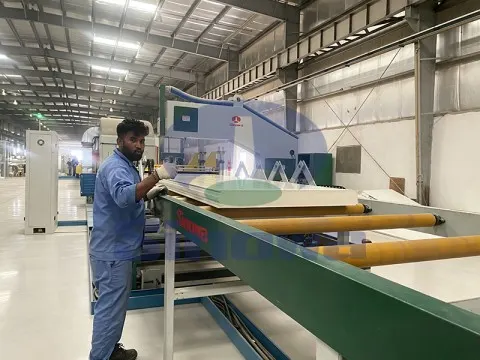
Sinowa is a professional manufacturer of sandwich panel machine in china, we provide diversified and high-performance sandwich panel production lines, including fully automatic continuous PU sandwich panel line and customized special lines to meet mass production and personalized order demands. These sandwich panel lines support processing multiple foam core materials, such as PU, PIR, mineral wool, rock wool and glass wool, covering different insulation and fireproof standards.
Featuring stable operation, high efficiency, energy saving and easy maintenance, our PU sandwich panel line deliver sandwich panels with excellent thermal insulation, fire resistance, sound insulation and lightweight durability. The finished panels are widely applied in industrial workshops, warehouse roofing and wall cladding, cold storage insulation, serving global construction and industrial insulation markets.
Main Products
-

Continuous PU Sandwich Panel Production Line
This continuous PU sandwich panel production line is an integrated automatic equipment. It covers uncoiling, forming, foaming, curing and cutting processes. With automatic raw material proportioning and precise temperature & pressure control, PIR sandwich panel production line continuously composites panels with double skins. Polyurethane sandwich panel production line stably produces steel and aluminum sandwich panels. Featuring high automation, the line makes fireproof and thermal-insulation panels for building enclosure and cold storage. -
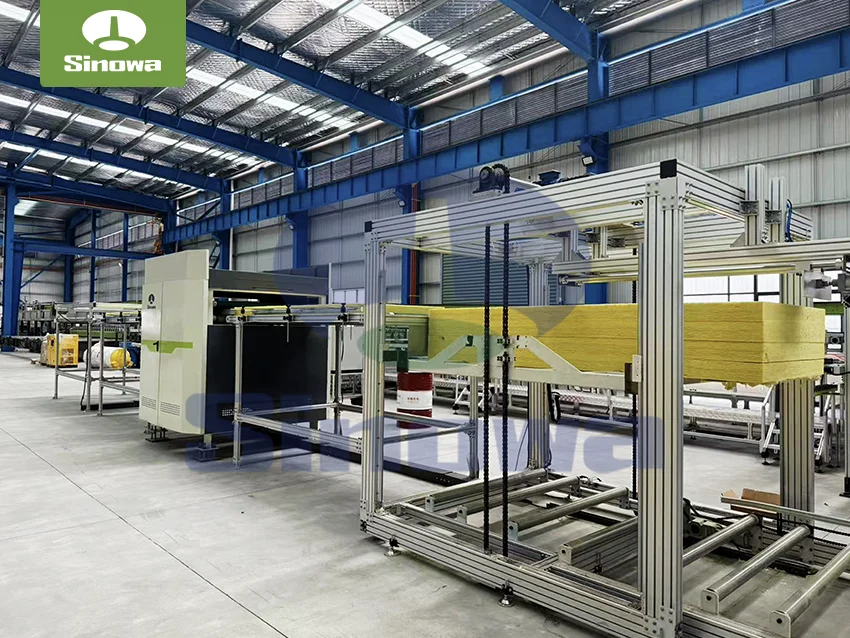
Rock Wool Sandwich Panel Production Line
Continuous rockwool sandwich panel production line is an automatic integrated production equipment, consisting of uncoiling, forming, gluing and compounding, heating curing, fixed-length cutting, automatic stacking and other modules. The mineral wool sandwich panel production line continuously conveys color steel plates and rock wool core materials to automatically complete lamination and curing, which can produce fireproof and thermal insulation sandwich panels. Featuring high automation degree and stable operation, this production line is suitable for mass production of panels used for building walls, roofs and other scenarios. -
Phenolic Insulation Board Production Line
This integrated automatic production line continuously manufactures PU and phenolic insulation boards. The insulation board production line covers raw material proportioning, high-pressure foaming, laminating, curing and fixed-length cutting. Featuring high automation and stable molding, the insulation panel production line supports various surface materials. PU boards offer excellent thermal insulation, while phenolic boards have superior fire resistance. These products are widely used in construction, cold chain, ventilation ducts and other thermal insulation fields.
Other FAQs
- Polyurethane Sandwich Panel Production Line Cleaning Cycle And Operation Standard
- Wearing Parts Replacement Cycle Of PU Sandwich Panel Production Line Equipment
- Sandwich Panel Production Line Upgrade And Expansion Feasible Solutions
- Standard Panel Thickness Range Of PU Sandwich Panel Line
- How To Maintain The Continuous Running PUR Sandwich Panel Production Line
- What Thickness Range Can A Polyurethane Sandwich Panel Production Line Manufacture
- What Power Supply Requirements Does A Continuous PU Sandwich Panel Line Have
- Why Does The Continuous PU Sandwich Panel Line Have Unstable Production Speed
- How To Choose A Reliable PU Sandwich Panel Machine Manufacturer
- How To Solve Foaming Instability Issues In Insulation Panel Production Line
Related Articles
- Insulation Panel Manufacturing Line
- Automatic Foam Core Sandwich Panel Line
- Automatic Insulation Board Production Line
- Fireproof PU Sandwich Panel Line
- Polyurethane Sandwich Panel Manufacturing Line For Commercial Building
- High Efficiency PU Sandwich Panel Line On Sales
- PU Sandwich Panel Manufacturing Machine For Low Density Composite Panels
- Roof Foam Insulation Board Production Line
- PU Sandwich Panel Production Plant For Decoration Industry
- PU Sandwich Panel Equipment For Insulation Board Production