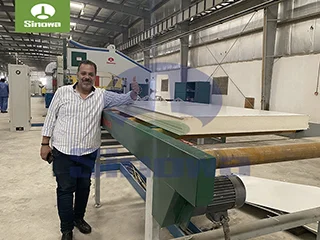
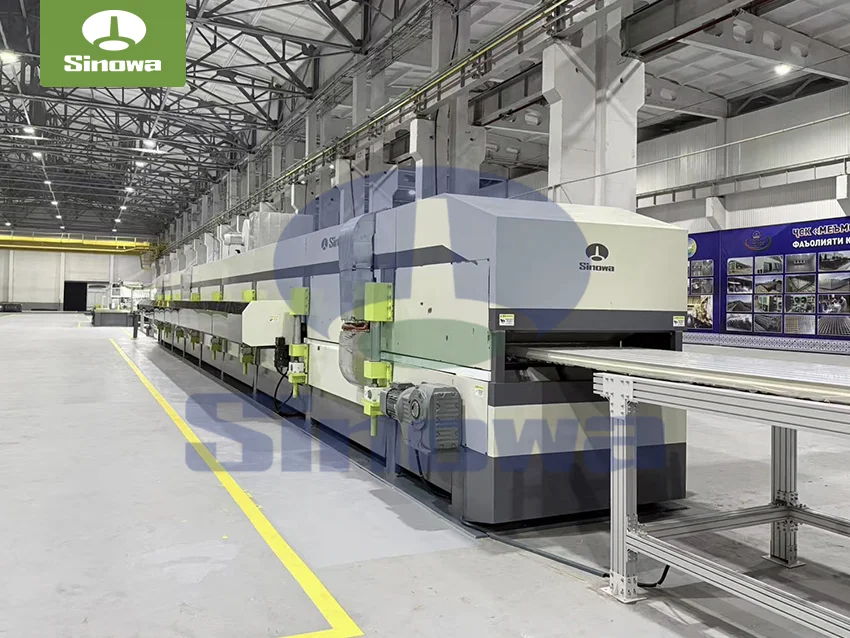
 sandwich panel line
The core operational logic of the rigid PU foam production line centers on the controllable chemical reaction between polyols and isocyanates, supplemented by catalysts, blowing agents, and additives to trigger stable foaming and curing processes. The entire production workflow starts with raw material pretreatment and conveying, where multi-component chemical materials are stored in independent sealed tanks to avoid cross-contamination and ensure material purity. The production line is equipped with precision metering units that accurately control the proportion of each raw material, a key step to guarantee consistent foam cell structure and physical performance. Different from traditional manual batching processes, the automated metering system maintains stable material ratios in long-term continuous operation, effectively avoiding performance fluctuations caused by human errors. After precise batching, materials are transported to a high-speed mixing unit, where uniform blending of all components is completed in a short time to form a homogeneous liquid reaction mixture. This well-mixed material lays a solid foundation for subsequent uniform foaming, eliminating defects such as uneven cell size, hollow structures, and inconsistent hardness that often occur in irregular production processes, ensuring the basic quality consistency of finished rigid PU foam products.
Material pretreatment and feeding management constitute the fundamental supporting module of the rigid PU foam production line, directly affecting the smooth progress of subsequent foaming reactions and final product quality. All raw material storage areas adopt constant-temperature and sealed protection designs to prevent chemical material deterioration, volatilization, and moisture absorption that may affect reaction activity. The production line supports the synchronous conveying of multiple raw material components, with independent pipeline systems and pressure regulation devices for each material to ensure stable and continuous material supply during high-speed production. The feeding system is equipped with intelligent monitoring modules to track material flow, pressure, and temperature in real time, automatically adjusting conveying parameters according to production speed and product specifications. When material supply is abnormal or pipeline blockage occurs, the system will trigger early warning and automatic protection mechanisms to suspend production and avoid defective products and equipment damage. In addition, the feeding system is designed with modular disassembly structures, facilitating daily cleaning, pipeline maintenance, and material replacement. This systematic material management mode ensures the stability of raw material states throughout the production process, providing reliable preconditions for high-precision and high-stability foam production.
The mixing and foaming unit is the core functional section that determines the structural characteristics of rigid PU foam, undertaking the key transformation from liquid chemical materials to preliminary foam structures. After accurate batching and stable feeding, multi-component materials enter the high-efficiency dynamic mixing device, which uses high-speed stirring to fully fuse polyols, isocyanates, catalysts, and auxiliary agents without dead angles. The mixing speed and time can be intelligently adjusted according to different product formulas, ensuring that the chemical reaction activity of each component is fully activated. Once mixing is completed, the homogeneous liquid mixture is evenly poured or injected onto the production carrier through a precise dispensing system. Under the action of temperature and catalysts, the mixture immediately initiates foaming reaction, producing fine and uniform gas bubbles and gradually expanding to form a closed-cell structure unique to rigid PU foam. The production line is equipped with adjustable foaming space and limit guiding structures to control the foaming range and expansion rate, preventing excessive expansion or insufficient foaming. This controllable foaming process enables the foam to form a dense and uniform preliminary structure, laying a key foundation for subsequent curing and shaping, and endowing the product with excellent thermal insulation and compression resistance.
Constant-temperature curing and shaping process is a critical link to finalize the physical properties and dimensional stability of rigid PU foam products. After preliminary foaming, the semi-finished foam products enter the segmented constant-temperature curing channel of the production line, which adopts zoned temperature control technology to set different temperature parameters for pre-curing, medium curing, and final curing stages. This staged temperature regulation mode enables the internal chemical cross-linking reaction of the foam to proceed fully and stably, avoiding internal stress concentration caused by rapid or uneven curing. During the curing process, the production line uses stable pressure holding structures to limit the external deformation of the foam, ensuring that the product maintains preset thickness, flatness, and overall dimensions. With the gradual completion of the cross-linking reaction, the foam cell structure is fully fixed, and the product gradually forms rigid mechanical properties with high hardness and strong structural stability. The whole curing process is automatically controlled by the system with real-time temperature and pressure feedback adjustment, which effectively improves the curing uniformity of large-area foam products. After full curing, the foam completely loses fluidity and forms a stable solid structure, completing the core molding process of rigid PU foam.
Laminating and composite forming functions enable the rigid PU foam production line to manufacture high-performance composite foam panels suitable for diversified industrial scenarios. For composite products requiring surface substrate fitting, the production line is matched with automatic substrate unwinding and pretreatment devices, which can adapt to various coil and plate surface materials. Before composite lamination, the system can complete surface cleaning and auxiliary adhesion treatment on the substrate to enhance the bonding tightness between the substrate and the foam core layer. The foamed and initially cured foam core layer is synchronously compounded with upper and lower substrates through a continuous laminating unit, which applies uniform and adjustable pressure to fit the foam and substrates closely without gaps or dislocation. The integrated lamination and secondary curing structure of the production line realizes synchronous bonding and solidification, making the composite structure integrated and stable. This composite processing technology effectively improves the overall structural strength, surface flatness, and wear resistance of foam products, expanding the application scope of rigid PU foam from single foam materials to integrated composite panels. The modular lamination design also supports flexible switching of composite specifications to meet customized production needs of different thicknesses and structural combinations.
Post-processing and intelligent quality control systems ensure the finished product qualification rate and production standardization of the rigid PU foam production line. After curing and composite forming, the foam products enter the automatic trimming and finishing unit, which precisely cuts off excess edge materials and irregular parts through high-precision cutting equipment to ensure consistent product dimensions and neat edges. The production line is equipped with online real-time detection modules, which continuously monitor key indicators such as foam density, cell uniformity, product thickness, and surface flatness during operation. The intelligent system automatically records production data and quality detection information, realizes real-time judgment of qualified and unqualified products, and sorts products automatically. For individual defective products caused by occasional parameter fluctuations, the system will mark and screen them independently to prevent unqualified products from entering the finished product link. In addition, the post-processing system includes finished product conveying and stacking functions, realizing automated finished product collection and arrangement. The whole post-processing process is highly automated, reducing manual intervention errors, improving production efficiency, and ensuring the long-term stable output of high-quality rigid PU foam products.
The overall equipment performance and application flexibility of the rigid PU foam production line make it a versatile and efficient manufacturing solution for modern foam industry. The production line adopts a modular integrated structural design, which is convenient for equipment installation, debugging, and later maintenance and upgrading, and can adapt to different factory layout spaces and production scale requirements. Its intelligent control system realizes one-click parameter setting and automatic operation of the whole process, with stable operating performance and low failure rate, which greatly reduces manual operation intensity and production management costs. In terms of production flexibility, the equipment can quickly adjust production formulas and process parameters to produce rigid PU foam products with different densities, hardness, and thermal insulation properties, covering the production needs of insulation panels, structural filling foam, special-shaped foam components, and composite board products. With stable production performance, high product consistency, and strong scenario adaptability, the rigid PU foam production line effectively meets the diversified and high-standard production demands of construction insulation, industrial equipment thermal protection, and composite material manufacturing industries, and has become an indispensable core equipment in the field of polyurethane foam manufacturing.
https://www.cnsinowa.com/sandwich-panel-machines/rigid-pu-foam-production-line.html