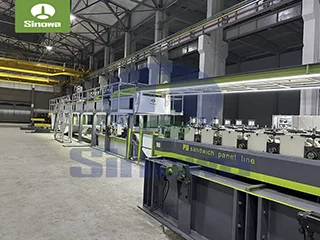
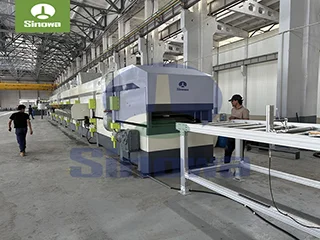
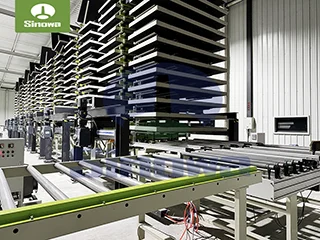
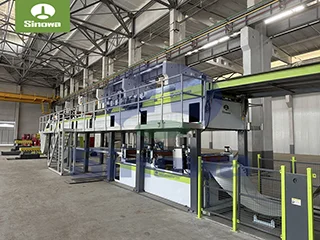
sandwich panel line
The fundamental operational logic of a continuous PU sandwich panel line underpins its unique industrial value and market competitiveness, distinguishing it radically from conventional batch-type production equipment. The entire production process follows a fully continuous synchronous operation mechanism, where upper and lower surface substrates are continuously unwound, leveled, and preprocessed at a constant conveying speed. Meanwhile, polyurethane raw materials undergo precise proportional metering, high-speed stirring, and uniform spraying through professional foaming systems, achieving in-situ foaming and composite bonding between double-layer substrates. Equipped with a matched circulating belt conveying system and sealed constant-temperature curing channel, the line ensures that PU foam completes uniform expansion, cross-linking curing, and structural shaping in a stable temperature environment, effectively avoiding uneven density, local hollowing, and inconsistent thickness common in intermittent production. Every functional module operates in precise linkage without frequent start-stop adjustments or manual intervention gaps, realizing uninterrupted long-cycle production. This streamlined operational mode not only greatly improves hourly output and overall production efficiency but also maintains consistent product structural performance and surface finish for each batch, laying a solid foundation for large-scale standardized industrial production.
Automation and intelligent control configuration serve as core determinants of the comprehensive performance and market value of continuous PU sandwich panel lines. Modern advanced production lines adopt integrated electrical and programmable control systems, realizing full-process automatic regulation from raw material feeding ratio, conveying speed, foaming volume, and curing temperature to fixed-length cutting and finished product stacking. The core control system supports real-time parameter monitoring and dynamic adjustment, automatically correcting subtle deviations in material proportioning and operating speed during continuous production to ensure stable product quality. In addition, intelligent fault detection modules are embedded in key operating parts, which can identify abnormal vibration, temperature fluctuation, and material blockage in real time, triggering early warning prompts and automatic protection mechanisms to reduce equipment failure downtime. Compared with semi-automatic models that rely heavily on manual parameter adjustment and operation supervision, highly automated lines effectively reduce on-site labor demand, lower human error rates in production, and optimize overall operational efficiency. The upgrading of intelligent configuration not only enhances production stability and continuity but also extends the equipment’s service life and reduces later maintenance costs, bringing more stable long-term economic benefits for production enterprises.
Production capacity and operational efficiency are key practical indicators that affect the equipment’s market application value and investment attraction of continuous PU sandwich panel lines. The continuous linear production structure completely breaks the efficiency bottleneck of traditional segmented production, eliminating idle waiting time between different production processes and frequent equipment start-stop loss. High-performance models can maintain long-term stable high-speed operation, realizing continuous molding of sandwich panels with different thicknesses and specifications, with far higher unit time output than intermittent production equipment. This efficient production mode enables manufacturers to quickly respond to large-scale order demands and shorten product delivery cycles, greatly improving market response capability and order carrying capacity. Meanwhile, the synchronous matching of all production links effectively reduces material waste in the production process, including residual PU raw materials, substrate trimming waste, and defective product rates caused by unstable molding. Lower material consumption and higher finished product yield significantly reduce the unit production cost of sandwich panels. For industrial manufacturers pursuing scale benefits, the high-efficiency operational characteristics of continuous PU sandwich panel lines can quickly amplify production advantages and improve overall market profitability.
Structural design and manufacturing craftsmanship directly determine the stability, durability, and application adaptability of continuous PU sandwich panel lines, further influencing their core market value. High-quality production lines adopt thickened and reinforced integral frame structures, with key load-bearing and operating parts processed through precision casting and fine machining to ensure structural rigidity and operational stability during long-term high-frequency operation. The double-belt circulating conveying system is equipped with anti-deformation and anti-wear configurations, which can maintain stable flatness and conveying accuracy during long-distance continuous operation, avoiding panel warping and thickness deviation caused by belt deformation. The foaming and laminating area adopts an optimized sealed structural design, which ensures the uniformity of the internal curing temperature field, prevents heat loss, and improves foaming and curing quality. In addition, the equipment’s modular structural design realizes independent and coordinated operation of each functional unit, facilitating daily inspection, maintenance, and later functional upgrading and transformation. Exquisite manufacturing craftsmanship and scientific structural design reduce equipment vibration and operational noise, lower failure rates and maintenance frequency, and enable the equipment to adapt to long-term uninterrupted industrial production scenarios, effectively improving the long-term use value of the equipment.
Functional scalability and product adaptability are important factors that enrich the market connotation and application scope of continuous PU sandwich panel lines. Excellent production line equipment has strong flexible production capabilities, which can complete the production of sandwich panels with different thicknesses, widths, and surface material types by adjusting operating parameters and replacing simple auxiliary parts. It can adapt to diverse substrate materials including color steel plates, aluminum alloy plates, and other composite decorative materials, meeting the production needs of insulation panels, fireproof panels, and clean panels for different scenarios. Meanwhile, the equipment reserves multi-dimensional functional expansion interfaces, which can be matched with automatic film covering, edge sealing, embossing, and intelligent packaging auxiliary systems according to production demands, realizing the integration of more production processes and further improving product added value. This flexible and scalable design enables the equipment to adapt to the continuously updated market product demands and industrial upgrading trends, avoiding equipment elimination caused by single production functions. For enterprises with diversified product layout plans, the strong adaptability and scalability of continuous production lines greatly improve equipment utilization and investment return cycle stability.
Operational cost and later maintenance attributes are crucial reference dimensions for evaluating the comprehensive cost-performance of continuous PU sandwich panel lines. In terms of daily operation, high-efficiency continuous production lines adopt energy-saving optimized designs in power transmission, temperature control, and power consumption links, effectively reducing unit energy consumption in the production process compared with traditional equipment. The precise raw material proportioning and foaming control system avoids excessive raw material consumption, realizing efficient utilization of PU materials and surface substrates. In terms of maintenance, the modular structural design simplifies the disassembly, inspection, and replacement of vulnerable parts, reducing the time and labor cost of daily maintenance. Key components are made of high-wear-resistant and corrosion-resistant materials, with longer service cycles and lower replacement frequency of accessories. In addition, the intelligent monitoring system can accurately locate equipment faults, avoiding blind maintenance and reducing unnecessary maintenance costs. The low comprehensive operational and maintenance costs enable the equipment to maintain stable profit margins for manufacturers in long-term operation, highlighting excellent cost-performance advantages in the mid-to-long term market competition.
Market demand trend and industrial iteration further shape the long-term market value and development potential of continuous PU sandwich panel lines. With the continuous development of energy-saving building construction, cold chain logistics industry, and industrial standardized plant construction, the market demand for high-performance, high-consistency, and low-energy-consumption PU sandwich panels continues to grow steadily, driving the continuous upgrading of supporting production equipment. Modern manufacturing industries have increasingly higher requirements for product standardization and production efficiency, gradually eliminating backward intermittent production equipment, and high-automatic continuous production lines have become the mainstream market choice. Meanwhile, the continuous progress of composite material technology promotes the functional upgrading of sandwich panels, and continuous production lines with strong adaptability and scalable functions can keep pace with product iteration. As the industry’s threshold for standardized production continues to rise, high-quality continuous PU sandwich panel lines with stable performance, intelligent configuration, and low operating costs will occupy a more dominant market position, bringing sustainable investment value and market competitiveness for manufacturing enterprises.
https://www.cnsinowa.com/sandwich-panel-machines/continuous-pu-sandwich-panel-line-price.html