sandwich panel line
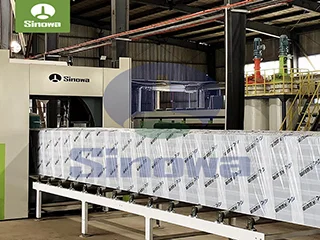
The overall structural layout of the continuous PU flat sandwich panel line follows a scientific linear production logic, with all functional modules closely interconnected to form a seamless closed-loop production system. The front-end unit focuses on continuous substrate unwinding and leveling, where flat coil materials are steadily released and processed to eliminate surface wrinkles and structural deformation, providing flat and tidy base materials for subsequent composite processing. This unit is equipped with automatic tension adjustment mechanisms to keep the upper and lower surface materials in a stable flat state during high-speed transmission, avoiding uneven stress that may cause panel warping. Following the substrate pretreatment section is the core raw material metering and mixing module, which adopts high-precision hydraulic metering devices to proportion PU polyether and isocyanate raw materials accurately. The fully enclosed mixing structure ensures uniform blending of chemical components, avoiding material stratification or incomplete reaction that affects foaming quality. Every structural part of the line is optimized for flat panel production, with parallel transmission tracks and horizontal pressing structures laying a solid foundation for the flatness and dimensional stability of finished panels in mass continuous production.
Precise PU foaming and uniform material pouring technology constitute the core competitiveness of the flat sandwich panel production line, directly determining the internal structural quality and thermal insulation performance of finished panels. After accurate proportioning and high-speed mixing, the liquid PU composite material is evenly poured onto the flattened lower substrate through a multi-point uniform pouring system. Different from traditional intermittent pouring equipment, the continuous line realizes dynamic synchronous pouring matching with substrate transmission speed, ensuring consistent pouring thickness and uniform material distribution across the entire flat substrate surface. In the low-temperature preliminary foaming stage, the liquid PU material undergoes mild physical expansion and initial chemical cross-linking, filling the reserved space between upper and lower substrates without generating local bulges or hollow areas. The system automatically adjusts pouring volume and foaming speed according to preset panel thickness parameters, realizing adaptive control for different product specifications. This refined foaming and pouring process effectively avoids common defects such as uneven core density, partial voids and inconsistent thickness, ensuring that each flat panel has a dense, uniform and stable foam core structure.
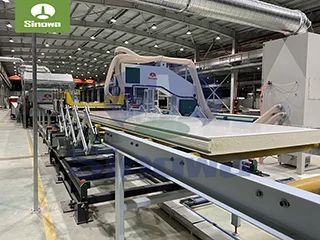
The double-belt composite pressing and constant-temperature shaping system is the key functional module that realizes integrated molding of flat PU sandwich panels. After PU material pouring and preliminary foaming, the upper and lower substrates with intermediate foam materials are synchronously sent into the fully enclosed double-belt pressing cavity. The upper and lower conveyor belts of the pressing system maintain absolute horizontal parallel operation, with precisely calibrated gap spacing that strictly defines the final thickness of flat panels and guarantees consistent dimensional accuracy along the entire panel length and width. The high-strength belt structure provides uniform surface pressure across the composite board, effectively squeezing out excess air inside the foam layer and promoting tight bonding between the PU core and surface substrates. Inside the closed pressing cavity, a constant-temperature thermal insulation environment is maintained to stabilize the foaming reaction speed, enabling gradual and uniform curing of the PU foam. The continuous pressing and shaping process eliminates surface unevenness and internal structural looseness, endowing flat panels with excellent flatness, overall rigidity and structural integrity after molding.
The continuous curing and temperature stabilization process further optimizes the structural stability and performance consistency of flat PU sandwich panels. After preliminary composite molding in the pressing section, the semi-finished panels enter the long-distance constant-temperature curing channel along with the conveyor system. The curing channel adopts a segmented temperature gradient design, with scientific temperature distribution matching the foaming and cross-linking reaction cycle of PU materials. In the early curing stage, moderate temperature promotes thorough chemical cross-linking of PU molecules to form a compact foam skeleton; in the later stage, constant low-temperature stabilization eliminates internal stress generated during foaming and pressing, preventing subsequent panel warping and deformation. The fully enclosed channel structure isolates external temperature and dust interference, ensuring that all panels complete the curing reaction in a consistent environment. The continuous curing mode realizes uninterrupted thermal processing of panels, avoiding performance differences caused by batch curing gaps. After full curing, the PU foam core forms a stable three-dimensional porous structure, giving the finished flat panels outstanding thermal insulation, sound insulation and pressure resistance performance.
Automatic fixed-length cutting and edge trimming processing is an essential post-processing link to standardize finished flat panel products. After completing curing and shaping, the continuous integrated panel strip is transmitted to the intelligent cutting unit, which adopts high-precision servo positioning and flying cutting technology to realize dynamic cutting without stopping production. The system automatically identifies preset length parameters and completes fast and smooth cutting of panel strips, ensuring consistent length specifications of each finished panel. Equipped with precision edge trimming devices, the unit accurately trims the irregular edges on both sides of the continuous panel strip, optimizing the flatness and regularity of panel edges while removing residual foam burrs. The high-speed cutting and trimming mechanism is optimized for flat panel characteristics, avoiding scratching or denting the flat surface of panels during processing. All cutting parameters are intelligently adjustable, enabling flexible switching between different panel size specifications. This automated post-processing mode not only improves production efficiency but also ensures high dimensional accuracy and uniform appearance quality of all finished flat panels.
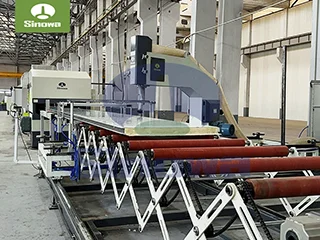
The final automatic conveying, cooling and stacking system realizes efficient finishing and standardized collection of finished flat PU sandwich panels. After cutting and trimming, the finished panels are transported to the circulating cooling conveyor platform, where residual heat on the panel surface and internal curing stress are fully dissipated through natural air cooling and auxiliary air circulation. The flat conveying structure ensures that panels remain horizontal and stable during the cooling process, effectively preventing bending or surface deformation caused by uneven heat dissipation. After full cooling and shaping, qualified panels are automatically sorted and stacked by the intelligent stacking device, which adopts flexible grabbing and placing technology to avoid surface friction and collision damage to flat panels. The stacked finished panels are arranged neatly with consistent stacking specifications, facilitating subsequent packaging, transportation and storage. The entire finishing process operates synchronously with the front-end production flow, realizing truly unmanned continuous production from raw material feeding to finished product collection and greatly improving the overall automation level and production efficiency of the line.
The continuous flat PU sandwich panel production line boasts prominent comprehensive advantages in production efficiency, product quality and application flexibility compared with traditional batch production equipment. Its uninterrupted linear production mode eliminates repeated equipment debugging and material positioning processes between batches, greatly improving unit-time production capacity and reducing production cycle costs. The full-process closed-loop control of material proportioning, foaming, pressing and curing ensures extremely low product defect rates, with all finished flat panels maintaining consistent flatness, thickness and internal structural performance. The flexible parameter adjustment function enables the line to produce flat panels with different thicknesses and substrate types, meeting diversified market demands for thermal insulation composite panels. In addition, the intelligent fault monitoring and automatic adjustment system reduces manual intervention and equipment failure rates, improving production stability and operational safety. These superior performances make the continuous production line a mainstream and reliable solution for large-scale, high-quality manufacturing of flat PU sandwich panels in modern industrial production.
https://www.cnsinowa.com/sandwich-panel-machines/continuous-pu-sandwich-panel-line-for-flat-panel-production.html